
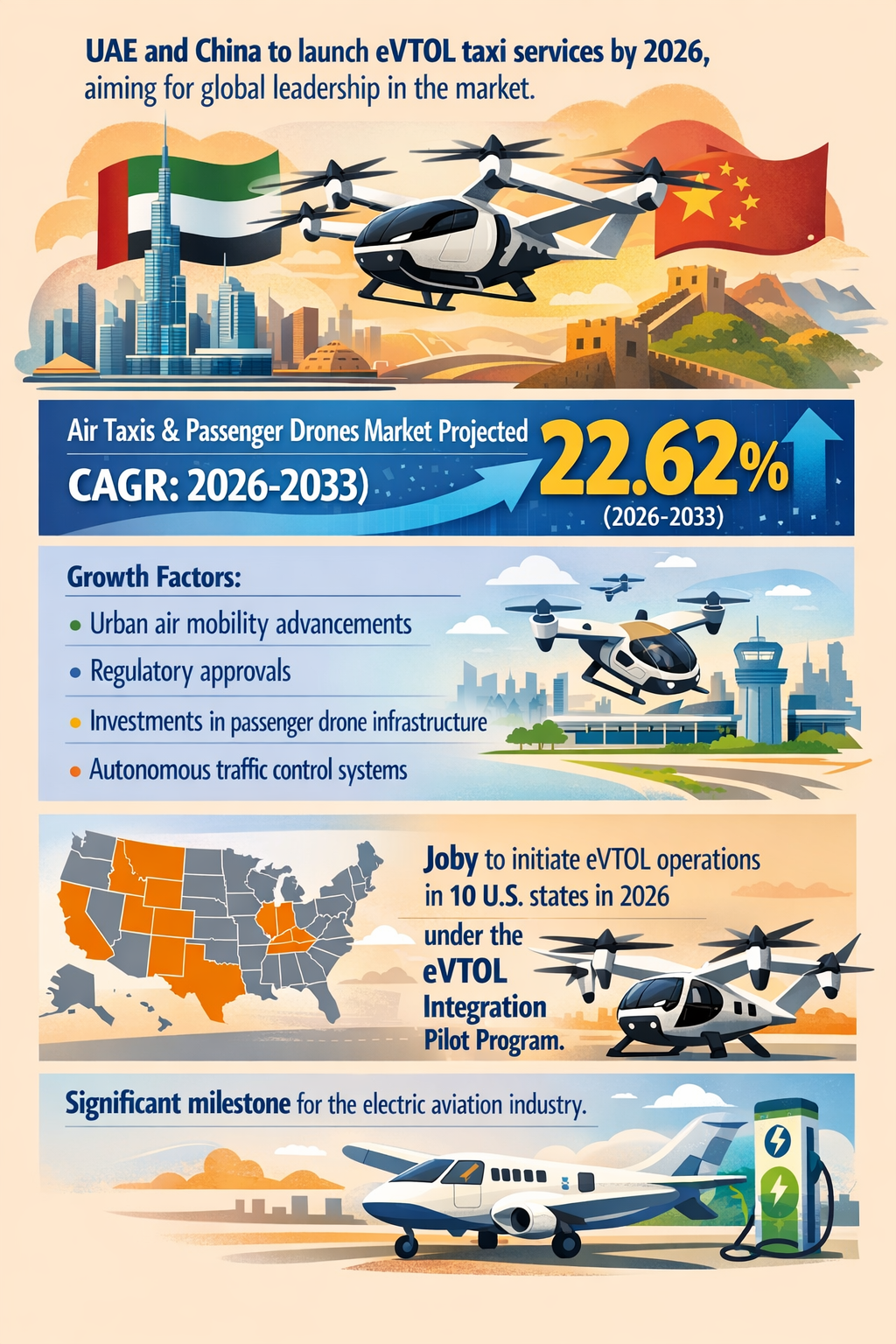
Recent evidence from multiple leading aviation and technology news sources throughout early 2026 shows a rapid acceleration and maturation of advanced air mobility (AAM), particularly in electric vertical takeoff and landing vehicles (eVTOLs) and flying taxis. Key developments center on regulatory progress, pilot testing programs, infrastructure build-out, strategic partnerships, and commercial operational planning. These signals demonstrate positive momentum toward mainstream adoption while highlighting emerging systemic challenges, notably in infrastructure and workforce. This analysis tracks recurring themes, quantifies their momentum, clusters related patterns, and provides insight into future strategic inflection points.
| Signal / Theme | Direction | Relative Frequency / Change | Commentary |
|---|---|---|---|
| Federal Aviation Administration (FAA) eVTOL Integration Pilot Program (eIPP) Launch and Expansion | Accelerating | 8+ projects across 26 states, active since early 2026; rapid increase in news coverage and operational planning | The FAA has catalyzed the AAM sector by approving eight pilot projects spanning 26 states, with operations expected to begin summer 2026. This federally backed program supports testing, regulatory integration, and data collection for commercial scale operations. |
| Manufacturers’ Certification Progress and Early Flight Operations (Joby Aviation, Archer Aviation, BETA Technologies, Wisk Aero) | Accelerating | Multiple high-profile milestones in late 2025 and early 2026; increasing references to Flight Testing and Type Inspection Authorization phases | Joby Aviation leads with Stage 4 FAA certification progress and imminent flight operations under eIPP. Competitors like Archer and BETA are advancing certification, while Wisk pushes autonomous capabilities. Early operation plans showcase transition from development to deployment phase. |
| Vertiport and Ground Infrastructure Development (Network Expansion, Grid Integration, Site Selection Tools) | Accelerating | Rising mentions of vertiport networks, infrastructure challenges, and state-level plans; multiple partnerships and studies reported in late 2025/early 2026 | Vertiport construction and charging infrastructure are a bottleneck yet critical enablers for AAM success. States like Florida, Colorado, and Georgia lead with strategic plans, while private partnerships work to scale vertiport access. Grid capacity and environmental permits are rising concerns. |
| Multi-State Collaborative Regulatory & Policy Frameworks (USA, Australia) | Accelerating | Growth from 8 to 37 states in NASAO AAM collaborative; Australian tri-party initiatives emerging ahead of Brisbane Olympic Games | Strategic state alliances in the US are consolidating regulation and market access, reducing fragmented approvals. Australia also emerges as a coming market with a coordinated approach linking industry and infrastructure for 2032 Games. |
| Emergence of Advanced Air Mobility Use Cases Beyond Passenger Transport (Cargo, Medical, Autonomous) | Accelerating | New partnerships and pilot projects focused on cargo (DHL/Lodd), EMS (Pivotal/Helix), and autonomous operations (North Carolina/Joby) | Expanded investment and pilot efforts in cargo delivery, emergency response, and autonomy represent ecosystem maturation beyond passenger shuttle services, indicating diversified revenue streams and earlier commercial viability trajectories. |
| Public Perception and Market Adoption Models (App Booking Platforms, Consumer Trust Initiatives) | Stable | Consistent references to rideshare-style apps launched by Elevate Jet; steady concerns around safety and noise remain | Innovations in consumer-facing booking apps ease adoption, but public trust is cautiously evolving. Regulatory oversight and transparent pilot ops remain crucial for broad acceptance. |
| Workforce and Construction Labor Shortages Impacting Infrastructure Rollout | Emerging / Accelerating Risk | Notably reported for Brisbane 2032 Games vertiport projects; escalating labor deficits raise risk of schedule slippage | Labor shortages in construction and AAM-specific skilled workers could delay key infrastructure projects, highlighting a near-term risk to tight deployment timelines especially in rapidly developing markets like Australia. |
The dominant pattern in this body of evidence is a transformation driver where regulatory frameworks, manufacturing certification, and operational pilot programs converge to shift eVTOLs from conceptual technologies to near-commercial realities. Federal government initiatives such as the FAA’s eIPP in the US have transformed the regulatory landscape by fast-tracking real-world testing across a broad geographic footprint, catalyzing market validation and attracting private investment. This momentum is further exemplified by manufacturers progressing into advanced certification stages and initiating early flight operations, signaling readiness for scaling.
Simultaneously, a cluster of emerging opportunity signals centers on infrastructure investment and multistate/regional collaborations. The build-out of vertiports, charging networks, and supportive airspace integration policies are accelerating, especially in leading states such as Florida, Virginia, and Ohio. The growth of polylateral state alliances reduces regulatory fragmentation, offering companies more streamlined multi-jurisdictional access. Internationally, Australia’s tri-party partnership targeting the Brisbane 2032 Olympics marks a significant first-mover positioning in the Asia-Pacific AAM landscape.
A second transformation driver cluster arises from the diversification of use cases beyond passenger taxis to include cargo logistics, emergency medical response, and autonomous flight operations. Early pilot projects in rural logistics and autonomous flight testing underscore a tactical shift to sectors where commercial returns and operational complexity differ from urban passenger transit. This diversification may provide earlier revenue flows and operational experience, de-risking the broader ecosystem.
Rising attention to public acceptance mechanisms and consumer experience innovations via AI-powered booking apps reflect the sector's growing attention to demand-side readiness. Meanwhile, workforce shortages and supply chain constraints on infrastructure development surface as an evolving risk, particularly where rapid capacity build-up is required (notably in Australia). This risk could slow momentum if not addressed with forward-planning and targeted policy interventions.
| Wild Card Name | Potential Impact | Surprise Characteristics | Early Warning Indicators | Commentary |
|---|---|---|---|---|
| Rapid Autonomous Flight Maturation and Regulatory Approval | Very High | Autonomy leaps faster than expected; bypasses need for pilots and associated infrastructure | FAA acceptance of autonomous certification standards; Key autonomous flight test milestones in 2026-27 | Wisk Aero and others test fully autonomous air taxis. If regulatory and technological hurdles fall quickly, autonomous eVTOLs could drastically reduce operational cost and revolutionize air mobility beyond current pilot-operated models, reshaping workforce and safety paradigms (Low Altitude Economy). |
| Critical Electrical Grid Failures or Infrastructure Bottlenecks | High | Grid capacity and vertiport power demands exceed municipal planning, causing operational shutdowns | Utilities report major outages or infrastructure delays affecting vertiport sites; regulatory holds on vertiport approvals | Grid integration studies reveal significant transformer replacement costs and load challenges. Unmitigated, these could delay or limit AAM rollout in major urban areas, impacting multiple operators and eroding investor confidence (Low Altitude Economy). |
| Severe Workforce Shortages Slow Infrastructure Delivery | High | Labor deficits in key markets (e.g., Australia) grow faster than anticipated, stalling vertiport and support services | Escalating construction labor deficits reported; delayed vertiport openings or scaled-back deployment plans | Without proactive workforce development and policy support, the necessary physical infrastructure could lag behind certification and operational readiness timelines, reducing commercial viability and market growth (ePlane AI). |
| Disruptive Competition from Non-Electric VTOL Innovations (DARPA X-76, Tiltrotor Type) | Moderate to High | Emergence of fast, high-capacity VTOLs with different power sources challenging eVTOL dominance | Rapid DARPA or military testing advances; early civil certification of hybrid or jet-powered VTOLs by 2028-30 | The DARPA X-76 aims for high-speed VTOL capability with unprepared site operation. If civil applications emerge earlier than forecasted, they may compete or complement eVTOL urban services, potentially altering market expectations (The Register). |