
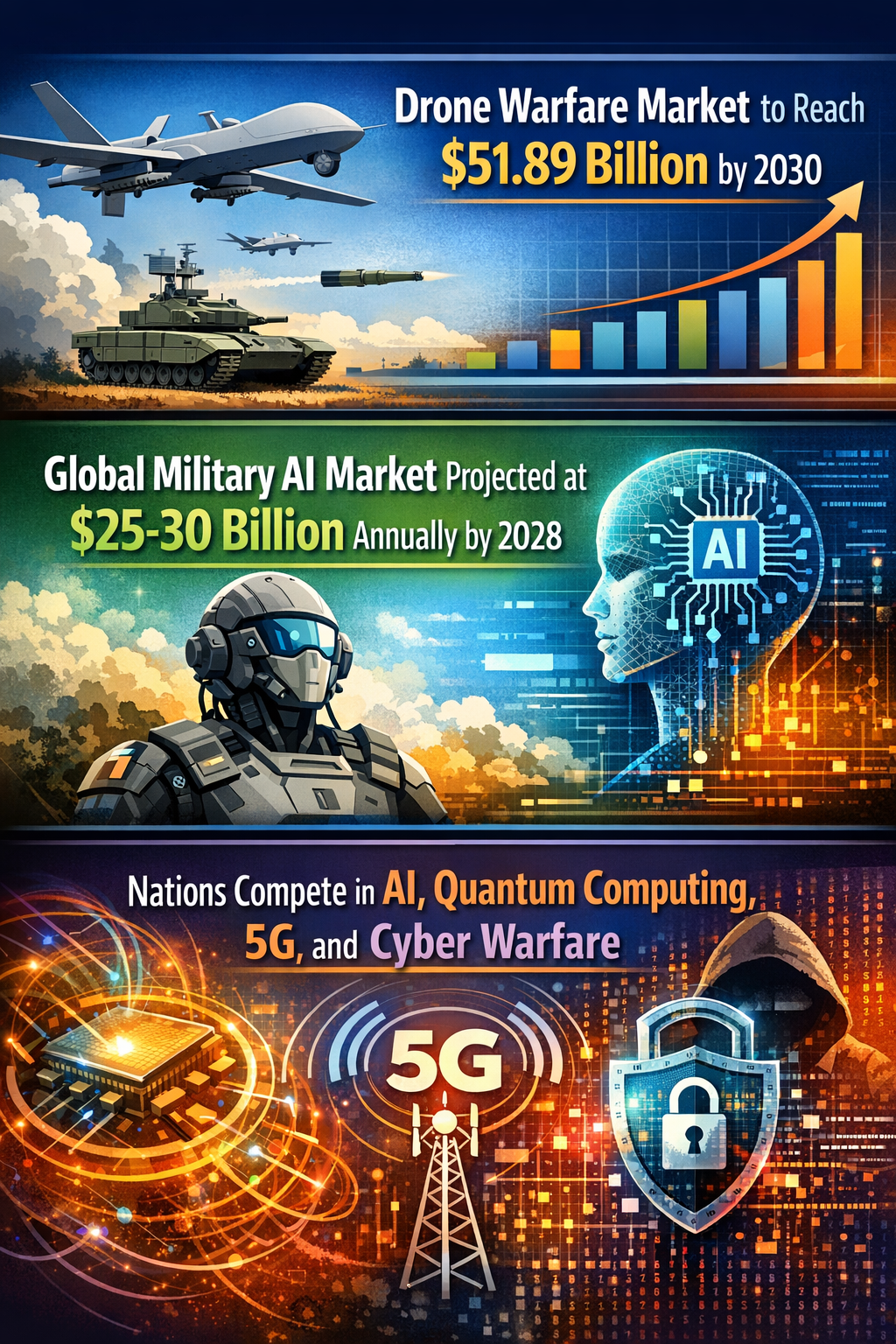
The Hidden Weaponisation of Civilian Dataflows: A Non-Obvious Inflection in the Weaponisation of Everything
As military powers advance autonomous systems and cyber warfare, an under-recognised weak signal emerges: the systemic weaponisation of civilian dataflows and AI-curated social infrastructure deployed as hybrid threat multipliers. This evolving dynamic threatens to recalibrate regulatory regimes, capital allocation, and the architecture of critical infrastructure governance within the next two decades.
Beyond the accelerating investments in AI-enabled military capabilities and cyberattacks on critical infrastructure, a subtler but structurally significant weaponisation is materializing—civilian data inherently captured by surveillance and AI platforms is becoming an inadvertent battlefield exploited to destabilize societies and economies. This paper identifies this weak signal and explores its potential to induce paradigm-level change in governance, industrial ecosystems, and strategic risk management.
Signal Identification
This is a weak signal currently obscured beneath the dominant narratives of kinetic AI warfare, drone tactics, and targeted cyberattacks on infrastructure. The weaponisation of civilian dataflows—comprising demographic, behavioral, and socio-political information harvested by AI surveillance used for both military and commercial purposes—exemplifies an emerging inflection point where civilian systems serve as force multipliers in strategic competition. It qualifies as a weak signal because, although cases such as civilian surveillance-based targeting and disinformation campaigns are reported (Brennan Center 10/05/2026; CSS Prep Forum 03/04/2026), its systemic potential is largely undervalued within strategic planning frameworks.
Estimated time horizon: 10–20 years. Plausibility band: Medium to high, given ongoing datafication trends paired with AI proliferation and geopolitically motivated digital interference. Sectors exposed include national security, telecommunications, critical infrastructure, AI governance, financial services, and public administration.
What Is Changing
Across multiple referenced developments, a recurring theme is the intersection of AI-enabled military competition with the vulnerability of civilian domains to hybrid forms of attack. Autonomous systems and AI integration in military ISR (Intelligence, Surveillance, Reconnaissance) and cyber capabilities (Arvak 01/06/2026) create sophisticated platforms capable of exploiting civilian data vulnerabilities with precision.
The hybrid nature of modern conflict extends beyond targeting physical infrastructure, with data-driven manipulation undermining national cohesion—a factor notably observed in Pakistan’s domestic polarization through disinformation, amplified by AI systems in information warfare (CSS Prep Forum 03/04/2026). This erosion of social fabric through algorithmically enhanced misinformation is not just a transient phenomenon but indicative of a structural vulnerability.
Further, the legal and ethical implications of military AI in domestic surveillance, especially its ability to flag protected characteristics as security threats, highlight unseen societal risks (Brennan Center 10/05/2026). This reveals a blurring of military and civilian domains wherein civilian liberties become collateral in strategic competition.
The increasing reliance on digital water and utility systems in geopolitical conflict—illustrated by Russia’s alleged breaches of water treatment plants used as hybrid warfare means (COAIO News 12/05/2026)—exemplifies how civilian data and control points are weaponised either directly or via the systemic dependencies they represent. This extends to drone warfare, where operational data gathered in Ukraine (Ukraine War Analytics 20/04/2026) feeds back into strategies that exploit networked civilian and military systems symbiotically.
Collectively, these signal strands expose a latent structural theme: AI-driven civilian data ecosystems are being weaponised as invisible yet decisive fronts within modern conflict and competition, requiring a recalibration of strategic foresight that transcends kinetic-centric models.
Disruption Pathway
This weak signal could mature into structural change through a series of accelerating dynamics:
First, increasing digital interconnectivity and datafication of civilian life—ranging from urban IoT (Internet of Things) networks to social media platforms—expand the attack surface for adversaries leveraging AI to extract, manipulate, or weaponise civilian data systems. Autonomous AI-powered ISR systems integrated with civilian data repositories may enable real-time identification of social vulnerabilities at scale, pushing intelligence competition deeper into civil society domains.
Second, the inability of traditional regulatory regimes to effectively govern transboundary data flows and AI-enabled social manipulation may induce systemic stresses in governance models. Efforts to restrict kinetic military competition often overlook these dual-use civilian infrastructures. Subsequently, regulatory fragmentation or uncoordinated national responses could exacerbate vulnerabilities.
Third, industrial adaptation will be triggered as firms in telecommunications, cloud computing, AI development, and critical infrastructure must integrate defensive cyber and data integrity capabilities alongside conventional security products. Capital allocation will pivot toward hybrid resilience—blending cyber, data governance, and physical infrastructure hardening—creating new industry subsegments.
Fourth, feedback loops may emerge where civilian data weaponisation prompts defensive censorship or data isolation policies, undermining global digital interoperability and triggering unintended socio-political outcomes including digital divides, economic decoupling, and erosion of trust in public and private institutions.
Finally, dominant models of governance and industrial positioning will shift as strategic competition embraces “data sovereignty” and AI transparency regimes as core pillars. This could realign alliances and global supply chains based on data governance regimes rather than traditional military or economic considerations.
Why This Matters
Senior decision-makers face immediate and long-term implications for capital deployment, regulatory frameworks, and strategic risk assessment. The emergent weaponisation of civilian data ecosystems could redefine the boundaries of national security, forcing a reconsideration of investment priorities toward integrated data protections and hybrid threat mitigation.
Regulators will need to balance open innovation with sovereignty and resilience, potentially disrupting current technology market architectures. This might usher in regulatory frameworks that mandate AI explainability, data provenance, and robust civilian-military data partitioning. Early movers in industry who develop robust hybrid defence products and compliance capabilities may capture new markets and strategic advantages.
Supply chains for data infrastructure and AI technologies may experience shifts, as trust and regulatory compliance become integral strategic assets. Liabilities linked to inadvertent facilitation of hybrid attacks through civilian data also imply novel risk governance challenges, requiring new frameworks for attribution and responsibility.
Implications
The weaponisation of civilian dataflows may likely advance beyond transient noise characteristic of isolated cyber incidents or disinformation spikes, maturing into a systemic multiplier in future conflict and competition.
This development could plausibly reconfigure industrial ecosystems and governance models that traditionally treat civilian and military domains as largely discrete. Capital allocation might increasingly prioritize AI governance, data integrity assurance, and social system resilience.
This signal is not simply an extension of cyberwarfare or a parallel arms race in AI-controlled drones—rather, it represents a layering of strategic interaction onto civilian dataflows whose scale and invisibility mask their offensive and defensive potency.
Competing interpretations might argue that emerging international norms or technology self-regulation could contain these risks. However, existing regulatory inertia and geopolitical competition trends make unilateral or coordinated restraint unlikely in the short to medium term.
Early Indicators to Monitor
- New regulatory drafts addressing AI transparency, data sovereignty, and civilian-military data use frameworks
- Surveillance and AI patent filings focused on civilian data integration in defense applications
- Venture capital clustering in hybrid cyber-social resilience technologies aligned with AI systems
- Government procurement shifts favoring AI-based social resilience and misinformation detection tools
- Standards formation activities around civilian data interoperability and AI ethical constraints
Disconfirming Signals
- Rapid establishment of binding international treaties limiting AI-enabled civilian data exploitation
- Effective implementation of universal AI governance frameworks with verifiable compliance and enforcement
- Major geopolitical détente reducing incentives for hybrid warfare involving civilian infrastructure
- Technological breakthroughs negating adversarial AI social manipulation effectiveness
Strategic Questions
- How can capital allocation strategies integrate hybrid data defence alongside traditional physical and cyber security investments?
- What regulatory architectures can reconcile civilian privacy, AI transparency, and hybrid threat resilience without fracturing global digital ecosystems?
Keywords
AI; Cyber Warfare; Hybrid Threats; Critical Infrastructure; Data Sovereignty; Surveillance; Digital Governance; Weaponisation
Bibliography
- AI technologies in recent wars and armed conflicts 2010-2026. Arvak. Published 01/06/2026.
- AI revolution and tech turmoil: key developments shaping 2026’s 2PGC. COAIO News. Published 12/05/2026.
- Pakistan's heightened vulnerability and measures. CSS Prep Forum. Published 03/04/2026.
- NSDA Congress 2026: Lethal autonomous weapons and civil liberties. Brennan Center. Published 10/05/2026.
- Drone war evolution 2026: Toward future military doctrine. Ukraine War Analytics. Published 20/04/2026.