
Smart City-States as Nodes of a New Global Governance Architecture: An Under-Recognized Wildcard in Institutional Shifts
Emerging smart city-states governed by interconnected technocratic elites may herald a non-obvious reconfiguration of global institutional frameworks and governance paradigms. This nascent governance model could recalibrate capital flows, challenge regulatory sovereignty, and reshape industrial ecosystems over the next two decades.
The consolidation of governance through a network of technologically advanced city-states — championed by a cadre described as “the Praxians” — is not yet mainstream in horizon scanning discourse but poses significant implications for institutional authority and economic integration. These entities are envisioned as agile, enforceable units operating under transnational technocratic norms, potentially superseding traditional state-centered governance in effectiveness and legitimacy. This development offers a novel inflection point for understanding how institutional fragmentation and digital governance tools could collectively transform regulatory frameworks and economic geographies.
Signal Identification
This signal qualifies as a wildcard due to its high uncertainty and transformative potential outside mainstream institutional evolution paradigms. Unlike widely anticipated shifts such as WTO reforms or global economic institutional adaptations, smart city-states as global governance nodes remain marginal but purposeful experiments with systemic relevance. The horizon extends to 10–20 years given the scale of institutional inertia and technology maturation needed for their proliferation.
Plausibility is assessed as medium, contingent on technological feasibility, political acceptance, and the unresolved legitimacy crisis of existing multilateral institutions. Key sectors exposed include global governance, urban infrastructure, regulatory compliance, international trade, and capital allocation networks.
What Is Changing
Current institutional erosion is visible through declining efficacy and legitimacy of global bodies like the World Trade Organization (WTO), IMF, and World Bank amidst fracturing geopolitics and competing national interests (Marshall Manson LinkedIn 14/06/2026). This backdrop amplifies the search for governance innovation beyond traditional state-centric models.
Parallel discussions around enhancing global governance via AI oversight panels suggest digitization’s growing role in policy orchestration (Council on Foreign Relations 01/06/2026). However, the idea of leveraging highly autonomous, tech-enabled city-states as enforceable governance units moves beyond incremental digital integration by proposing an alternative sovereignty locus.
The “Praxians’” initiative (Unlimited Hangout 23/07/2026) outlines a networked approach to governance, where smart city-states deploy real-time data monitoring, compliance enforcement, and adaptive regulation to optimize political and economic functions. This model contrasts sharply with the WTO’s static trade rules, which are currently vulnerable to being bypassed due to rigidities and lack of resilience, especially affecting Global South economies (LiveLaw 15/07/2026).
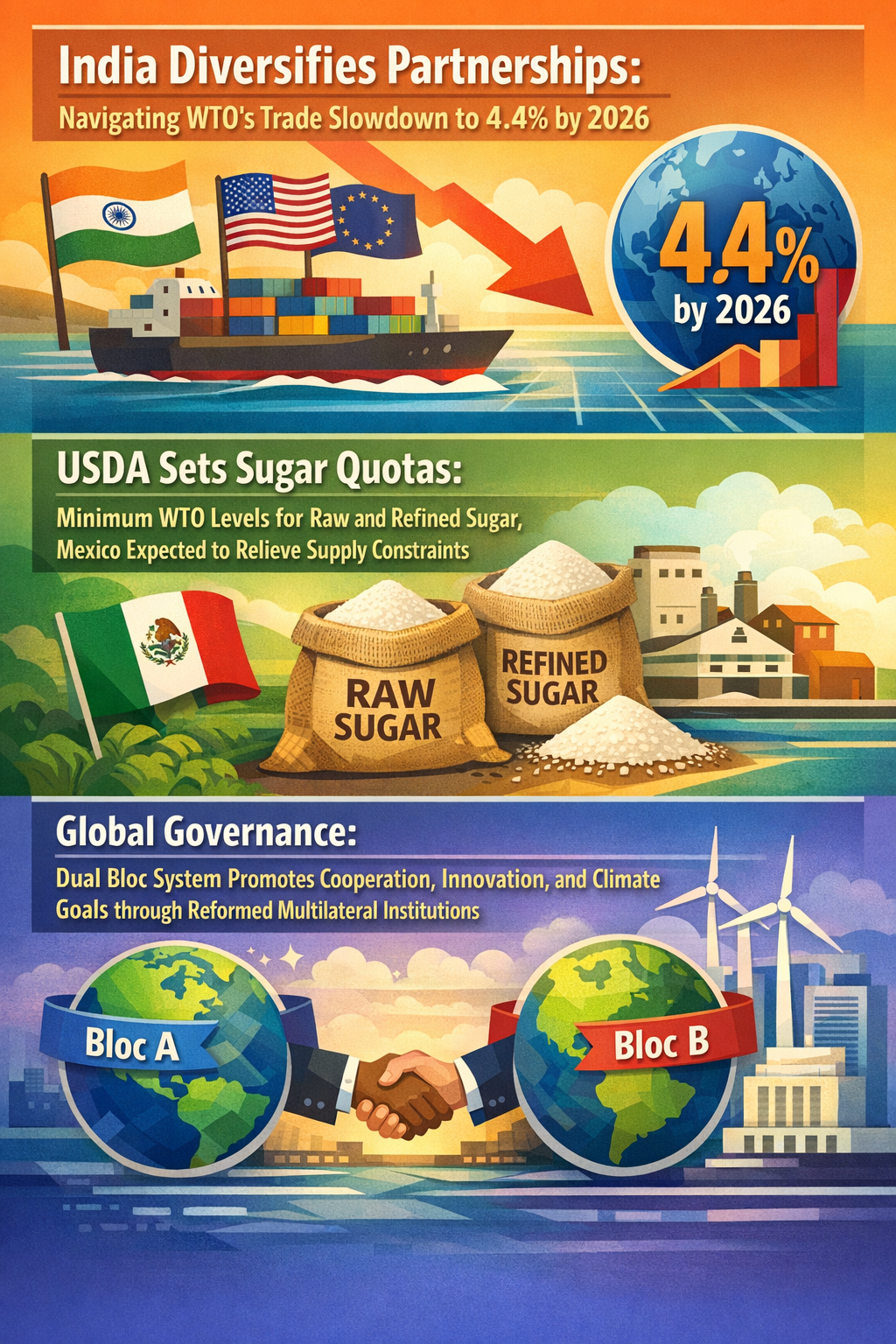
The WTO’s inability to adapt fluidly, as seen in stagnant sugar quotas and protected R&D rents, constrains supply chains and emerging markets further (AgBull 18/06/2026; Bertelsmann Transformation Index 10/06/2026). Smart city-states’ promise lies in bypassing these chokepoints by embedding governance within technological ecosystems that enforce fluid, localized, and transparent policy frameworks.
India’s diversified partnership approach in response to WTO’s slowdown (Forbes India 05/06/2026) signals a geopolitical reorientation that could align with emergent city-state networks, which offer modular governance adaptability unattainable by nation-states constrained by entrenched interests and bureaucratic inertia.
Disruption Pathway
Emergence starts with pilot smart city-states attracting capital seeking jurisdictional agility and optimized regulatory frameworks, driven by trade inefficiencies and institutional stagnation. Technology advances — notably AI-enabled policy enforcement, blockchain transparency, and IoT-integrated urban management — are catalytic enablers making decentralized governance viable and trustworthy.
As performance gains and economic efficiencies solidify, regulatory arbitrage pressures intensify, compelling states and global bodies to acknowledge these actors. Increased adoption may stress existing governance, undermining traditional state sovereignty and international regulatory regimes by creating alternative centers for rule-making and enforcement.
This pressure may prompt structural adaptation: multilateral institutions might integrate or recognize smart city-state networks, or conversely, fragmentation could deepen as power diffuses away from nation-states toward technologically mediated urban sovereignties.
Feedback loops might include capital reallocating disproportionately to more compliant, digitally governed city-states, depressing disadvantaged jurisdictions and accelerating uneven development. Unintended consequences could encompass governance legitimacy crises, conflicts over jurisdiction, and new forms of global techno-oligarchy as the Praxian model scales.
Eventually, industrial structures may recalibrate around these nodes, especially in finance, tech, trade, and infrastructure development, with regulatory frameworks adapting to a network-centric governance paradigm rather than monolithic state law enforcement.
Why This Matters
For capital allocators, recognizing early catalysts of smart city-state proliferation could reveal next-generation regulatory arbitrage and risk diversification mechanisms. Investments might pivot towards infrastructure enabling such governance models and compliant industrial ecosystems.
Regulators face the dual challenge of integrating adaptable digital governance while preserving macro-institutional coherence. Failure to evolve could risk regulatory irrelevance, reduced policy effectiveness, and erosion of sovereignty over economic levers.
Industrial strategists must anticipate shifting operational geographies where smart city-state jurisdictions offer accelerated permitting, adaptive standards, and direct market access, disrupting established supply chains and competitive positioning.
Governance bodies focusing on long-term risk must monitor legitimacy fractures and inclusion gaps, as uneven adoption could exacerbate geopolitical polarizations, potentially altering global power balances and alliance structures.
Implications
The rise of smart city-states as governance nodes might structurally recalibrate global institutional architectures by 2040. This change would diverge from mere IT integration or multilateral reform debates, representing a paradigm shift towards networked, technocratic micro-sovereignties.
This implies a potential diminution of both nation-state primacy and traditional international organizations like the WTO or IMF unless these bodies successfully reimagine governance efficacy through technological and institutional innovation.
The development is unlikely to be a discrete, rapid breakthrough but rather an incremental scaling with phase transitions triggered by crises in legitimacy or economic stagnation within conventional frameworks.
Alternative interpretations include skepticism about the political feasibility or ethical legitimacy of technocratic city-states, concerns about exclusionary governance, or the possibility that entrenched national and multilateral powers will co-opt or suppress these models.
Early Indicators to Monitor
- Formation and international recognition of smart city-states or autonomous urban governance units with integrated AI policy tools.
- Venture capital and sovereign wealth fund investments in governance-as-a-service platforms and urban digital infrastructure.
- Regulatory pilot programs enabling cross-border digital compliance and autonomous jurisdiction enforcement.
- Formal engagement or partnership agreements between smart city-states and national or multilateral organizations.
- Standards development addressing data sovereignty, AI governance, and urban techno-legal frameworks.
Disconfirming Signals
- Successful, comprehensive reform and democratization of existing multilateral institutions (e.g., WTO, IMF) restoring their legitimacy and efficacy.
- Political backlash and legal challenges preventing recognition or autonomous operation of smart city-states.
- Technological failures or security breaches undermining trust in AI-enabled governance frameworks.
- Strong international regulatory standards prohibiting or restricting extraterritorial digital sovereignty models.
Strategic Questions
- How can capital allocation strategies incorporate governance innovations without prematurely committing to unproven techno-sovereignty models?
- What regulatory frameworks or institutional reforms can balance the efficiency gains of smart city-states with legitimacy, equity, and integration into the existing global order?
Keywords
Smart City-States; Technocratic Governance; Global Governance Innovation; AI Policy Enforcement; Regulatory Arbitrage; Multilateral Institutional Reform; Capital Allocation; Trade Regulation
Bibliography
- Looking ahead, Nepal's ability to thrive in the WTO will depend heavily on how it reforms trade policies and boosts efficiency. Bertelsmann Transformation Index. Published 10/06/2026.
- The Praxians' approach has found favour with other globalist oligarchs, who agree that enforcing global governance through a network of smart city-states will deliver a more efficient and effective global Technocracy. Unlimited Hangout. Published 23/07/2026.
- USDA sets FY 2027 sugar quotas at WTO minimum: USDA kept raw and refined sugar TRQs at minimum WTO levels, leaving specialty users constrained and Mexico as the main expected supply relief. AgBull. Published 18/06/2026.
- If the WTO cannot evolve from a protector of R&D rents into a facilitator of global resilience, it risks total delegitimization in the eyes of the Global South. LiveLaw. Published 15/07/2026.
- The UN's AI Panel Could Shape Global Governance. Council on Foreign Relations. Published 01/06/2026.
- Disruption in trade, challenges with energy and natural resources, and pressure on global economic institutions like the World Bank, IMF, and WTO are the top forces driving economic uncertainty. Marshall Manson LinkedIn. Published 14/06/2026.
- Amid a projected WTO global trade slowdown to 4.4% in 2026, India is diversifying partnerships. Forbes India. Published 05/06/2026.