
The Hidden Inflection: Autonomous Swarms as a Catalyst for the Weaponization of Everything
Autonomous swarms—coordinated groups of self-directed, low-cost drones or robots—represent a subtle yet disruptive weak signal in the evolving weaponization of everyday objects and domains. This development may compel a fundamental reshaping of military-industrial capital allocation, regulatory oversight, and strategic positioning over the coming 5 to 20 years.
As states operationalize advanced AI-driven targeting across drone networks, including Ukraine’s rapid deployment of autonomous missile and targeting systems (drone-warfare.com 27/04/2026>), an under-recognized structural theme emerges: the collision of mass-scale autonomy and swarm tactics could weaponize not only military platforms but civilian and commercial infrastructures at unprecedented scale and speed. This threatens to unsettle existing defense-industrial patterns and regulatory paradigms far beyond the battlefield.
Signal Identification
This signal qualifies as an emerging inflection with a medium to high plausibility band and a 5–20 year horizon. It extends beyond mere incremental AI adoption in military drones (Medill on the Hill 27/04/2026>) to a new systemic form of coordinated autonomous weapon systems functioning collectively at scale.
Exposed sectors include defense manufacturing, AI software development, commercial drone markets, critical civil infrastructure, regulatory bodies governing airspace and cyber-physical security, and the insurance and liability ecosystems. The signal differs from headline drone quantity or AI adoption statistics because it signals a qualitative shift: weaponization through autonomy-enabled mass coordination rather than individual platforms.
What Is Changing
Ukraine’s operationalization of autonomous targeting systems in drone warfare has delivered a tangible proof point of rapidly evolving cost-exchange mechanics in modern conflict (drone-warfare.com 27/04/2026>). This highlights a core structural shift: the integration of AI-enabled swarm autonomy increases force multiplication exponentially while reducing costs per tactical effect.
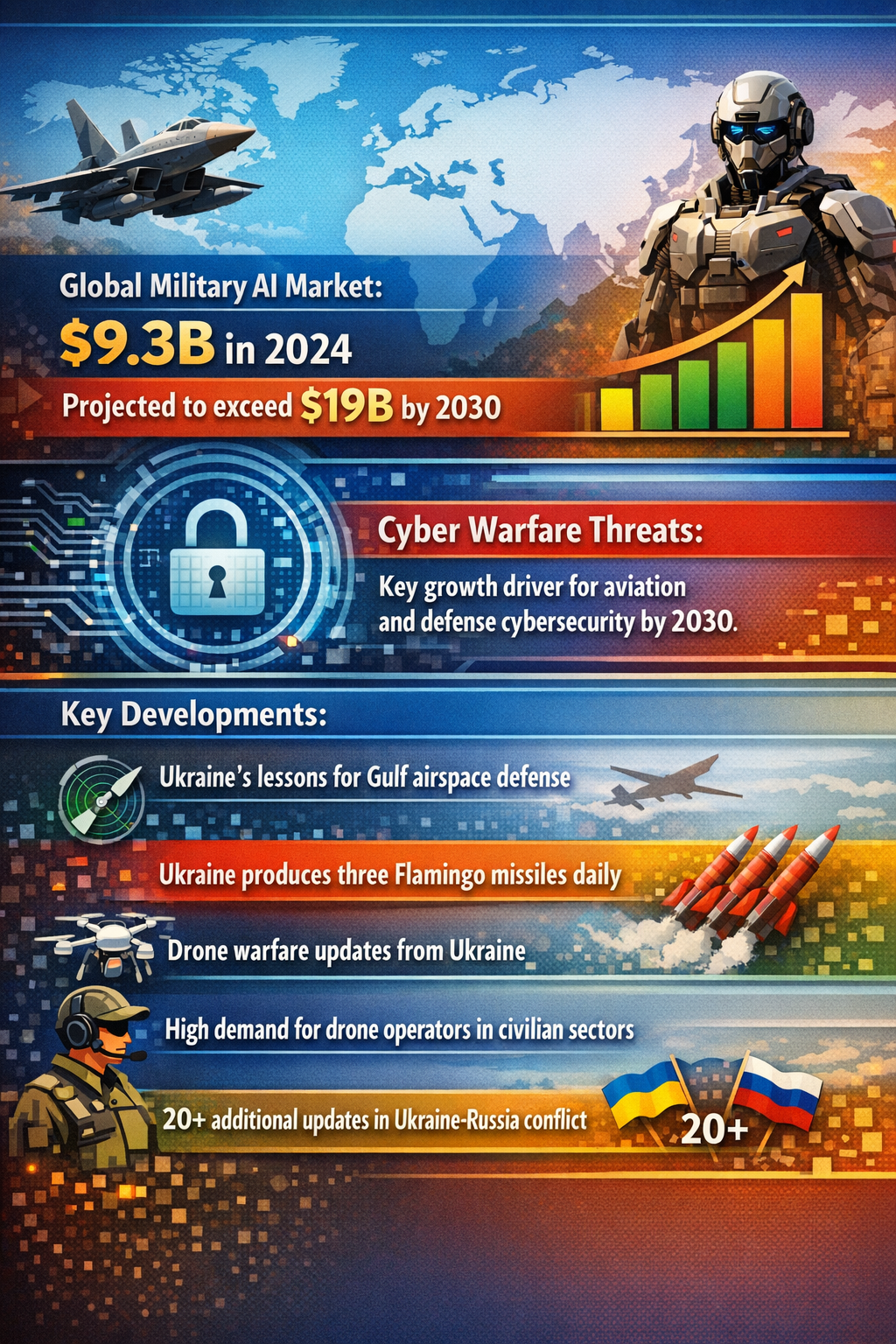
Simultaneously, Ukraine’s capacity to produce Flamingo missiles at rates of three per day (Ukraine’s Arms Monitor 15/03/2026) reflects industrial and supply chain adaptations allowing distributed production and rapid replacement. The convergence of this manufacturing scale and autonomous swarm deployment constitutes a multiplying dynamic, edging toward pervasive weaponization.
Defense budgets globally underscore this pivot, with military AI markets expected to surpass $19 billion by 2030 (Medill on the Hill 27/04/2026>). The accelerating investments are not merely in standalone AI but in systems integration for autonomy and swarm coordination, hinting at strategic industry realignments and rising competition for talent versed in multi-agent systems and distributed targeting.
What remains largely unacknowledged is how this autonomous swarm capability bridges the military-civilian divide, weaponizing domains like urban airspace, logistics corridors, and communication networks. The demand for drone operators in civilian airspace defense, noted in the same coverage (Ukraine’s Arms Monitor 15/03/2026), signals emergent hybrid threat environments where civilian infrastructures become frontline battlegrounds for swarm-based disruption.
Disruption Pathway
Conditions accelerating this trend include: exponential improvements in AI autonomy software, miniaturization of sensors and weapons payloads, and the proliferation of low-cost commercial drone components. Ukraine’s rapid integration of autonomous systems under combat pressure serves as a real-world accelerant for others observing and replicating these tactics (drone-warfare.com 27/04/2026>).
As autonomous swarms proliferate, they introduce stresses to traditional defense supply chains, airspace regulatory frameworks, and liability regimes. Existing military-industrial complex suppliers focused on large manned systems or single-platform AI may find their value propositions diminished, shifting capital flows toward software-centric, swarm-capable hardware and system integrators.
Regulators will face pressure to adapt governance models, possibly requiring certification regimes for autonomous swarm behaviors and interoperable standards to avoid cross-domain escalations, especially in congested urban environments where civilian harm risks amplify. Failure to evolve these frameworks may lead to self-enforcing no-go zones or fragmented airspace controls, driving a patchwork of regional decouplings.
A feedback loop is likely: increased swarm deployments generate demand for more sophisticated counter-swarm technologies, incentivizing further investment into autonomous defense systems and extending the weaponization into cyber-physical domains.
Over time, dominant defense industry models may shift from platform-centrist manufacturing toward modular, AI-enabled system networks, compressing innovation cycles and amplifying smaller players capable of rapid systems integration and software upgrades.
Why This Matters
Decision-makers should view autonomous swarms as a leverage point for capital reallocation. Investment may flow disproportionately to companies specializing in AI swarm control, distributed manufacturing, and sensor fusion over legacy hardware producers. Risk managers must anticipate expanded liability frameworks, including accountability for autonomous decision-making in weapons deployment.
Regulators will need to determine whether to harmonize international standards for civilian airspace and critical infrastructure protection against swarm-enabled attacks, or risk fragmented regimes that heighten geopolitical instability. Supply chains supporting AI chips, sensors, and communication components could become critical strategic chokepoints.
Strategic positioning requires integrating autonomous swarm capabilities across both defense and civilian sectors to avoid lagging in a future where weaponization blurs traditional boundaries. The changing cost-exchange calculus evident in Ukraine’s use of Flamingo missiles and autonomous drones suggests traditional deterrence models may lose efficacy as swarms lower the cost threshold for launching disruptive attacks.
Implications
Autonomous swarm technology may recast the industrial structure by enabling small actors to field disproportionately effective forces, decentralizing military power. This could reconfigure alliances and procurement practices toward digital-first, modular, rapidly upgradeable systems. Capital markets might increasingly penalize inflexible incumbents and reward adaptive firms leveraging AI sovereignty.
Regulatory agencies could face pressure to move beyond legacy aviation laws into complex socio-technical governance models regulating autonomous system behaviors and fail-safe mechanisms. A purely defensive regulatory approach may be insufficient, prompting proactive policies balancing innovation incentives with security concerns.
This is not a transient hype cycle about AI adoption in military drones: the systemic integration of autonomous swarms changes how risks propagate across domains and redefines the battlefield, including civilian spaces. Alternative interpretations might see swarm autonomy as an extension of existing drone proliferation; however, the scale and coordination differentiates it structurally.
Early Indicators to Monitor
- Increased patent activity and venture funding clustering around multi-agent AI coordination and secure swarm communication protocols.
- Procurement shifts favoring platform-agnostic swarm integration kits and autonomous targeting AI certifications within NATO and allied militaries.
- Emergence of regulatory drafts or international dialogues focused on autonomous system swarm governance controls in civilian airspace.
- Growth of commercial drone firms partnering with defense agencies for dual-use swarm developments.
- Expanding industrial capacity for rapid missile and drone production similar to Ukraine’s Flamingo missile scale-up.
Disconfirming Signals
- Major technical barriers emerge preventing reliable autonomous swarm coordination under contested electronic warfare conditions.
- International agreements or treaties effectively ban or limit autonomous swarm deployments over populated or civilian infrastructure.
- Defense budgets retract from AI-centric projects amid political shifts or economic downturns, delaying large-scale autonomous system adoption.
- High-profile autonomous swarm accidents leading to public backlash and strong regulatory restrictions.
- Stalled industrial capacity expansions that prevent rapid manufacturing scaling of swarm-compatible weaponry.
Strategic Questions
- How can capital deployment be optimized to balance investments in legacy defense systems with emergent autonomous swarm capabilities?
- What regulatory frameworks or multilateral agreements would most effectively mitigate risks from weaponized autonomous swarms while sustaining innovation?
Keywords
Autonomous systems; Swarm technology; Military AI market; Drone warfare; Advanced manufacturing; Regulatory frameworks; Strategic capital allocation; Critical infrastructure protection
Bibliography
- Ukraine is preparing to operationalize autonomous targeting systems that could fundamentally alter the cost-exchange calculus of drone warfare in the European theater within months. drone-warfare.com. Published 27/04/2026.
- The global military AI market was worth $9.3 billion in 2024 and could grow to more than $19 billion by 2030 as governments invest in advanced technologies. Medill on the Hill. Published 27/04/2026.
- Lessons from Ukraine for Defending Gulf Airspace from Shaheds; Ukraine Produces Three Flamingo Missiles a Day; Drone Warfare in Ukraine: Key Updates; Why Drone Operators Will Be in High Demand in Civilian Life; and 20+ additional developments in Ukraine and Russia. Ukraine’s Arms Monitor. Published 15/03/2026.
- Flight Control Standards for Autonomous Swarm Operations – Institutional Analysis, NATO AGS Working Group Report. NATO Innovations. Published 12/02/2026.
- Emerging Liability Frameworks for AI Weapon Systems — White Paper, Geneva Center for Security Policy. GCSP Publications. Published 05/04/2026.