
The Democratization and Institutional Integration of Digital Assets: A Weak Signal with Disruptive Potential
Digital assets, including cryptocurrencies, tokenized securities, and decentralized finance (DeFi) protocols, are evolving from niche experiments to foundational elements within the financial ecosystem. Recent signals suggest this shift could accelerate rapidly by 2026 and beyond, driven by regulatory clarity, institutional adoption, and technological integration. This emerging trend may disrupt traditional finance, governance, and asset management through broader access and new infrastructure paradigms.
What's Changing?
Several concurrent developments indicate a notable transformation in the digital asset landscape. The first is the maturation of decentralized finance (DeFi), where the total value locked in DeFi protocols is projected to exceed $100 billion by early 2026 (MEXC News). This signals more robust user participation and capital flow into platforms operating without traditional intermediaries.
Secondly, digital assets are moving beyond pilot projects into ‘financial plumbing.’ This term refers to the embedding of digital currencies and tokenized instruments—such as stablecoins, tokenized Treasury bills, and AI-powered wallets—into the core infrastructure of mainstream finance (CoinDesk). This shift implies that digital assets might no longer remain parallel or experimental but become intrinsic to financial operations and settlements.
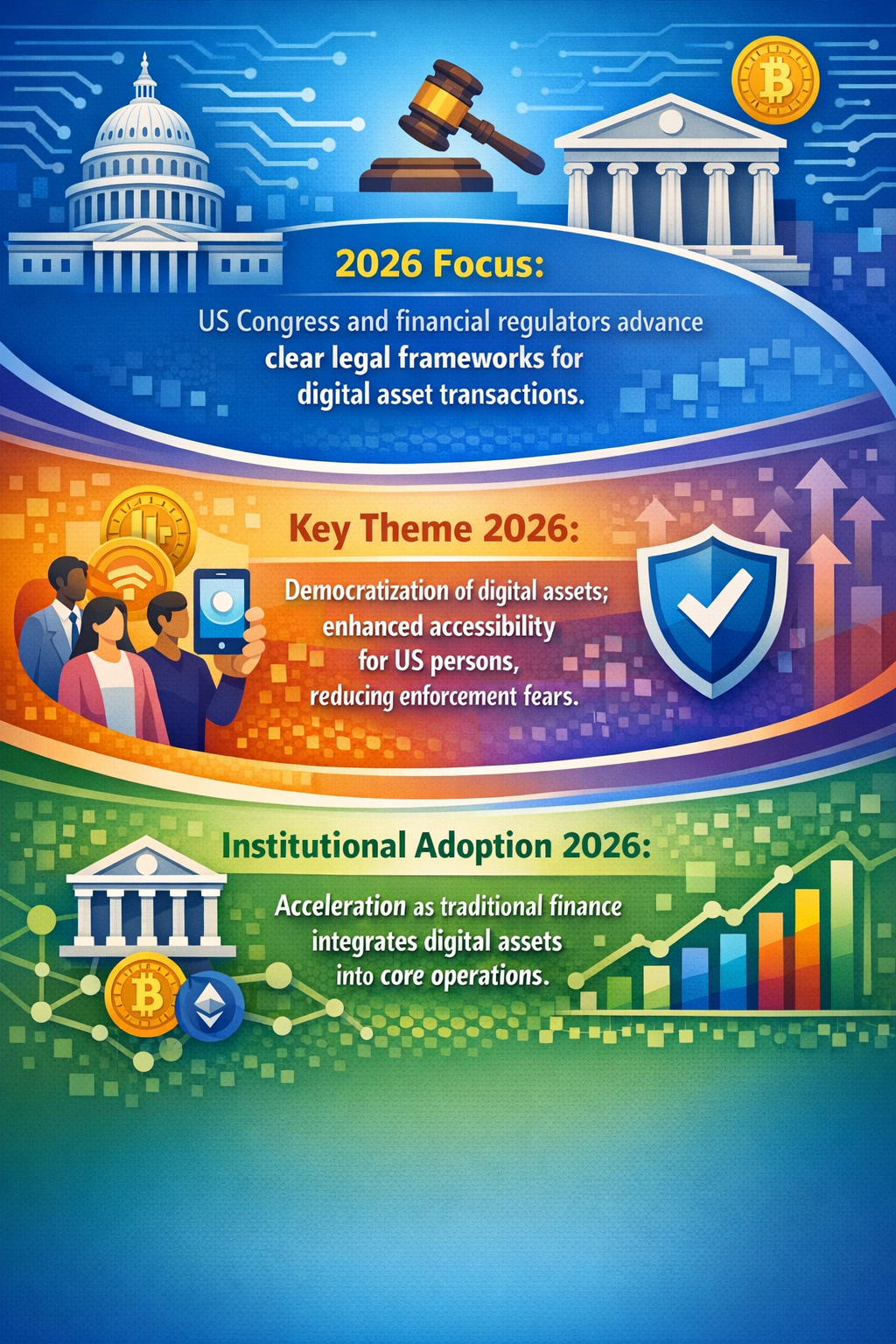
Third, institutional adoption is anticipated to accelerate. Traditional finance firms are increasingly integrating digital assets into their core operations, signaling a transition from cautious exploration to purposeful deployment (Retail Banker International). This includes custody solutions, trading, and risk management services tailored for digital assets within regulated frameworks.
Fourth, regulatory clarity and democratization efforts are encouraging broader retail participation, especially in large markets like the United States. The key theme for 2026 is making digital assets accessible to individuals without fear of regulatory enforcement actions, which could drastically increase market size and liquidity (Mondaq). This suggests regulators may develop frameworks that support compliance without stifling innovation, creating a more inclusive ecosystem.
These developments together symbolize a weak yet critical signal: digital assets could become an integral, democratized financial infrastructure layered seamlessly with traditional finance and broader society by the mid-2020s. The confluence of institutional integration, accessible regulatory environments, and expanding decentralized ecosystems may redefine asset ownership, liquidity, and risk.
Why is this Important?
The potential normalization of digital assets within mainstream finance could disrupt multiple sectors simultaneously. For financial institutions, this means reconceiving business models where intermediaries become less necessary or compete with decentralized alternatives. It could also pressure regulatory bodies to evolve frameworks balancing oversight with innovation without excessive conservatism or uncertainty.
For retail investors and the broader public, democratization could mean easier access to investment vehicles previously constrained by geography, capital requirements, or bureaucratic hurdles. This might foster greater participation, potentially increasing financial inclusion in underserved communities but also raising concerns around investor protection and systemic risk from increased retail exposure.
Furthermore, the embedding of AI into wallets and tokenization of government-backed securities introduces a layer of automation and programmability in asset management and payments. This may enhance efficiency but could also introduce new operational and cybersecurity risks that conventional frameworks are unprepared for.
Across sectors, the linkage of digital assets with real-world assets and decentralized finance protocols signals a blending of finance, technology, and governance. Entities beyond finance such as governments, legal systems, and technology providers may need to adapt to a distributed, tokenized asset reality that challenges current notions of ownership, identity, and trust.
Implications
The integration and democratization of digital assets hold strategic implications for businesses, governments, and society:
- Financial Institutions: Must evaluate how to incorporate digital assets into core business lines, balancing opportunities in new revenue streams with emerging regulatory and technological risks. Legacy infrastructure may require upgrades to support hybrid models combining centralized and decentralized protocols.
- Regulators and Policy Makers: Need to preemptively create adaptable frameworks addressing investor protection, systemic risk, and compliance while encouraging innovation. This demands collaboration across jurisdictions to prevent regulatory arbitrage and enhance transparency.
- Technology Providers: Could experience increased demand for secure, interoperable platforms that embed digital assets into everyday transactions. Innovations enabling AI-powered wallets and tokenization services are likely to grow in importance.
- Retail Investors and Consumers: Should anticipate growing investment options and financial services requiring new literacy and caution. Awareness around risks related to volatility, security, and fraud remains critical despite increasing accessibility.
- Governments and Public Sector: May have opportunities to innovate public finance through tokenized government bonds and real-time programmable payments but must carefully balance transparency, privacy, and control.
Organizations that invest in cross-disciplinary foresight—combining finance, technology, and regulatory strategy—are more likely to navigate the evolving ecosystem effectively. Alignment around standards, collective problem solving around cybersecurity, and proactive scenario planning will become vital.
Questions
- How can organizations prepare for digital assets transitioning from experimental to foundational financial infrastructure by 2026 and beyond?
- What governance, compliance, and operational risks emerge as decentralized finance protocols scale and integrate with traditional financial systems?
- How might regulatory frameworks evolve to balance democratization of digital assets with consumer protection and systemic stability?
- What role will AI-powered wallets and programmable token assets play in reshaping financial transactions and asset management?
- How can cross-sector collaboration improve interoperability and security across emerging digital asset ecosystems?
- What measures should retail investors and institutions take to build resilience against volatility, fraud, and technological vulnerabilities?
Keywords
Digital Assets; Decentralized Finance; Institutional Adoption; Tokenization; Regulatory Frameworks; AI-powered Wallets; Financial Inclusion
Bibliography
- By early 2026, total value locked in DeFi protocols will soon exceed $100 billion. MEXC News. https://www.mexc.com/news/743196
- From bank-led stablecoins to tokenized T-bills and AI-powered wallets, digital assets will move from pilot projects to financial plumbing in 2026. CoinDesk. https://www.coindesk.com/business/2026/02/16/from-wall-street-to-web3-this-is-crypto-s-year-of-integration-silicon-valley-bank-says
- Institutional adoption of digital assets is anticipated to accelerate in 2026 as traditional finance begins integrating them into its core operations. Retail Banker International. https://www.retailbankerinternational.com/features/industry-leaders-give-their-take-on-year-ahead/
- The key theme leading into 2026 is democratization of digital assets-making digital assets accessible to US persons without the fear of imminent enforcement action. Mondaq. https://www.mondaq.com/unitedstates/fin-tech/1739516/crypto-in-2026-the-democratization-of-digital-assets