
The Emergence of Smart Urban Energy Ecosystems in the Global South
Rapid urbanization and economic growth in the Global South are generating unprecedented challenges and opportunities for energy systems. A weak but vital signal of change is the integration of smart city concepts with decentralized, green energy solutions to create urban energy ecosystems. These ecosystems could significantly disrupt traditional energy, infrastructure, and governance models over the next two decades, reshaping how cities operate and how industries respond to energy demand and sustainability pressures.
Introduction
The trajectory of urban growth across regions such as the Middle East, Africa, and Asia-Pacific presents a unique opportunity to reimagine energy systems within smart cities. While the rise of smart cities is established, an emerging development combines rapid electricity demand growth with advances in IoT (Internet of Things) and AI-enabled energy management. This convergence may lead to self-regulating urban energy ecosystems that are more efficient, resilient, and sustainable, challenging incumbent utility and infrastructure paradigms.
What’s Changing?
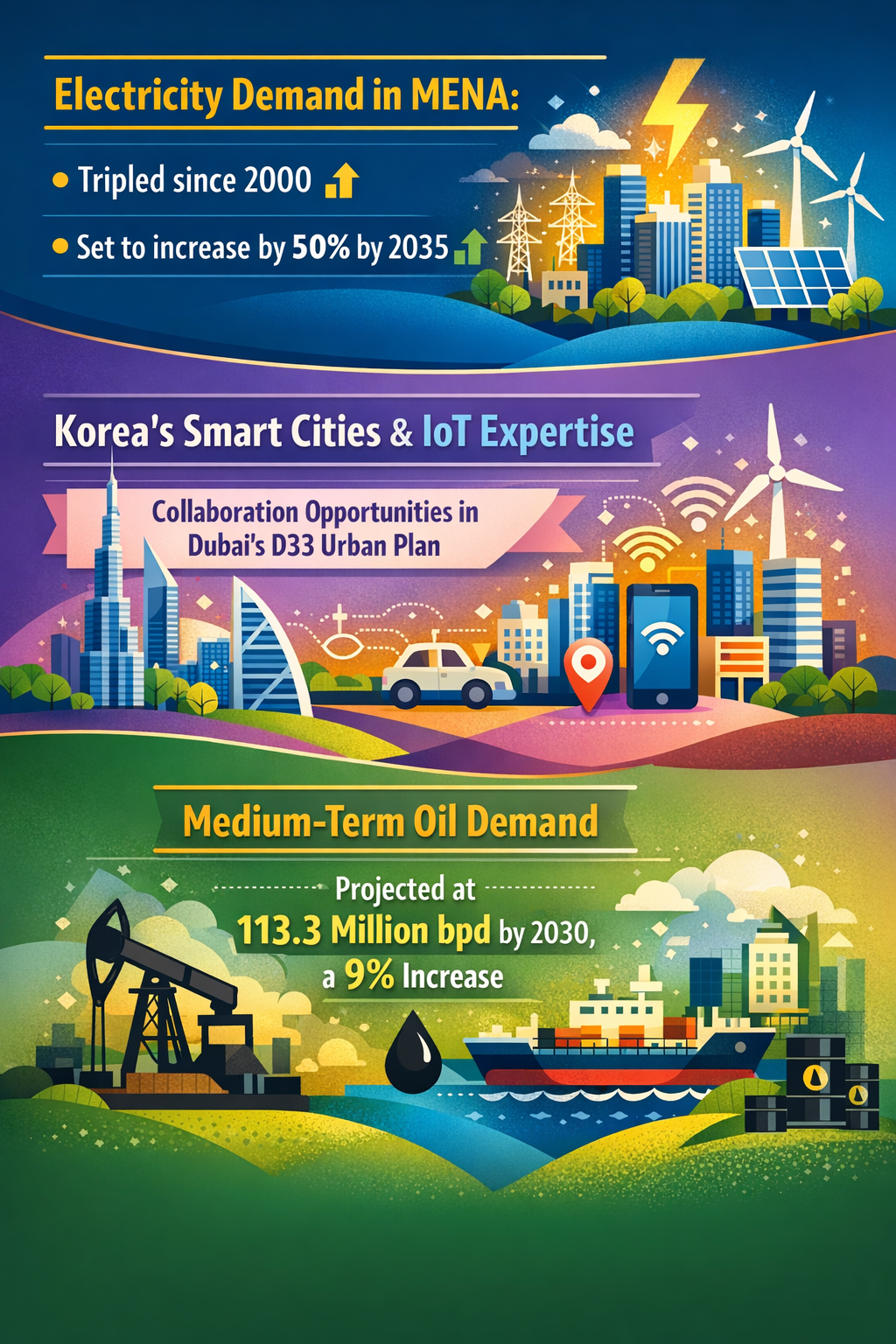
The foundation of this trend lies in multiple converging developments documented recently. First, rapid urbanization in emerging regions is driving explosive increases in electricity demand. For example, electricity consumption in the Middle East and North Africa has tripled since 2000 and is expected to grow by 50% by 2035, driven by population expansion, urbanization, and industrial activity (The National).
Simultaneously, Asia-Pacific, also experiencing fast urban growth, is witnessing government-driven smart city initiatives that embed Internet of Things (IoT) solutions and AI systems to optimize urban services, including mobility and utilities (AutoEVTimes). Korea’s experience with integrated smart city models such as Incheon Songdo demonstrates the potential for policy-driven urban innovation, transferable internationally through collaborations like Dubai’s D33 urban plan (Smart City Korea).
Another layer of change is economic. The Global South economies are projected to drive over 65% of global GDP growth by 2035, encouraged by infrastructure investments that often target urban development and digitization (Russia’s Pivot to Asia). This economic dynamism increases pressure on urban energy grids to become more adaptive, sustainable, and resilient.
Crucially, the visionary concept of smart cities moving beyond digitization into comprehensive frameworks linking green growth with governance is gaining traction in several countries. These frameworks advocate for urban energy systems that balance environmental sustainability, social equity, and economic vitality (Nhan Dan).
Collectively, these trends suggest the emergence of smart urban energy ecosystems where:
- Decentralized renewable energy installations (solar, wind) embedded in urban grids become the norm.
- AI-driven energy management systems optimize supply-demand balance in real time using IoT devices.
- Smart governance mechanisms enable citizen participation and transparency in energy decision-making.
- Energy storage and microgrid technologies support resilience and reduce dependence on centralized utilities.
This multi-dimensional shift is a weak signal now but is likely to accelerate as technology costs fall and governance models evolve to support integrated urban energy planning.
Why is this Important?
The traditional centralized energy utility model, dominant for the last century, faces increasing challenges amidst these dynamics. Rapidly urbanizing regions risk power shortages, infrastructure strain, and environmental degradation if legacy systems remain unchanged. The integration of smart city technology with decentralized, green energy systems offers a pathway to:
- Manage surging electricity demand more efficiently, reducing outages and consumption peaks.
- Lower carbon emissions by embedding renewables directly into urban energy networks.
- Enhance urban resilience against climate-induced disruptions and geopolitical energy risks.
- Empower local stakeholders and communities through participatory governance enabled by transparent data access.
For businesses, this trend could disrupt traditional energy supply chains, opening markets for IoT providers, software platforms, energy storage innovators, and urban planners with expertise in integrated energy systems. Governments might need to revise regulatory frameworks to accommodate decentralized production and new data-sharing models.
Implications
The implications of this emerging trend extend across multiple sectors and geographies:
- Energy Sector Transformation: Utilities could transition from energy producers to service providers managing complex, distributed assets. Investments might shift dramatically toward digital infrastructure and local renewable generation capacity.
- Urban Planning and Governance: City planners and policymakers will need new tools and skills to orchestrate energy ecosystems. Public-private partnerships might become essential for financing and operating these networks.
- Technology and Innovation: Demand for AI-enabled, IoT-integrated energy management platforms will likely surge. Innovations in energy storage, such as battery technologies and vehicle-to-grid solutions, will be critical.
- Societal Impact: Enhanced energy access and reliability could improve quality of life and economic opportunity, especially in rapidly growing urban areas. However, there may also be risks around data privacy and equitable access that require careful management.
Proactively, stakeholders should:
- Invest in pilot projects that demonstrate decentralized energy ecosystems with real-time AI management.
- Develop regulatory frameworks encouraging data interoperability, transparency, and fair energy markets.
- Focus on capacity building for local governments and utilities in smart energy governance.
- Explore collaborations across regions with successful smart city models as knowledge transfer hubs.
Failing to recognize and prepare for this shift could result in inefficiencies, stranded assets, and lost economic opportunities. Conversely, early adopters might benefit from new markets and improved sustainability profiles.
Questions
- How can governments in rapidly urbanizing regions balance the need for rapid energy infrastructure expansion with the requirements of smart, decentralized energy ecosystems?
- What regulatory changes are necessary to enable widespread adoption of AI and IoT in urban energy management while safeguarding data privacy?
- How might traditional utilities redefine their roles within emerging smart urban energy frameworks to remain relevant?
- What financing models can effectively harness public-private partnerships to support integrated smart city energy initiatives?
- How can equity and access be ensured so that smart urban energy benefits all socio-economic groups within growing city populations?
Keywords
smart cities; urbanization; decentralized energy; AI energy management; IoT; renewable energy; smart urban energy ecosystem; energy storage
Bibliography
- Global South economies will account for over 65% of global GDP growth by 2035, driven by population expansion, urbanization, and infrastructure investment. Russia’s Pivot to Asia. https://russiaspivottoasia.com/moscow-wins-big-in-mice-development-for-brics-and-the-global-south/
- The vision to 2045 is to build a comprehensive smart city model linked to green growth and modern governance. Nhan Dan. https://en.nhandan.vn/the-key-to-smart-cities-post157182.html
- Asia-Pacific is forecast to deliver the fastest growth rate, driven by rapid urbanization, government initiatives in smart cities, and a burgeoning consumer base receptive to new mobility solutions. AutoEVTimes. https://autoevtimes.com/self-driving-car-market-set-to-surpass-usd-112-7-billion-by-2035/
- Korea, with its world-class experience in smart cities (e.g., Incheon Songdo) and IoT solutions, offers numerous opportunities for collaboration, incorporating smart city initiatives (e.g., Dubai’s urban plan D33) at the policy level. Smart City Korea. https://smartcity.go.kr/en/2025/10/17/2025년-uae-ai-산업-정보/
- Electricity demand in the Middle East and North Africa has tripled since 2000, and it is set to increase by 50% by 2035, as rapid population growth, urbanization and industrial expansion drive consumption. The National. https://www.thenationalnews.com/opinion/editorial/2025/09/19/electricity-power-gcc-middle-east-climate-change/