
The Silent Recalibration: Population Caps as a Wildcard in Migration & Mobility Futures
Population control referenda and caps—though deployed rarely—are emerging as a non-obvious wildcard with the potential to reshape migration flows, economic growth, and regulatory approaches to mobility within affluent nations. This signal, driven by sociopolitical backlash against immigration despite demographic imperatives, could induce structural shifts in capital allocation, labor markets, and supranational governance over the next two decades.
While climate-driven migration and demographic aging dominate migration discourse, the tactical use of population caps and immigration ceilings as direct policy tools in wealthy destination countries is underappreciated. Switzerland's 2026 population cap referendum exemplifies a nascent inflection point where democratic governance mechanisms seek to halt growth from migration, despite economic dependencies. If this trend scales, it threatens to destabilize the conventional economic growth–migration nexus and trigger complex regulatory adaptations affecting cross-border mobility governance, labor supply models, and investment flows in infrastructure and services.
Signal Identification
This development qualifies as a wildcard due to its low current prevalence but high systemic disruptive potential. The explicit democratic imposition of population caps in wealthy, low-birthrate countries represents an inflection in migration policy tools rarely seen outside politically isolated contexts. It carries a 10–20 years time horizon with a medium plausibility band because similar nationalist and anti-immigration sentiments exist but may face countervailing economic and geopolitical forces. Sectors exposed include real estate, financial markets, labor-intensive industries, public infrastructure investment, social welfare systems, and migration governance bodies.
What Is Changing
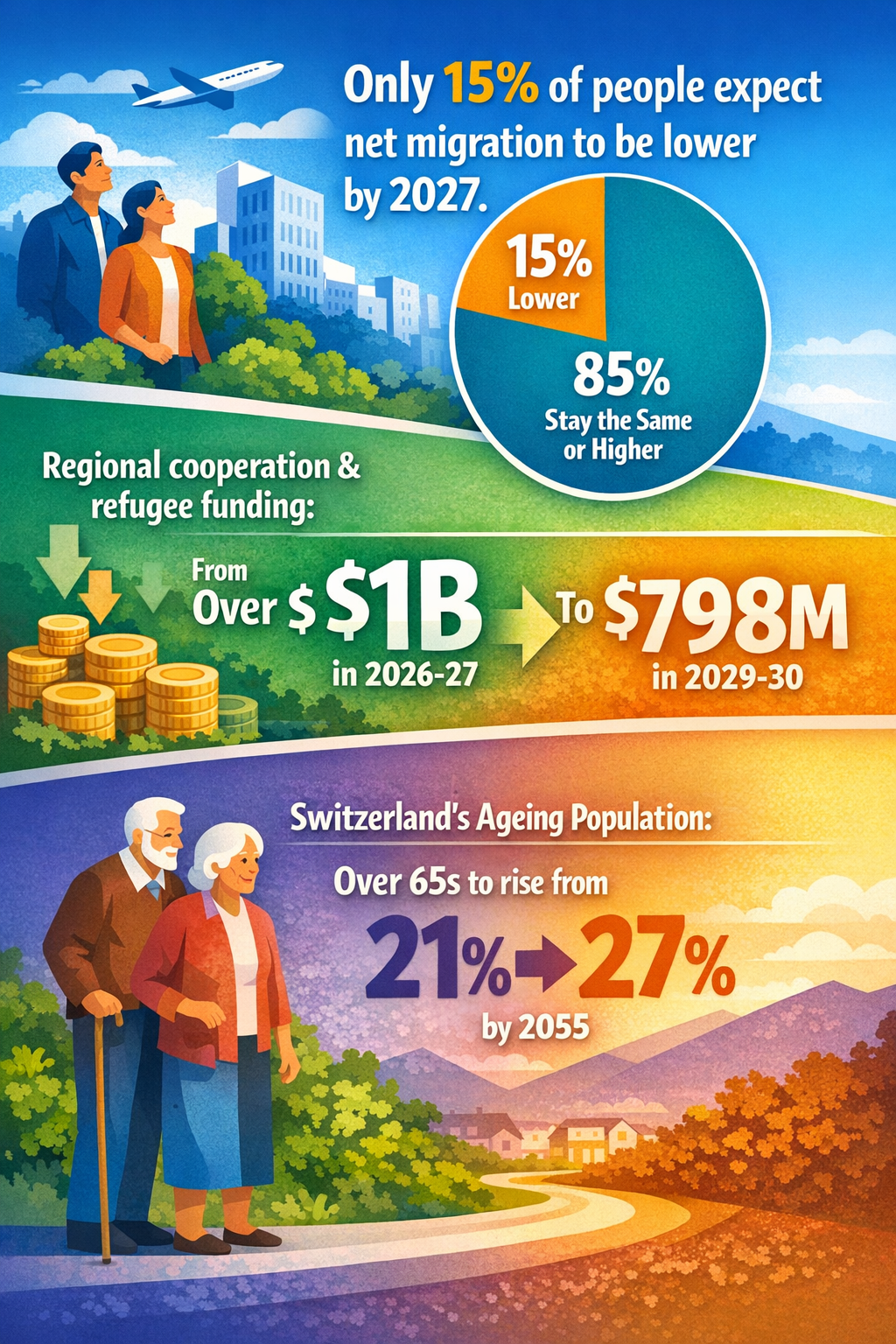
Across the referenced materials, a recurring yet under-explored theme emerges: the tension between demographic necessity and sociopolitical resistance to immigration is prompting countries to contemplate artificial population controls (The Guardian 13/06/2026; The Week 13/06/2026). Switzerland, facing an aging population with over 27% expected to be above 65 by 2055, relies heavily on immigration to sustain its labor force and economic vitality (The Guardian 13/06/2026). Despite this dependency, anti-immigration measures are gaining traction as direct policy instruments. The proposed population cap referendum limits Switzerland’s total population to 10 million, signaling a nascent willingness to explicitly hinge national economic models on demographic ceilings (The Week 13/06/2026).
Simultaneously, macro pressures around migration management are intensifying, from reductions in humanitarian funding (David Pocock 15/06/2026) to EU-wide digitised migration databases and offshore return centers (The Week 12/06/2026). These developments underscore how receiving states are tightening migration controls, often conflicting with the underlying need for migration-driven population renewal, especially as net inflows remain high by societal expectations (The Guardian 21/05/2026). The juxtaposition between demand for migration-based economic support and popular or political will to limit growth appears increasingly unsustainable yet not widely recognized as a structural fault line.
What is genuinely new is the democratisation of population control as a direct, legally binding policy option, legitimizing an explicit upper limit on residents that cuts across the tacit assumptions of unlimited productive migration potential. This diverges from incremental tightening of immigration rules or border enforcement, representing a fundamental challenge to the growth paradigm embedded in current industrial and urban economic models.
Disruption Pathway
The concrete implementation of population caps in wealthy economies could escalate through several linked mechanisms. Initial conditions include rising popular resistance to migration increase amid concerns on housing affordability, cultural cohesion, and environmental sustainability (The Guardian 13/06/2026). If populist movements or political coalitions successfully mobilize referenda or legislation, explicit population ceilings become enforceable policy instruments.
This introduces acute stresses into economic systems dependent on immigration-fueled growth. Labor shortages may accelerate, especially in aging societies where birth rates remain depressed (The Guardian 13/06/2026). These stresses may prompt innovation pressure on automation and reshuffling of labor markets, yet parts of the economy—such as services and construction—may face contraction or migration-dependent bottlenecks.
Regulatory adaptations could include more stringent visa caps, reformed citizenship pathways, or even international diplomatic friction over reduced migration quotas. Concurrently, the global competition for migrants may intensify, pressuring sending countries and potentially destabilizing existing bilateral agreements on labor mobility. The EU’s establishment of digital migration databases and return hubs outside its borders exemplifies how multilateral governance may tighten in response, possibly limiting humanitarian channel capacities (The Week 12/06/2026; David Pocock 15/06/2026).
Feedback loops could reinforce societal polarization: population caps could increase perceptions of scarcity, further hardening migration opposition, while also risking economic stagnation or decline. This might delegitimize conventional growth models, fostering experiments with alternative economic frameworks focused on sustainability over expansion. Capital allocation may shift away from labor-intensive and real estate development sectors toward technology-driven productivity enhancements or migration-independent growth engines.
In this pathway, dominant models of industrial organization and migration governance might shift from open or managed growth toward containment and demographic stabilization strategies. The ongoing climate-induced migration increase (expected to rise 200% by century’s end) represents a looming counterforce that could exacerbate these tensions but is often viewed separately from political cap dynamics (PMC 14/03/2023).
Why This Matters
From a strategic decision perspective, population caps introduce a latent structural risk that redefines migration as a finite and politically constrained resource rather than an elastic economic input. Capital allocation is exposed: investors in housing, infrastructure, and labor-intensive industries may face sudden downscaling or regulatory hurdles. Conversely, sectors focused on automation, AI, and digitization could benefit from attempts to substitute immigrant labor.
Regulators must conceive new frameworks balancing demographic sustainability with economic vitality, potentially requiring innovative visas, residency contracts, or cross-border labor sharing agreements. Sovereign risk assessments must integrate political volatility linked to population caps, as policy reversals may occur abruptly depending on public sentiment dynamics.
Competitively, countries enforcing caps could erode their attractiveness to global talent and investment, heightening intra-bloc migration pressures or brain drain to more open markets. Supply chains dependent on flexible labor migration may strain, increasing offshoring or reshoring dynamics depending on regulatory climates.
Governance ramifications extend to migration management institutions that will need to reconcile contradicting mandates—managing migration demand and enforcement under political ceilings while responding to humanitarian and climate migration surges.
Implications
Population caps as democratically endorsed policies may cause structural reconfigurations rather than transient migration slowdowns. They might recalibrate the interplay between demographic trends and economic policy, potentially ushering in an era of enforced demographic stabilization. This is distinct from standard migration tightening or border policy reforms, which typically modulate flows but do not define absolute limits on resident numbers.
However, competing interpretations exist. Some may argue population caps are politically unsustainable long term due to economic backlash or international migration pressures. Others may view them as a temporary electoral phenomenon without concrete policy enactment or enforcement. The potential remains high for hybrid models combining moderate caps with incentive policies to boost fertility or labor participation as alternative fixes.
Early Indicators to Monitor
- Referenda and legislative proposals for explicit population or immigration caps in aging, high-income countries.
- Investment dislocations or sectoral capital reallocations linked to migration-dependent industries.
- Emerging bilateral or multilateral agreements designed to manage quota ceilings or migration ceilings.
- Policy shifts by supranational bodies towards digital migration controls and offshore return hubs.
- Public opinion shifts tracked through polls on immigration and demographic growth tolerance.
Disconfirming Signals
- Repeal or rejection of population cap measures, especially in economically reliant countries (e.g., Switzerland failing its 2026 referendum).
- Significant fertility rate rebounds negating the need for migration-driven population growth.
- Large-scale international crises or climate shocks stimulating uncontrollable migration flows overriding cap enforcement.
- Coordinated international agreements promoting open migration regimes to counter demographic decline.
Strategic Questions
- How should investment portfolios adjust to potential demographic ceilings that may cap labor supply growth in key markets?
- What regulatory frameworks can balance political demands for population caps while maintaining economic resilience?
Keywords
Migration Policy; Population Caps; Demographic Change; Migration Governance; Labor Markets; Capital Allocation; EU Migration Pact; Population Decline
Bibliography
- Even following the Paris Agreement targets, drought-induced migration could increase by about 200% by the end of the 21st century. PMC. Published 14/03/2023.
- Like many European countries, Switzerland needs immigration because birthrates are falling and it faces a steadily ageing population, with the proportion of people aged over 65 due to climb to more than 27% from 21% by 2055. The Guardian. Published 13/06/2026.
- The anti-immigration measure could upend Switzerland's economy. The Week. Published 13/06/2026.
- Regional cooperation and refugee and humanitarian assistance funding is forecast to drop from just over $1 billion in 2026-27 to $798 million in 2029-30. David Pocock. Published 15/06/2026.
- The new Pact on Migration and Asylum will be backed by a shared digital database, and the establishment of return hubs outside EU borders for failed asylum-seekers. The Week. Published 12/06/2026.
- Only 15% of people expect net migration to be lower in 2027. The Guardian. Published 21/05/2026.