
A review of recent evidence reveals several key signals shaping the trajectory of police technology—particularly in domains related to drone countermeasures, artificial intelligence (AI) integration for security applications, and digital identity/authentication systems—all relevant to operational contexts similar to the Australian Federal Police (AFP). These signals predominantly cluster around drone and counter-drone technology evolution, AI-enabled security and misinformation risks (including deepfakes), and supply chain and authentication technologies grounded in anti-counterfeiting and trusted data frameworks.
| Signal Name / Theme | Direction | Approx. % Change or Frequency Indicator | Short Commentary |
|---|---|---|---|
| Anti-Drone and Counter-UAS Technology | Accelerating | ~3× increase in deployment discussions and testing (2024-2026) | The prevalence and threat of unauthorized drone usage (including smuggling, surveillance, and hostile acts) has led to rapid innovation and widespread investment in anti-drone systems, including AI-enhanced detection, jamming, and kinetic neutralization. The US military's active use of the southern border as a technology sandbox exemplifies real-world validation efforts. Market forecasts anticipate >20% CAGR growth through 2034, reflecting urgent security needs globally (IMARC Group, Business Insider). |
| AI in Security, National Defense, and Governance | Accelerating | Significant growth in policy and military AI initiatives over past 2 years | AI integration across detection, threat assessment, command and control, and autonomous systems is becoming a strategic imperative. US government agreements with tech giants for pre-deployment AI model testing indicate growing official focus on managing AI-related security risks. AI is also baking into counter-drone solutions and broader defense tech, signaling systemic transformation (AI & Academia, Al Jazeera). |
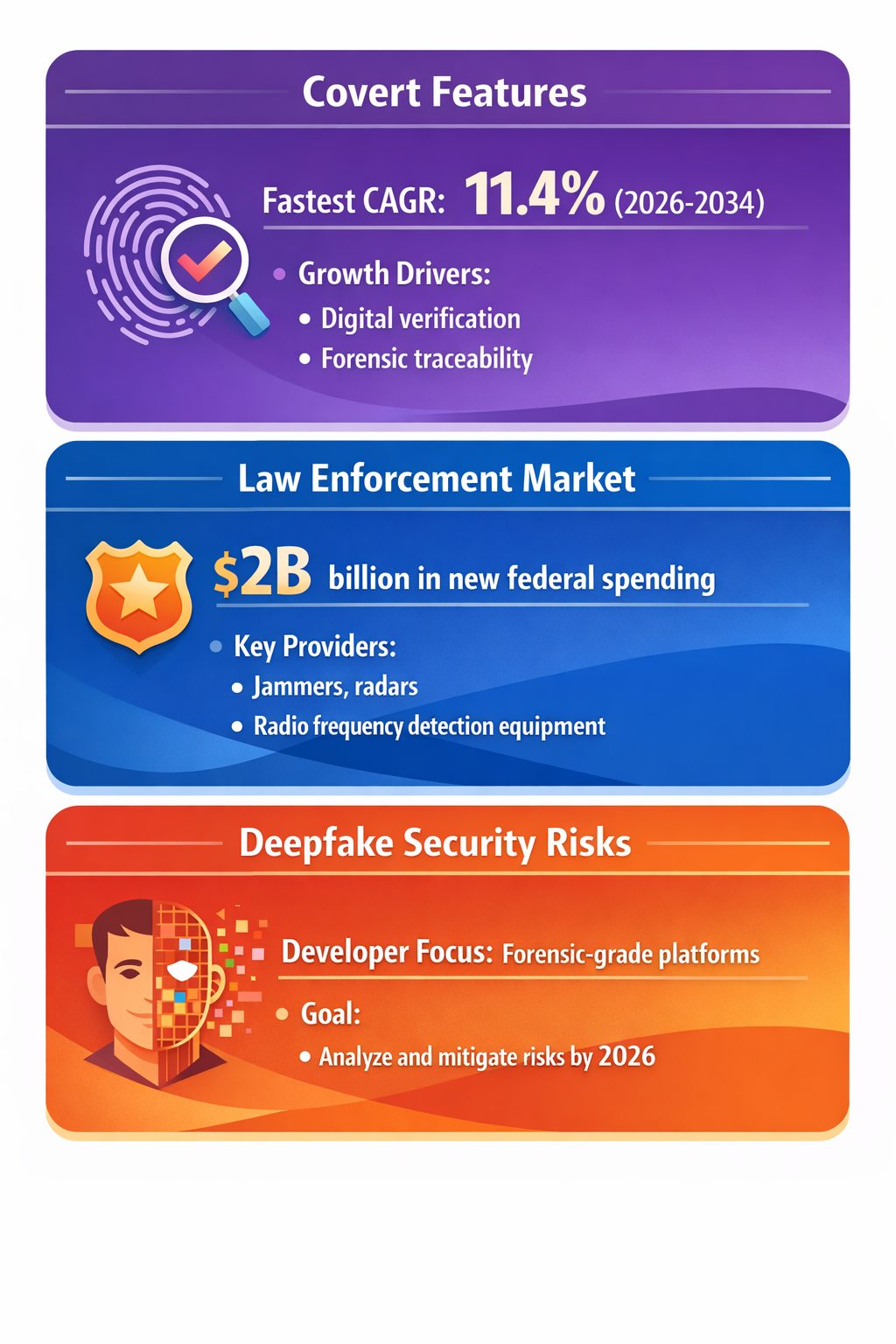
| Deepfake and Synthetic Media Risks to Security and Integrity | Accelerating | Rapid escalation in sophistication and deployment since 2024 | The rise of deepfake-as-a-service platforms and AI-generated synthetic media has introduced a new vector for fraud, social engineering, misinformation, and political manipulation. The evolving difficulty of detecting and countering these threats is driving investment in forensic detection technologies and employee trainings. This is a clear emerging risk directly impacting identity verification and communication trust within law enforcement and federal security domains (Shelby Global). |
| Advanced Identity Verification & Anti-Counterfeiting Packaging (Including AI-enabled Authentication) | Accelerating | Projected CAGR ~11%+ in Europe; expanding tech adoption | With growing sophistication in counterfeiting, packaging embedded with multiple layers of authentication (holograms, RFID, blockchain-enabled product passports) is emerging as a robust tool to enhance supply chain integrity. The integration of AI-powered verification platforms enables real-time authentication that could be extrapolated for security credentialing and evidence verification purposes. Regulatory frameworks in Europe (e.g., EU’s Falsified Medicines Directive) are driving rapid adoption and cross-industry innovation (Market Data Forecast). |
| Non-Military Drone and UAV Industry Expansion and Strategic Supply Chain Developments | Accelerating | ~12× jump in production/output 2024-2025 (Taiwan case) | Taiwan’s push for non-Chinese, trusted drone supply chains aimed at democratic allies highlights supply-side challenges and geopolitics in unmanned aerial systems. The hybrid military doctrines and fragmented procurement efforts reflect growing pains of new technological integration. This signal reflects evolving risk/opportunity balancing in procurement and supplier vetting for federal law enforcement and defense entities (Taiwan Business TOPICS). |
The dominant cluster centers on counter-drone technologies, including active deployment, R&D, and market growth driven by security threats from both military and criminal sources such as smuggling cartels. These developments reveal a transformation driver pattern, with rapid adoption of integrated AI and electronic warfare innovations to handle a spectrum of drone threats effectively.
Closely linked is the broader AI security ecosystem encompassing AI's role in national defense, cybersecurity, and emergent regulatory governance. This signals a systemic cross-sector convergence where AI's proliferation forces traditional government and law enforcement structures to modernize detection and policy approaches—balancing innovation, risk mitigation, and sovereignty.
An accelerating risk cluster arises from the growing complexity of deepfake and synthetic media weaponization, affecting both political stability and operational integrity in law enforcement communications. The sophistication of synthetic identity fraud demands multi-layered defense strategies combining technical detection, process redesign, and human factor education.
Another rising opportunity cluster is represented by identity verification and anti-counterfeiting technologies involving AI-augmented authentication mechanisms embedded in packaging and supply chain controls. This showcases a practical technology enabler for policing authenticity and tracing critical assets, relevant to AFP's forensic and operational challenge set.
Lastly, the drone/UAV industry supply-side evolution stresses geopolitical sourcing and standards complexities, illustrating procurement, certification, and industrial policy dilemmas that influence federal police technology adoption frameworks.