
Welcome to Shaping Tomorrow

Our Scans · AI Funding & Capital Markets · Trend Tracker


Headline & Summary

The analysis of recent evidence across AI funding, capital markets, and broader economic indicators reveals several accelerating themes reshaping investment and strategic dynamics. Key signals include the monumental capital inflows into AI infrastructure fueling a tech investment supercycle; shifting geopolitical dynamics surrounding semiconductor and advanced AI supply chains; the rapid commercialization and IPO activity of AI-native companies and adjacent sectors such as aerospace; transformative labor market disruptions linked to AI adoption; and the growing prominence of sustainable energy and national security in investment and policy priorities. Concurrently, emerging risks related to financial market vulnerabilities, infrastructural capacity bottlenecks, and regulatory tensions are intensifying. These clusters collectively indicate a maturing AI funding ecosystem undergoing systemic transformation, marked by converging technology, finance, and geopolitical dimensions.

Signal Name / ThemeDirectionRelative Frequency / ChangeShort Commentary
Massive Capital Inflows & Infrastructure Buildout for AI Accelerating ~ +40% YOY funding increase (2024–2026) Evidence shows a historic $7 trillion+ investment commitment globally (2026-2031), with hyperscalers and AI labs like OpenAI and Anthropic securing multi-hundred-billion-dollar funding rounds and infrastructure deals (e.g., OpenAI: $600B CAPEX commitments through 2030). Data center and semiconductor CAPEX is scaling exponentially, driving transformative growth in AI processing capacity.
Geopolitical Rivalry over Semiconductors & AI Supply Chains Accelerating Significant increase in state-backed investments, new trade agreements, and export controls since 2022 US and China aggressively pursue semiconductor independence, reshoring supply chains, and technology supremacy via multi-trillion-dollar state support (e.g., US over $100B state aid by 2026; China over €140B by 2024). Europe's strategic positioning remains reactive, grappling with US economic coercion and pushback against regulations. Investment-for-access pacts with allies underscore intensifying industrial policy competition.
AI Company IPO Wave & M&A Activity Accelerating IPO pipeline growing notably in 2025–2026; SpaceX IPO historic valuation ($2.1T) AI-native firms such as Anthropic, OpenAI, Cerebras, and SpaceX (xAI) drive a surge of IPOs and strategic partnerships. SpaceX’s unprecedented public market debut valued Musk as the world’s first trillionaire. This IPO wave is reshaping capital market dynamics, valuation benchmarks, and strategic M&A including major deals in AI infrastructure, SaaS repositioning, and tech security.
AI-Driven Labor Market Disruption & Skills Transformation Accelerating ~70% of employers adopting skills-based hiring; AI-driven layoffs growing over 2025–2026 AI adoption is causing a profound workforce shift including forecasted loss of up to 50% of entry-level white-collar jobs within five years. Hiring paradoxes appear as applications per opening surge, yet skill mismatches persist. Corporate and government responses diverge, with China expanding labor protections while US policy emphasizes deregulation and litigation against state AI governance.
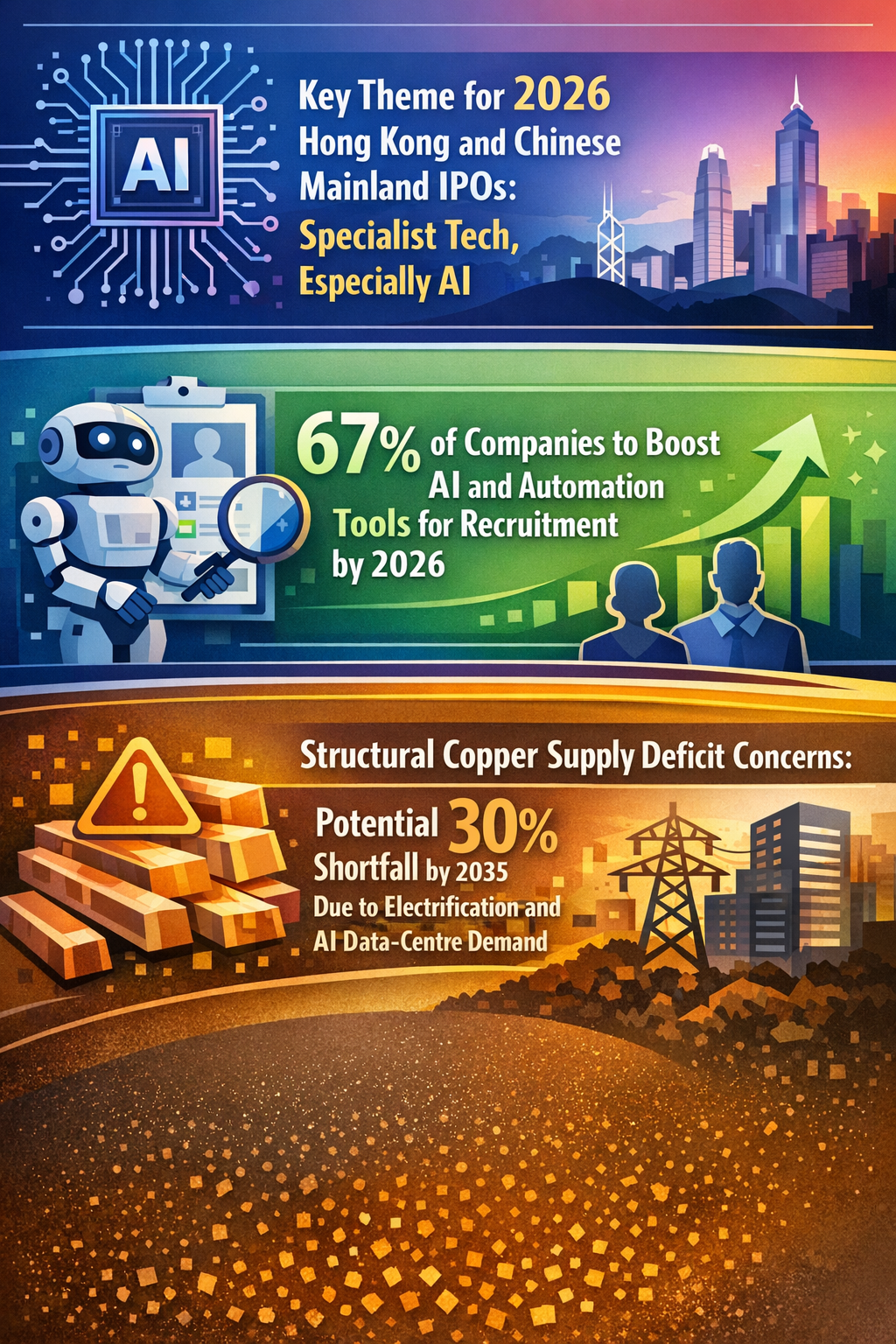
Sustainable Energy & Critical Minerals Investment Linked to AI Growth Accelerating Hyperscalers’ $710B+ 2026 CapEx driving nuclear energy & copper demand AI data center expansion is intensifying demand for stable, carbon-free baseload power, fueling nuclear energy stock rebounds and underpinning governmental focus on critical minerals like copper. Junior miners using AI to scout copper prospects reflect this macro transition toward sustainable supply-side solutions for AI infrastructure growth.
Regulatory & Financial Market Frictions in AI & Tech Sector Stable / Accelerating Increasing financial oversights and legal conflicts since 2025 Markets confront valuation bubbles, concentration risks, and fragility as regulatory bodies (e.g., EU) and national governments escalate digital sovereignty and trade disputes with US tech giants. Financial stress is evident in private credit markdowns, debt refinancing risks, and emerging cybersecurity vetting frameworks for AI access.

Pattern Narrative

The current momentum in AI funding and capital markets shows a multifaceted, deeply interwoven transformation with three central clusters:

  • Capital & Infrastructure Surge: The rapid acceleration of capital commitment to AI compute, data centers, and semiconductor manufacturing forms a strong backbone for next-wave AI economy expansion. Entities from private equity, sovereign funds, and hyperscalers saturate the ecosystem with liquidity, while staggering infrastructure buildouts lock in long-term capacity and commercial dependencies (Verdantix, PwC, Perspective on Risk).
  • Geoeconomic Competition & Policy Friction: AI and semiconductor technology have become core components of US-China strategic rivalry, stimulating nationalistic industrial strategies and strains in EU-US trade relations. The weaponization of supply chains, tariffs, and digital sovereignty regulations characterize this cluster (Institut Montaigne, European Council on Foreign Relations).
  • Labor Market & Talent Dynamics: The AI revolution manifests as both an existential challenge for workforce composition and a demand shift toward skills and adaptability. Talent shortages coexist with surges in applications and increased investment in AI-driven recruitment tech. Regulatory responses differ globally (National University, Fintech News Singapore).

Other supporting trends include an acceleration in IPO activity, especially in cross-sector convergence such as aerospace and AI, and fossil/nuclear energy investments catalyzed by hyperscalers’ growth plans for energy-intensive AI infrastructure (Insurance Journal, 24/7 WallSt, Kalkine).

Implications

Stakeholders should monitor:

  • Capital deployment pacing relative to adoption metrics, managing infrastructure overbuild risks and jitter in private credit markets to avoid liquidity shocks.
  • Geopolitical developments especially US-China-EU trade and export control policies–including semiconductor subsidy programs, data sovereignty disputes, and regulatory escalations affecting tech firms.
  • Labor market evolution with a focus on skills development, AI-induced job displacement metrics, and regional/diversity impacts in recruitment and talent retention.
  • IPO and M&A activity signaling market valuation corrections or consolidations, specifically how AI infrastructure and SaaS firms transition to revenue growth and margin improvement.
  • Climate and resource investment shifts linked to AI infrastructure energy demands, notably how nuclear, copper, and related commodities markets evolve.

Signals Gaining Momentum (Top 5)

  1. AI Capital & Infrastructure Buildout: Skyrocketing capital commitments and megaprojects representing historic-scale investment into AI compute and data centers (Verdantix, PwC).
  2. Geopolitical Industrial Policy & Supply Chain Nationalism: Escalating US-China rivalry over chips and AI tech, coupled with EU responses, triggering novel economic statecraft and coercion tactics (Institut Montaigne, ECFR).
  3. AI IPO & M&A Activity: Historic IPO valuations with SpaceX leading a record-breaking year for AI and adjacent tech stock listings, fostering ecosystem concentration (The Guardian, PwC).
  4. Labor Market Disruption & Skills-Based Hiring Surge: Disruptive AI adoption causing massive layoffs and reshaping hiring landscapes toward skills and AI fluency (Fintech News Singapore, National University).
  5. Energy & Critical Minerals Investment Linked to AI Growth: Hyperscaler capital expansion catalyzing nuclear energy demand and copper supply exploration, spotlighting sustainability (24/7 WallSt, Kalkine).

Wild Cards to Watch

  • Recursive Self-Improving AI Systems
    Potential Impact: Very High
    Surprise Characteristics: Emergent autonomous AI models capable of self-directed R&D, operating beyond human oversight.
    Early Warning Indicators: Public disclosure of AI systems autonomously optimizing their own architectures or capabilities; sudden leaps in AI efficiency/performance outside planned development cycles.
    Commentary: The prospect that AI systems may autonomously create their successors, accelerating their evolution beyond human control, poses systemic risks to technological governance, regulatory frameworks, and societal stability (Perspective on Risk). Monitoring innovation labs' transparency, research disclosures, and deployment protocols is essential.
  • Government Export Controls Triggering AI Model Access Shocks
    Potential Impact: High
    Surprise Characteristics: Sudden government actions restricting access to frontier AI models (via export controls, sanctions) that disrupt enterprise usage globally.
    Early Warning Indicators: Regulatory actions citing national security concerns; industry reports of model takedowns or access limitations; supply chain interruptions in AI hardware.
    Commentary: Export controls such as the US export order affecting Anthropic's Fable 5 reveal vulnerability dependencies in AI supply chains and enterprise infrastructures. Sudden restrictions could drive enterprise risk recalibration and accelerated multi-vendor diversification (Build Fast with AI).
  • Acceleration of AI-Driven Job Losses Outpacing Reskilling and Policy Response
    Potential Impact: High
    Surprise Characteristics: Disproportionate displacement in middle- and higher-skilled white-collar jobs leading to socioeconomic stress.
    Early Warning Indicators: Spikes in sector-specific layoffs, stalled or declining labor participation, slow policy adaptation for workforce reskilling.
    Commentary: The mismatch between AI labor substitution and societal adaptation risks structural unemployment and inequality. Early signals include banking sector layoffs and uneven implementation of AI governance globally (Fintech News Singapore, National University).
Briefing Created: 24/06/2026

Login