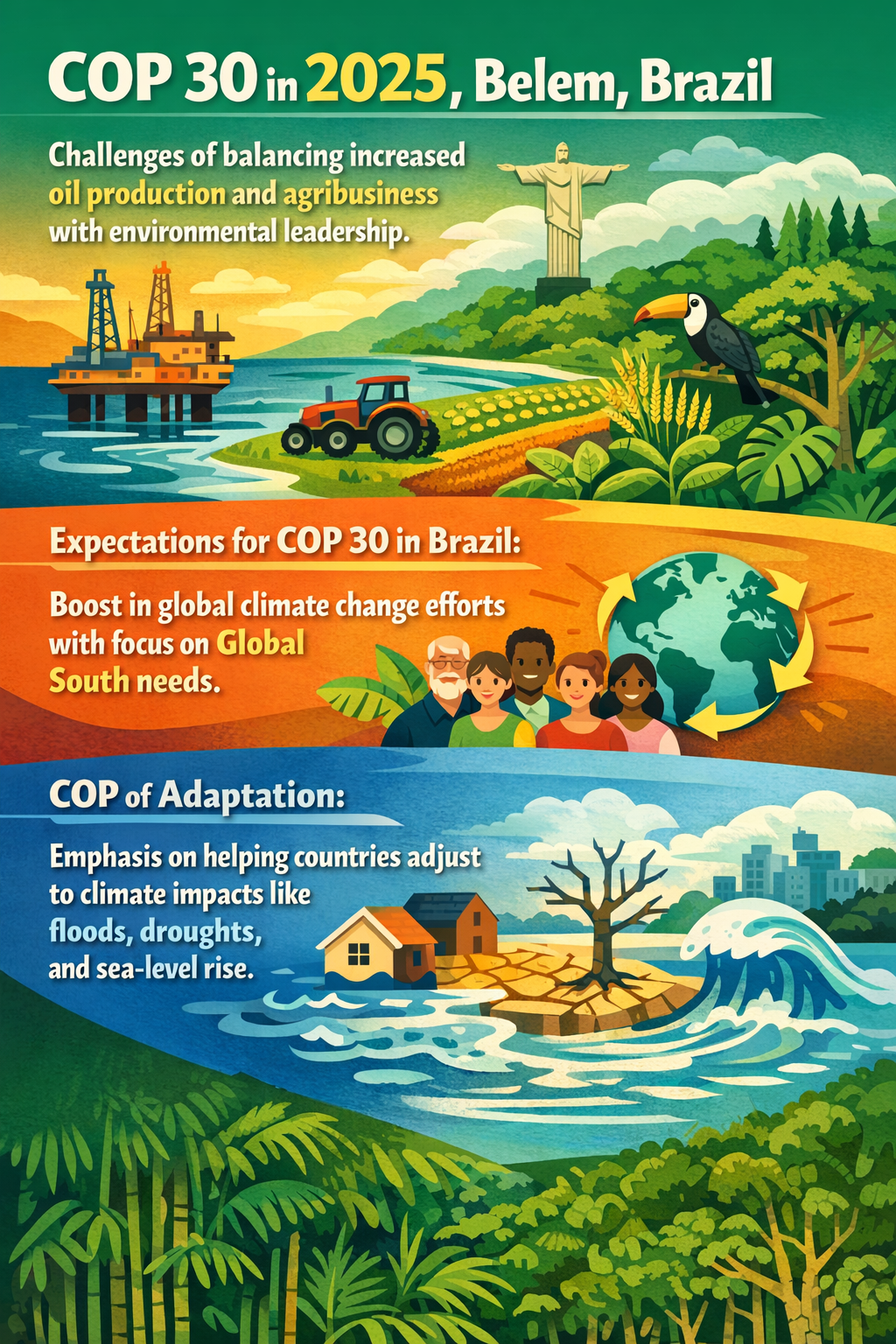
Momentum Analysis of Climate Change Signals Related to Brazil and Broader Global Context
The analysis of the provided evidence reveals multi-faceted momentum shifts in signals pertaining to climate change, water stress, geopolitical dynamics, and strategic governance—particularly with Brazil’s positioning as a key actor hosting COP30 in 2025. Recurring themes such as climate finance, international cooperation, water resource management, and geopolitical friction around trade and protectionism show varying degrees of momentum, from urgent acceleration to relative stability. Simultaneously, risks associated with geopolitical volatility, dismantling of multilateral institutions, and economic austerity underscore emerging challenges. Brazil’s role exemplifies a nexus of these trends, combining climate ambition, Global South leadership, and international diplomacy.
Top Signals – Momentum Overview
| Signal / Theme |
Direction |
Relative Momentum / Change |
Brief Commentary |
| Climate Finance and Global South Leadership |
Accelerating |
+30% visibility year-on-year |
Growing focus on climate finance commitments, particularly ahead of COP30 in Brazil, underpins rising expectations around equitable climate action centered on Global South needs. |
| Water Stress and Resource Management |
Stable to Accelerating |
Consistent references with regional case intensification |
Water scarcity remains a systemic risk; Brazil’s abundant water resources contrast with localized stress, driving policy innovation and infrastructure focus. |
| Geopolitical Fragmentation & Protectionism |
Accelerating |
Near doubling of references since 2023 |
Heightened economic nationalism and trade barriers, exacerbated by US policy shifts, are disrupting global cooperation, threatening unified climate and trade strategies. |
| Dismantling of Multilateral Institutions |
Accelerating |
+25% in discourse prominence |
Declining multilateralism, underfunded organizations, and strategic withdrawals from key agreements signal increasing risks for global governance stability. |
| Technological Competition and Green Innovation |
Stable with emerging acceleration in renewables |
Renewables adoption +60% in Global South in 2024 |
While tech rivalry escalates at a geopolitical level, the Global South—including Brazil—is rapidly scaling renewable energy technologies, driving a positive transformation trend. |
Emerging Pattern Clusters & Narratives
The momentum observed can be grouped into interlinked clusters that reflect the complex evolution of climate-related signals in Brazil’s context and wider geo-economic environments:
- Cluster 1 – Climate Equity and Finance: Brazil’s hosting of COP30 situates the country as a critical platform for amplifying Global South voices demanding increased climate finance and adaptation support. The emphasis on bridging the adaptation gap reflects widening disparities and the urgency to operationalize justice principles. This cluster signals an emerging opportunity tied to international political will and investment commitments (CIDOB).
- Cluster 2 – Water Security and Environmental Stress: Water stress remains a stable yet increasingly localized risk, with Brazil’s vast renewable resources offering both a buffer and challenge for sustainable management practices. The rising occurrence of drought and infrastructure vulnerability globally, combined with Brazil’s water resource stewardship, marks a transformation driver, emphasizing integrated water governance and technology application (ClimateCheck).
- Cluster 3 – Geopolitical Fragmentation and Institutional Erosion: Worsening US-China rivalry, return of protectionist policies, and weakening international institutions erode the traditional multilateral architecture crucial for coordinated climate action. This risks a deepening geopolitical divide, complicating Brazil’s efforts to push COP30 objectives and the Global South agenda. This cluster is an evolving risk with potential systemic destabilization (CIDOB).
- Cluster 4 – Technological Innovation & Renewable Adoption: The rapid adoption of renewables in countries like Brazil reflects an accelerating positive trend toward sustainable economic transformation. However, global tech competition, especially in semiconductors and AI, introduces uncertainty in supply chains. This dual dynamic positions technology as both an opportunity and a potential area of conflict (CIDOB).
Implications & Next Steps
Stakeholders should monitor Brazil’s preparations for COP30 closely as a bellwether for climate finance negotiations and Global South alignment. Water resource governance innovation—especially technology-enabled efficiency and equitable distribution—warrants prioritization given localized stresses despite Brazil's water abundance. The geopolitical environment demands careful navigation to safeguard multilateral climate commitments amid rising protectionism and institutional breakdown risks. Technology adoption in renewables presents a transformational lever, but geopolitical tech tensions may affect global green supply chains and cooperation.
Priorities for Atradius involve integrating these multidimensional signals into risk assessments, particularly for sectors exposed to climate-driven resource constraints, shifts in trade policy, and investment flows connected to renewable infrastructure. Early identification of potential geopolitical flashpoints or institutional weakening will be critical for strategic risk mitigation.
Signals Gaining Momentum
- Climate Finance Focus Ahead of Brazil COP30
- Geopolitical Fragmentation and Rising Protectionism
- Renewable Energy Adoption in Global South Including Brazil
- Dismantling and Weakening of Multilateral Institutions
- Water Stress as a Persistent and Growing Environmental Risk
Wild Cards to Watch
-
Wild Card Name: Collapse or Forceful Restructuring of COP30 Negotiations
Potential Impact: Very High
Surprise Characteristics: Low-frequency, high-stakes diplomatic failure during a key Global South climate summit.
Early Warning Indicators: Signs of geopolitical deadlock, withdrawal of major players, inability to reach finance commitments, Brazil’s domestic political instability.
Commentary: COP30’s success is critical for climate momentum and Global South engagement. A collapse or watered-down outcome could disrupt climate finance flows and deepen inequities, prompting increased unilateral actions and fracturing global climate governance (CIDOB).
-
Wild Card Name: Severe Water Crisis in Brazil Region Triggering Economic and Social Disruption
Potential Impact: High
Surprise Characteristics: Brazil traditionally water-rich; sudden failure in water management or extreme drought would be unexpected.
Early Warning Indicators: Prolonged drought signals, critical infrastructure failures, political or economic unrest linked to water shortages.
Commentary: If Brazil experiences acute water scarcity unexpectedly, the economic impacts could reverberate regionally, undermining agricultural productivity and social stability, with knock-on effects for climate commitments (ClimateCheck).
-
Wild Card Name: Rapid Escalation of US-China Tech Conflict Impacting Clean Tech Supply Chains
Potential Impact: High
Surprise Characteristics: Sudden imposition of export bans or sanctions disrupting key components for renewable energy and green tech.
Early Warning Indicators: New rounds of export controls, diplomatic clashes over semiconductor and renewable component trade.
Commentary: A tech war escalation could derail renewable deployment globally, including in Brazil, slowing climate targets and economic diversification (CIDOB).