
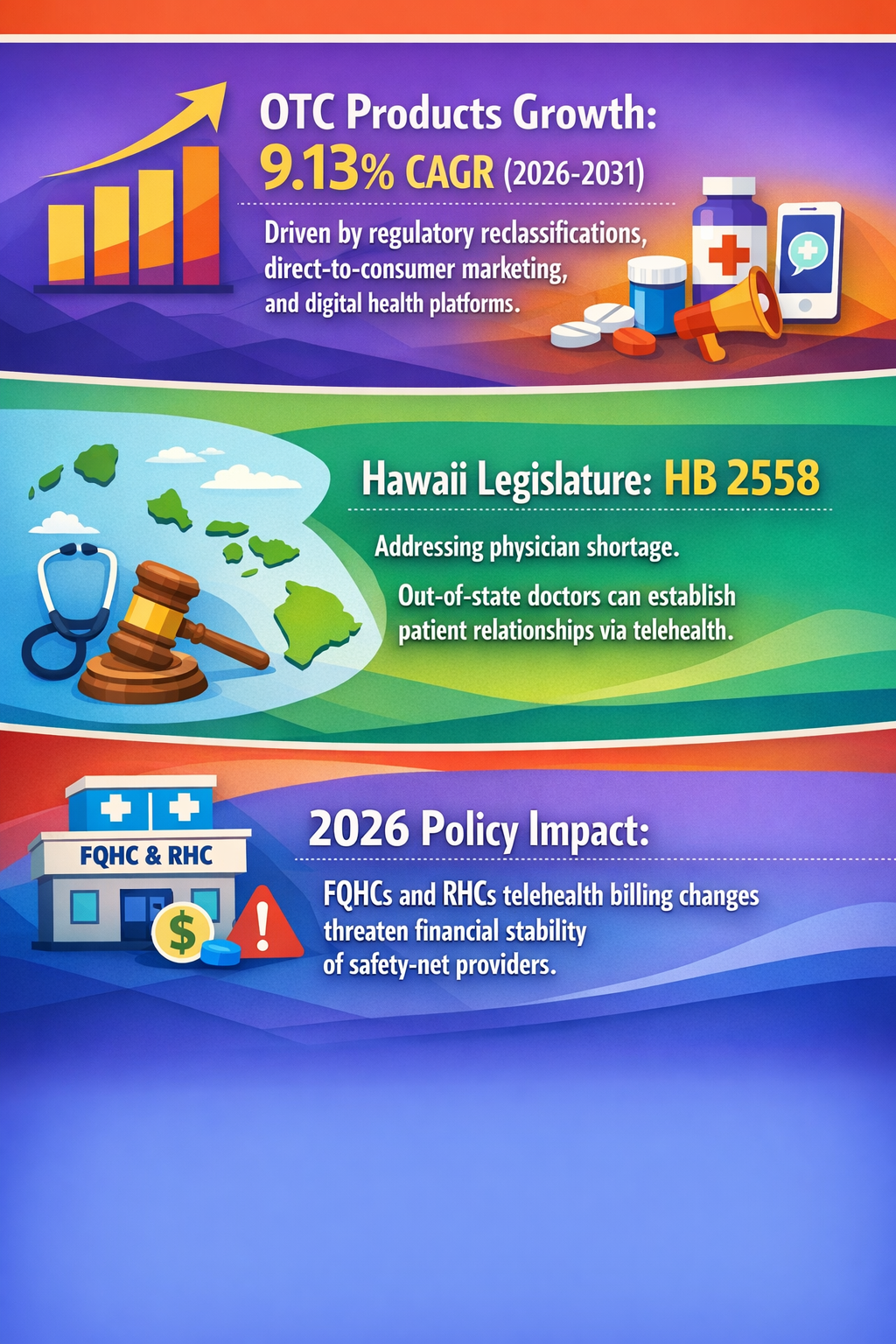
Recent evidence across the digital health, virtual care, and care-at-home domain highlights notable acceleration in Remote Patient Monitoring (RPM), Artificial Intelligence (AI) integration, telehealth expansion coupled with regulatory modernization, and workforce capacity-building in rural and underserved areas. These signals collectively underscore a systemic transformation driven by technology innovation, policy support, and shifting care delivery models. Meanwhile, themes around interoperability, cybersecurity, and digital equity maintain steady prominence, reinforcing foundational infrastructure needs. Botanical/plant-derived therapeutics, while significant in pharma, remain peripheral to core digital health trends but indicate a broader move toward integrated and personalized care solutions.
| Signal Name / Theme | Direction | Relative Frequency / % Change | Commentary |
|---|---|---|---|
| Remote Patient Monitoring (RPM) & Care-at-Home Expansion | Accelerating | High frequency; projected CAGR ~12.9% (North America); multiple policy endorsements in 2026 | RPM is rapidly scaling in response to chronic disease burdens, CMS reimbursement expansions, and integration with hospital-at-home programs. Technological improvements in wearables and AI analytics are driving both adoption and clinical utility across home and rural settings. |
| AI-Driven Digital Health Innovation & Clinical Augmentation | Accelerating | Substantial increase in market size projections; 37% CAGR in AI-driven digital health segment until 2030 | Generative AI, ambient clinical intelligence, and precision medicine are reshaping workflows, diagnostics, and patient care personalization. Governance and cybersecurity concerns prompt parallel advances in trustworthy AI frameworks. |
| Telehealth Expansion & Regulatory Modernization | Accelerating | Increased legislative actions in 2026, growing licensure reciprocity compacts and expanded scope applications | Telehealth is increasingly embedded across specialties beyond physicians, including veterinary, genetic counseling, social work, and obstetrics. Licensure compacts and cross-state practice laws are facilitating workforce mobility and access enhancement, particularly for rural and underserved populations. |
| Rural & Workforce Development via Federal Funding Programs (RHTP) | Accelerating | Universal state adoption of workforce strategies; growing investments in training, licensure reforms, and retention measures | The Rural Health Transformation Program is a focus of robust state-level implementation in 2026, targeting provider recruitment, upskilling, and scope expansions. Emphasis on community health workers and peer specialists addresses nonclinical service gaps crucial for rural care sustainability. |
| Interoperability & Data Integration | Stable | Consistent focus with mandatory EU Health Data Space implementation by 2034 and growing national platform consolidations | Interoperability continues as a foundation for scalable digital health, supporting seamless EHR data exchange, care coordination, and research. European and Australian efforts showcase long-term commitments to data liquidity and uniform standards. |
| Cybersecurity & AI Governance in Digital Health | Stable | Frequent concern in 2026 policy discussions; integration of Zero Trust and explainable AI frameworks emerging | As digital health grows, cybersecurity remains a constant priority, complicated by AI's ethical and safety dimensions. Ongoing development of regulations and governance approaches are critical to sustain trust and compliance. |
The momentum toward RPM and virtual care models reflects a broader transformation of healthcare delivery from institutional settings to patient-centric, home-based, and rural-accessible modalities. This technological enablement is synergistically boosted by comprehensive policy and reimbursement frameworks (notably CMS initiatives) that financially incentivize RPM adoption and telehealth expansion.
AI emerges as a dual driver: augmenting clinical workflows through automation and predictive analytics, and supporting personalized medicine via advances in genetic and behavioral data integration. However, AI’s growth is accompanied by heightened attention to governance, data quality, security, and regulatory oversight, indicating an ecosystem maturing toward responsible innovation.
Telehealth legislative actions in multiple U.S. states reflect a concerted policy shift to embed virtual care across diverse disciplines, reducing barriers from licensing and scope limitations. Simultaneously, substantial investments in rural workforce development under the Rural Health Transformation Program signify recognition that technology alone cannot resolve access – the human element remains pivotal.
Interoperability and cybersecurity, while not accelerating dramatically, persist as essential infrastructural pillars. Their steady presence implies ongoing efforts to harmonize and secure data-sharing environments critical for sustaining advanced digital health services.