
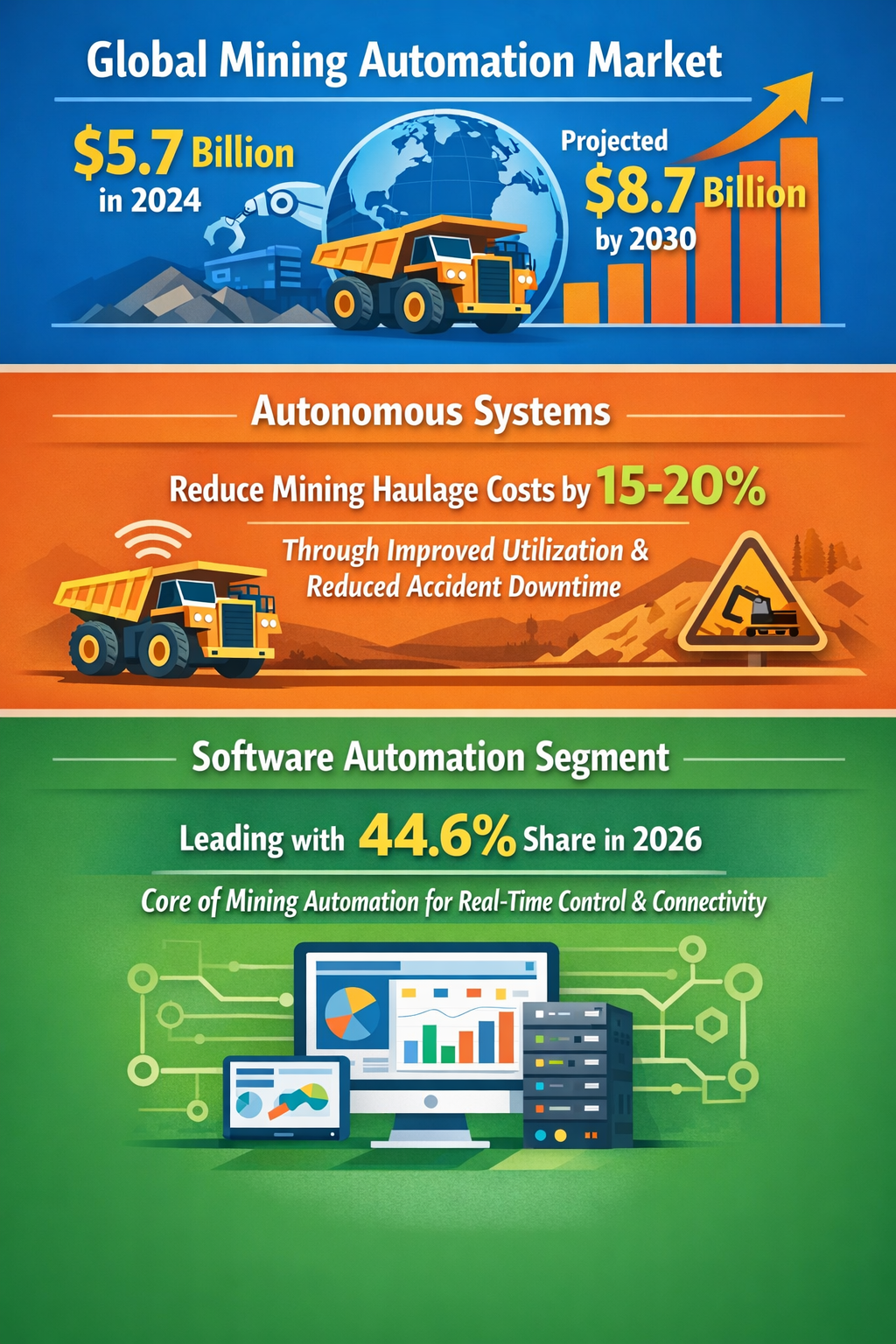
Recent evidence across Automation, AI, and Digital Operations highlights distinct signals gaining momentum, particularly in mining automation technologies, the expanding footprint of autonomous trucks, and the growing scrutiny of AI’s environmental impact and infrastructure needs. These evolving early indicators reveal accelerating adoption and investment patterns, alongside intensifying challenges around sustainability and resource constraints. Together, they form clusters that signal an increasingly complex interplay between technological opportunity, operational transformation, and emergent risks in strategic energy and social dimensions.
| Signal / Theme | Direction | Relative Momentum / % Change | Short Commentary |
|---|---|---|---|
| Mining Automation Market Growth and Advanced Fleet Autonomy | Accelerating | Market valued at $6.3B in 2026, projected to $12.9B by 2033 (CAGR 10.8%) | Strong momentum driven by labor shortages, safety focus, and AI integration in autonomous haulage and mining equipment, underscored by fleet management software and emerging 3D navigation systems. |
| Autonomous Trucks Expansion, especially Level 4 and Mining Applications | Accelerating | Market growing from $47.5B in 2026 to $115.3B by 2033 (CAGR 13.5%) | Driven by commercial driver shortages and emissions regulations, heavy-duty and mining autonomous trucks lead adoption, with significant operational cost reductions and regional policy advances. |
| Energy & Resource Footprint of AI Infrastructure (Electricity, Water, Land) | Accelerating | Electricity demand from AI surging; data centers driving 12.4% commercial demand increase (2021-2025) | Rapid growth in AI workloads intensifies electricity, water consumption, and environmental footprint concerns, unveiling infrastructure bottlenecks and sustainability trade-offs. |
| AI Capital Expenditure Efficiency and Chip Utilization Concerns | Stable but Rising Awareness | GPU utilization estimated at 5%, with growing AI capex scrutiny | Increasing investor and expert concern about wasteful AI hardware investments and underutilized resources, foreshadowing potential market corrections or efficiency drives. |
| Regional Leadership in Automation and AI Infrastructure (Asia Pacific, North America) | Stable with Growth in Asia Pacific & North America | Asia Pacific mining automation at 42.9% market share in 2026; North America leads autonomous trucks at 38% | Geopolitical and policy investments create regional technology and deployment hubs, with Asia Pacific surging via government support and North America maintaining dominance in autonomous trucking and infrastructure. |
Two high-growth clusters stand out as core transformation drivers: (1) Automation and autonomy in heavy industries, particularly mining and freight logistics; and (2) the energy and sustainability challenges accompanying AI’s infrastructure demands.
Mining automation and autonomous trucks share overlapping technology signals—advanced AI-enabled fleet management, Level 4 autonomy, and operational cost gains—pointing to sustained commercial momentum. Both sectors benefit from labor shortages and stringent safety and emissions regulations, enabling accelerated deployment especially in geofenced or controlled environments. The adoption of AI-based self-managing systems evidences a shift toward fully autonomous, highly efficient industrial ecosystems.
Simultaneously, the environmental and infrastructure footprint of AI adoption emerges as a critical risk cluster. Rising electricity demand driven by data centers and AI workloads is colliding with aging grids and regional resource constraints, notably water availability in drought-prone areas. Public and policy attention to sustainability, affordability, and social license is intensifying. This fold includes growing scrutiny of inefficient capital and compute resource utilization within AI development cycles, suggesting the industry must balance rapid growth against environmental and economic pragmatism.