
Natural Hydrogen as a Strategic Wildcard in Mining Decarbonisation
Exploring how natural hydrogen extraction could disrupt mining decarbonisation by reducing energy costs and emissions, reshaping capital flows, regulatory approaches, and industrial configurations over the next two decades.
Mining decarbonisation efforts increasingly focus on renewable electricity, electrification, and circular economy approaches; however, a little-recognized potential lies in harnessing naturally occurring hydrogen as a clean energy vector within mining operations. This development represents a structural inflection that could recalibrate cost structures and emissions baselines in mining sectors reliant on fossil fuels for power and heat. Unlike synthetic green hydrogen reliant on electrolyzers and grid renewables, natural hydrogen extraction leverages subsurface geophysical phenomena, potentially unlocking a cost-competitive and low-carbon fuel source under deployed mining sites. Its scalable deployment within 10–20 years warrants revisiting how mining capital allocation, regulatory frameworks, and industrial partnerships could evolve to integrate this emerging energy input.
Signal Identification
This development qualifies as an emerging inflection indicator given its potential for systemic impact on mining decarbonisation pathways. Natural hydrogen extraction remains nascent but increasingly feasible thanks to advancing subsurface exploration technologies and pilot projects, such as those reported in Canada’s mining sector (ScienceDaily 26/05/2026). Its horizon is 10–20 years with a medium plausibility band based on current technical validation, regulatory acceptance trajectories, and pilot outcomes. The primary sectors exposed include hard-rock mining, minerals processing, energy supply within mining operations, and downstream manufacturing of clean energy technologies dependent on mining outputs.
What Is Changing
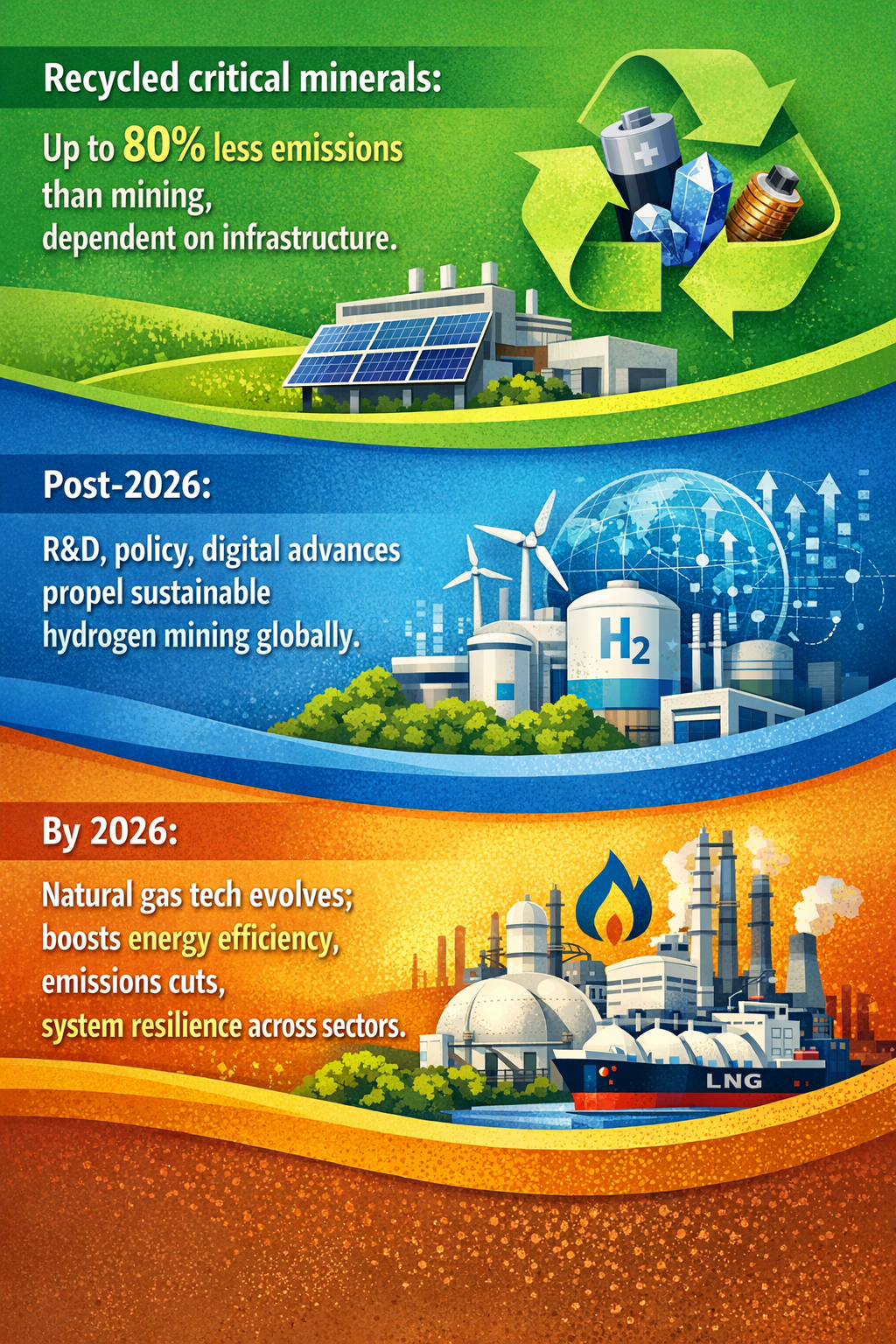
Decarbonisation strategies in mining have so far concentrated on electrification powered by grid renewables, circular mineral economies, and reducing Scope 1 and 2 emissions through energy efficiency (Resonance Global 15/03/2026). However, while recycled critical minerals can reduce greenhouse gas footprints by up to 80%, the necessary infrastructure is underdeveloped, limiting the benefits (Resonance Global 15/03/2026). Simultaneously, mining’s social license increasingly depends on demonstrable decarbonisation, spurring companies to actively seek energy solutions that embed sustainability and competitive edge (Highways Today 13/01/2026).
Natural hydrogen emerges as a distinctive systemic lever because it could directly substitute fossil fuels in onsite energy generation with minimal infrastructure overhaul. Unlike green hydrogen produced via electrolyzers — which requires substantial electricity input often from renewables connected to strained grids — natural hydrogen is freed by geothermal and geochemical processes inherent to many mining regions (ScienceDaily 26/05/2026). This fundamentally alters the decarbonisation landscape by embedding energy generation underground, reducing transmission losses, and lowering operational energy costs without the volatility linked to renewable electricity markets. This signal is under-recognized in strategic discussions relative to its potential to reshape industrial integration and regulatory paradigms.
Further, as demand for minerals critical to clean technologies grows, miners face a paradox intensifying the complexity of balancing increased production and sustainability (Farmonaut 20/02/2026). Integrating natural hydrogen may provide a cost-stable energy vector that buffers against commodity price shocks linked to fluctuating fossil fuel and grid renewable prices, adding strategic operational resilience in ecosystems that are otherwise vulnerable to decarbonisation-induced cost inflation.
Disruption Pathway
The natural hydrogen disruption pathway may begin with incremental exploration investments as pilot projects demonstrate feasibility within specific mining geologies. Initial conditions accelerating adoption include rising carbon pricing, volatile fossil fuel markets, advancing subsurface sensing technologies, and regulatory incentives that recognize natural hydrogen as a low-carbon fuel qualifying for emissions credits or subsidies.
As pilot phases prove economic viability, mining firms could progressively co-develop fuel extraction with mineral extraction, creating operational synergies. This integration could stress traditional energy supply chains relying on external fossil fuel deliveries and decouple mining operations from electricity grid dependencies. Regulatory systems will face pressures to adapt frameworks for natural hydrogen royalties, environmental impact assessments, and cross-sector permitting — particularly where hydrogen extraction overlaps with water and land rights.
Structural adaptations may include the emergence of vertically integrated energy-mining firms or joint ventures between mining companies and natural hydrogen specialists, altering the industrial landscape from pure upstream mining toward energy resource convergence. New feedback loops could emerge where lower energy costs spur more mineral output, generating capital to invest further in hydrogen exploration and infrastructure, creating a positive reinvestment cycle.
Conversely, if natural hydrogen extraction leads to unexpected environmental externalities or resource conflicts, regulatory retrenchment or community opposition might stall scaling, underscoring the importance of adaptive governance mechanisms. Over time, dominant regulatory and industry norms could pivot toward recognizing natural hydrogen as a foundational pillar in mining decarbonisation strategies, transitioning from pilot novelty to commercial standard.
Why This Matters
Decision-makers in capital allocation may find natural hydrogen extraction reshaping the calculus around energy investments in mining, favoring integrated onsite energy production over expensive electrification or imported renewables. Early movers may secure strategic advantages through reduced operational emissions footprints, improved cost predictability, and enhanced social license, critical under tightening environmental regulations.
Regulators should anticipate emerging frameworks addressing hydrogen extraction rights, emissions accounting, and integration within mining permits. Misalignment or lag in regulatory adaptation could generate uncertainty or fragmented policies limiting deployment and investment. Conversely, forward-looking policy enabling natural hydrogen exploitation could attract capital and encourage innovation clusters.
Strategically, mining companies and energy suppliers could redefine their roles and partnerships. Firms entrenched in fossil fuel-powered energy supply may see their market challenged by natural hydrogen providers embedded within mining value chains. Supply chain infrastructures are likely to shift from electrification-focused investments to hybrid systems incorporating underground fuel generation, affecting equipment manufacturing and downstream logistics.
Implications
This signal could plausibly scale into structural change that shifts mining decarbonisation paradigms away from exclusive reliance on electrification and material recycling alone. It may likely influence capital flows toward integrated subsurface energy extraction ventures and drive regulatory innovation around natural hydrogen industry classification and environmental safeguards.
However, natural hydrogen is not a panacea; it does not replace the need for circular economy infrastructure or renewable grid expansion, which remain essential for sustainable mining. Stakeholders must avoid conflating natural hydrogen’s potential with overstated immediate impact or ignoring its geological variability. Competing interpretations may regard natural hydrogen as a niche or experimental energy source rather than a transformative lever. Careful monitoring and contextual evaluation are required to distinguish structural potential versus hype.
Early Indicators to Monitor
- Increase in exploratory drilling and geophysical surveys targeting natural hydrogen reservoirs within mining jurisdictions
- Changes in government regulatory proposals recognizing or incentivizing natural hydrogen extraction as a clean fuel
- Clusters of venture funding or corporate partnerships focusing on subsurface hydrogen extraction technologies integrated with mining
- Patent filings for extraction, storage, and utilization technologies related to natural hydrogen in mining contexts
- First commercial-scale pilot demonstrations reporting operational data and emissions reductions in mining sites
Disconfirming Signals
- Repeated pilot project failures or unexpectedly high costs rendering natural hydrogen uneconomical
- Lack of regulatory progress or prohibitive legal rulings limiting natural hydrogen extraction rights
- Significant environmental damage or community opposition leading to moratoriums
- Rapid cost declines in grid renewable electricity and green hydrogen plants obviating natural hydrogen’s economic rationale
- Breakthroughs in recycling infrastructure scaling that substantially reduce primary mineral demand and energy use
Strategic Questions
- How should capital allocation frameworks integrate natural hydrogen potential relative to electrification and recycling investments in mining decarbonisation?
- What regulatory and governance adaptations are required to preemptively support safe, scalable natural hydrogen deployment within mining operations?
Keywords
Natural hydrogen; Mining decarbonisation; Circular economy; Energy transition; Carbon emissions; Capital allocation; Regulatory frameworks; Clean energy
Bibliography
- Natural hydrogen could help reduce both costs and carbon emissions for Canada's mining sector. ScienceDaily. Published 26/05/2026.
- Recycled critical minerals could incur around 80% less greenhouse gas emissions than primary mining - but only if the recovery infrastructure exists. Resonance Global. Published 15/03/2026.
- Mining companies are finding that being part of the climate solution not only secures their social license but also positions them competitively in a world where low-carbon production will be increasingly valued. Highways Today. Published 13/01/2026.
- With global policies promoting decarbonization across transport and energy sectors, the mining industry faces both opportunities and challenges in balancing output and sustainability. Farmonaut. Published 20/02/2026.
- Blueprint for Sustainable Mining. Highways Today. Published 13/01/2026.