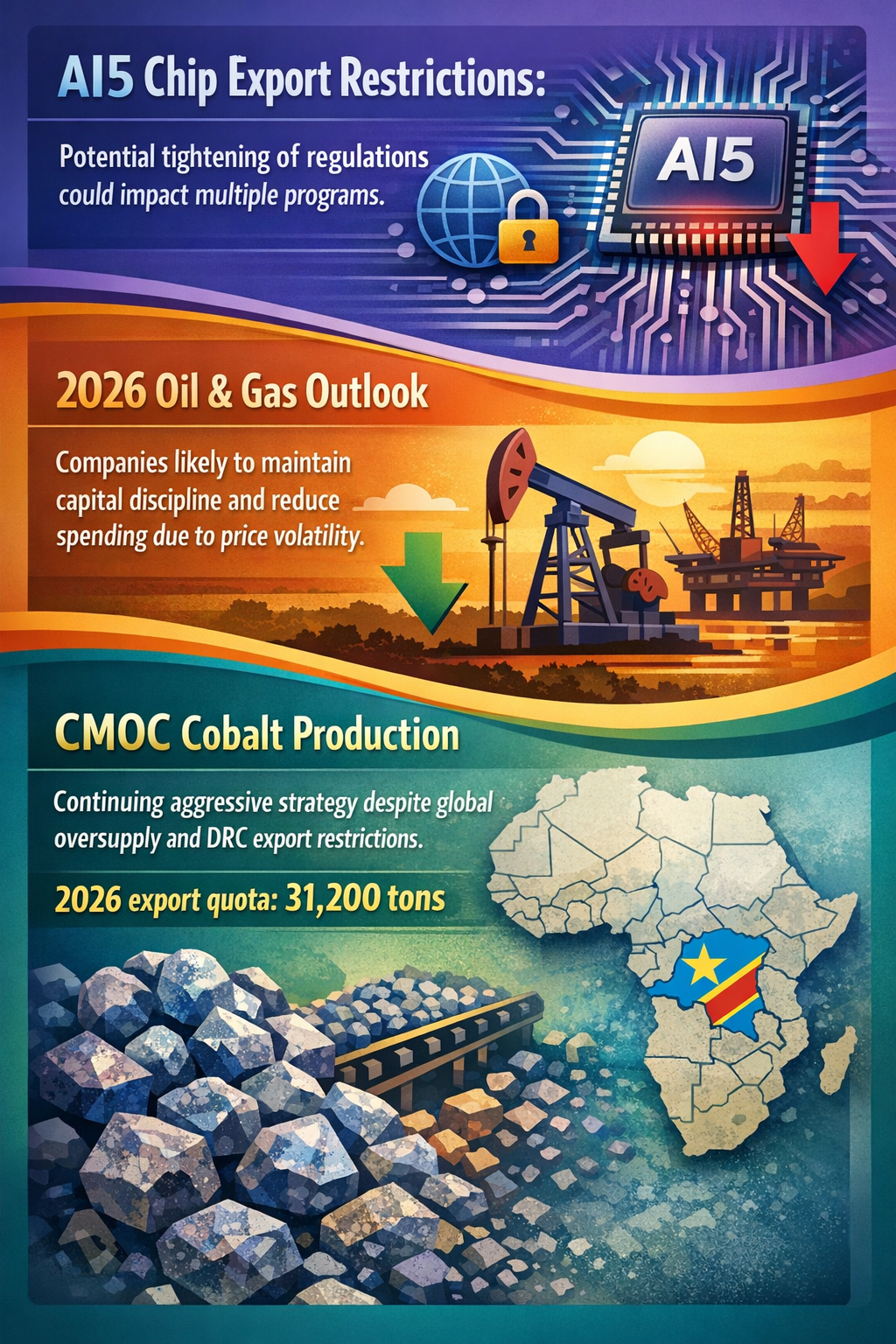
Commodity Currents: Navigating Sovereign and Credit Instability in a Shifting Global Economy
- Commodity-linked sovereign debt remains vulnerable amid volatile resource prices, geopolitical tensions, and shifting global trade patterns.
- Key drivers include oil and minerals price swings, regulatory tightening in major markets, and supply chain disruptions affecting critical inputs.
- Export controls and geopolitical frictions exacerbate uncertainty, influencing sovereign creditworthiness and corporate counterparty risks.
- Emerging signals such as constrained sulfuric acid supply and export restrictions on strategic technologies highlight fragility in commodity-dependent economies.
- For Atradius, understanding these dynamics is crucial to balancing risk appetite, ensuring credit portfolio resilience, and identifying new growth opportunities in evolving markets.
A Fearful Future – “Resource Fallout: When Commodity Shocks Trigger Sovereign Crises”
In this scenario, a perfect storm of prolonged commodity price collapses, exacerbated by geopolitical sanctions and export restrictions, leads to widespread sovereign defaults in resource-dependent countries. Countries reliant on hydrocarbons and minerals face crushing debt burdens amid plummeting revenues and restricted access to credit markets. Supply chain disruptions, such as shortages in sulfuric acid critical for mineral processing, raise production costs and stifle recovery. Credit instability ripples through financial institutions holding sovereign exposures, triggering tighter global credit conditions. The regulatory environment tightens further as major economies impose stricter export controls to secure strategic resources, aggravating economic isolation for vulnerable nations.
What could Atradius do?
- Intensify credit risk surveillance on commodity-linked sovereigns, incorporating scenario stress tests that factor in extended price shocks and geopolitical embargoes.
- Diversify insurance and guarantee portfolios away from highly exposed commodity subsectors, seeking alternative sectors or geographies with more stable fundamentals.
- Enhance collaboration with sovereign risk analysts and international institutions to identify early-warning signals and co-develop mitigation frameworks for clients and counterparties.
An Uncertain Future – “Volatile Veins: Navigating Cycles of Boom, Bust, and Regulatory Flux”
This future is marked by sharp, unpredictable swings in commodity markets driven by uneven global recovery patterns, erratic policy interventions, and strategic export restrictions. Regulatory tightening, especially in Europe and parts of Asia, complicate trade flows and capital movements. Supply chain bottlenecks—such as sulfuric acid shortages and delayed offshore equipment deliveries—add operational headaches. Sovereign credit quality oscillates between cautious optimism and renewed stress. Portfolio valuations fluctuate, demanding nimble risk management. Simultaneously, some commodity-dependent economies innovate to diversify revenues, creating mixed signals for credit investors.
What could Atradius do?
- Adopt flexible underwriting frameworks that allow rapid adjustment of credit terms in response to real-time market intelligence and regulatory changes.
- Invest in advanced data analytics to monitor supply chain health and commodity price indicators, enabling proactive client engagement and tailored coverages.
- Build modular product offerings that cater to diverse client needs, including hedging solutions and multi-sector credit insurance packages.
A Cautious Future – “Steady Streams: Balanced Risk Management in a Transitioning Commodity Landscape”
Here, commodity markets gradually stabilize thanks to coordinated policy efforts and moderate global demand growth. Export restrictions soften somewhat, allowing more predictable trade flows. Sovereign borrowers implement measured reforms balancing fiscal consolidation with social investments. Supply chains progressively adapt to structural challenges, reducing key input shortages. Credit conditions improve but remain sensitive to shocks. This middle ground fosters a cautiously optimistic environment where risk is managed conservatively but opportunities exist for strategic expansion.
What could Atradius do?
- Consolidate risk evaluation models integrating environmental, social, and governance (ESG) factors tied to commodity dependency and sovereign governance reforms.
- Prioritize engagement with stable sovereign partners and corporates demonstrating strong creditworthiness and diversified revenue streams.
- Strengthen client advisory services focused on compliance with evolving regulations and optimizing access to international trade finance.
A Confident Future – “Resilient Resources: Leveraging Innovation and Cooperation for Credit Stability”
In this optimistic scenario, technological advances and multilateral cooperation reduce commodity market volatility. Supply chain innovations overcome current bottlenecks, such as new industrial processes easing sulfuric acid dependency. Export controls are harmonized internationally, fostering more open, transparent trading environments. Commodity-linked sovereigns implement effective economic diversification strategies. With improved credit profiles and risk transparency, Atradius benefits from expanded business in emerging and transitioning markets, balancing risk with opportunity.
What could Atradius do?
- Develop specialized credit insurance products for sovereigns investing in green energy and supply chain modernization.
- Invest in partnerships with tech firms and trade organizations to incorporate innovative risk assessment tools and market insights.
- Proactively market Atradius expertise to governments and corporates seeking stable risk transfer solutions amid evolving commodity dynamics.
A Hopeful Future – “Transformative Trade: Building a Sustainable Commodity Credit Ecosystem”
The ideal future envisions a globally coordinated shift toward sustainable commodity production and financing. Enhanced transparency, regulatory alignment, and risk-sharing mechanisms foster resilient sovereign credit. Strategic resources are managed responsibly with diversified export portfolios and resilient supply chains. Export restrictions transform into frameworks encouraging equitable technology transfer and capacity building. In this environment, sovereign and credit instability linked to commodities dramatically reduces, supporting stable economic growth and trade.
What actions could Atradius take now?
- Lead industry efforts in developing standardized ESG-linked credit insurance products tailored to commodity sectors, drawing lessons from risk mitigation in fearful and cautious futures.
- Invest early in digital platforms for real-time data sharing and risk analytics, informed by the adaptability needs seen in uncertain futures.
- Forge alliances with multilateral institutions to advocate for balanced export controls and encourage transparent sovereign debt practices.