
The Rise of Applied Anthropology in Strategic Foresight and Policy Planning
Applied anthropology is gaining traction as a critical tool for addressing complex societal challenges, especially those involving future uncertainties such as climate change, technological disruption, and social inequality. Emerging weak signals, such as the blending of medical anthropology with biotechnologies and the evolution of mobile ethnography methodologies, suggest that anthropology’s practical integration into foresight and planning could disrupt traditional research and policy domains. This development could lead to more holistic, nuanced forecasting and decision-making across business, government, and research sectors.
What’s Changing?
Recent developments indicate an expanding role for applied anthropology beyond academic study, towards a strategic, integrative role in understanding and anticipating social dynamics in fast-changing environments.
First, new interdisciplinary blends of anthropology and other sciences are surfacing. For example, medical anthropology is increasingly adopting biocultural approaches to address prevention and treatment globally, emphasizing localized contexts alongside biological factors (Bokitba Medical Anthropology). This synthesis signals a departure from purely clinical or epidemiological approaches to health crises, incorporating human cultural variation as a key variable for effective solutions.
Second, emerging anthropology-driven educational programs targeting healthcare and social sectors highlight a shift towards experiential, ethically-informed training. The launch of a UK university’s psychedelic-oriented postgraduate course melds neuroscience, anthropology, ethics, and metaphysics to transform therapeutic approaches (Zoomies Canada on Psychedelic Postgrad). This course reflects an anticipation of future demand for culturally sensitive, holistic mental health interventions that go beyond conventional pharmacology.
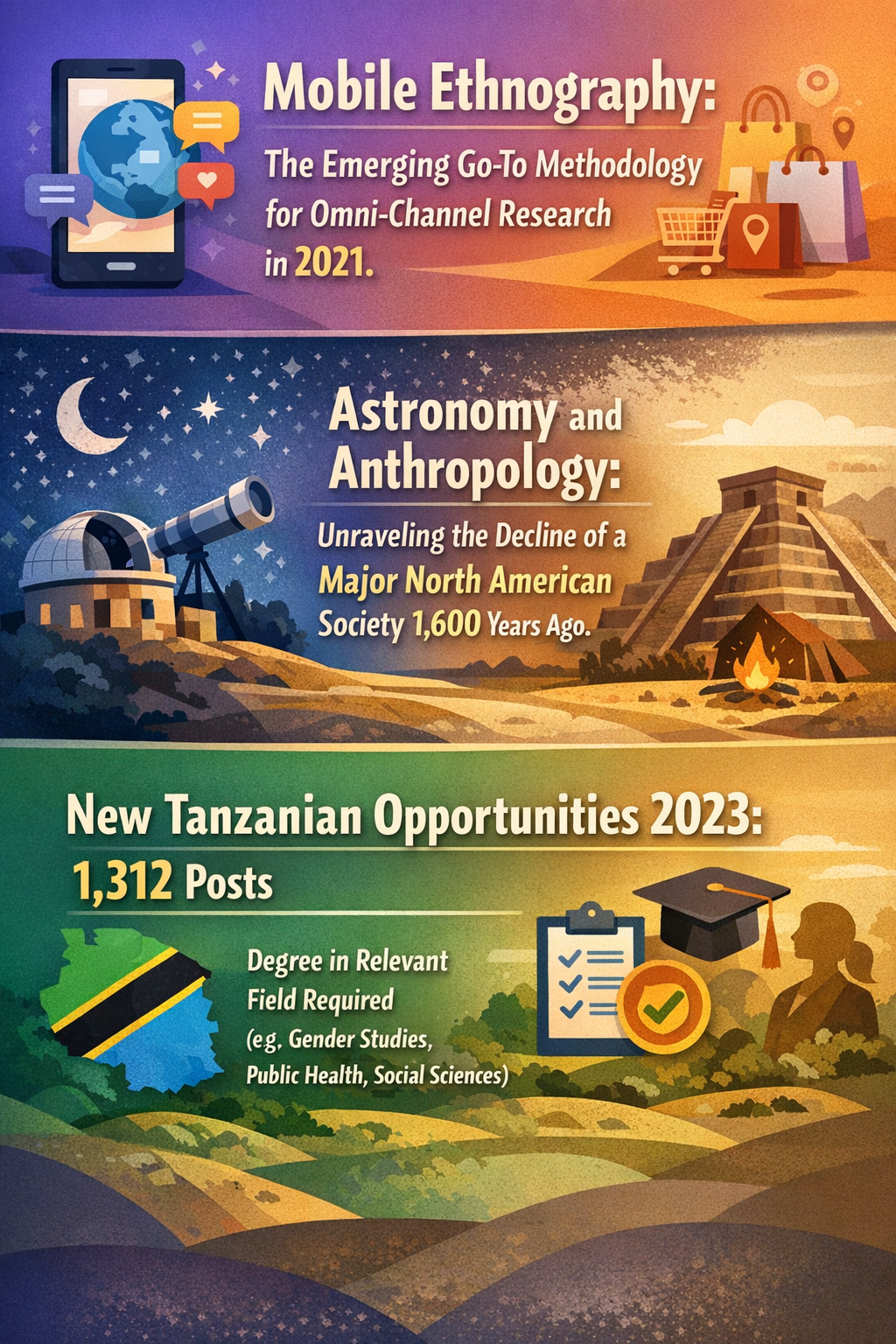
Third, evolving research methodologies in anthropology, such as mobile ethnography, position the discipline to capture real-time, multi-contextual human behaviors across digital and physical realms simultaneously (QRCA Views on Mobile Ethnography). This ability to integrate online-offline behaviors in naturalistic settings may revolutionize the accuracy and relevance of social insights used in policy and market forecasting.
Fourth, anticipatory anthropology—a forward-focused branch emphasizing vulnerabilities from climate change, automation, and biotechnologies—is gaining scholarly and practical momentum (Oxford Research Encyclopedia on Anticipatory Anthropology). This field highlights a novel approach where anthropological tools are harnessed for scenario planning and early warning systems that can detect “weak signals” of disruption before they become mainstream crises.
Finally, corporate and institutional hiring trends reveal a rising valuation of anthropology skills. Major enterprises like Infosys emphasize the importance of expertise in liberal arts, humanities, and anthropology to navigate workforce transformation and technological integration (Forbes on Infosys Hiring Trends). This reflects recognition that understanding human behavior, culture, and social systems is critical to adaptive and resilient organizational strategies in uncertain futures.
Why is this Important?
These shifts could dramatically alter how governments, corporations, and research institutions approach complex global challenges.
First, anthropology’s focus on cultural context and human variability could improve the effectiveness and equity of policies addressing social disruptions from climate change, technological unemployment, or health disparities. Standard predictive models often overlook nuanced social behaviors and power dynamics, which anthropological insights would better illuminate.
Second, emerging education and methodological innovations promise to enhance the quality of foresight data and scenario planning by adding depth and real-time adaptability. For example, mobile ethnography capturing multi-sensor data could refine real-world decision-making processes and consumer research that traditionally rely on static, retrospective sampling.
Third, anticipation methodologies rooted in anthropology may identify critical weak signals of change earlier than traditional quantitative trend analyses, allowing for more proactive interventions rather than reactive crisis management.
Fourth, widespread adoption of anthropological expertise in corporate strategies implies companies might better align technological innovation with human values, avoiding alienation and fostering sustainable business models that incorporate social inclusivity.
Implications
The integration of applied anthropology into strategic foresight and planning implies several potential disruptions and opportunities.
- Policy and Governance: Policymakers might increasingly rely on anthropological frameworks to co-design interventions with affected communities, reducing implementation failures caused by cultural misalignments. This could shift government practice towards anticipatory governance where futures literacy becomes embedded in public administration.
- Healthcare and Biotechnologies: Medical anthropology's biocultural approaches may trigger redesigns in global health strategies and biotech research that stress local knowledge and ethics alongside technological advances, improving treatment adoption and health outcomes.
- Research Methodologies: The rise of mobile ethnography and digital-anthropological methods could reshape market research, social science research, and even intelligence gathering by enabling continuous, real-world behavioral analysis bridging online-offline environments.
- Corporate Strategy: Organizations that invest in anthropology-informed foresight may better anticipate consumer shifts and labor market transformations, designing products and workflows that resonate across diverse cultural contexts, boosting resilience to disruption.
- Education and Workforce Development: Universities and training institutions may expand applied anthropology programs, equipping future professionals across sectors with skills to navigate complexity and plurality, enhancing cross-disciplinary innovation.
However, the transition to applied anthropology’s deeper inclusion faces challenges regarding scaling qualitative insights into actionable metrics, integrating ethnographic data into existing analytical systems, and balancing methodological rigor with responsiveness.
Questions
- How can governments institutionalize anticipatory anthropology frameworks to improve early detection of social and technological disruptions?
- In what ways can corporations embed mobile ethnography and other dynamic social methodologies into strategic market research for competitive advantage?
- What strategies might healthcare systems adopt to integrate biocultural anthropological insights into personalized medicine and global health interventions?
- How will education providers redesign curricula to prepare professionals capable of synthesizing anthropological foresight with emerging technologies?
- What ethical considerations arise when scaling ethnographic methods across digital platforms, and how should organizations address privacy and consent?
Keywords
applied anthropology; anticipatory anthropology; mobile ethnography; medical anthropology; biocultural approach; psychedelic therapy; ethnographic research
Bibliography
- The International Federation for Human Rights, Strategic Human Rights Litigation, and the Mexican Forensic Anthropology Team will be present to raise the alarm about the severity of the phenomenon of the disappearance of women and girls in Mexico. FIDH. https://www.fidh.org/en/region/americas/mexico/endemic-disappearances-of-women-and-girls-in-mexico-a-new-alert
- UK University will launch a psychedelic-oriented course to teach healthcare workers about therapy, neuroscience, anthropology, ethics, metaphysics, and research methods. Zoomies Canada. https://www.zoomiescanada.ca/could-uk-psilocybin-postgrad-impact-king-kong-mushroom-therapy-in-canada/
- Sensitively documenting and forecasting the impacts of climate change, global disruption, automation, and biotechnologies on vulnerable populations comprised some of the emerging frontiers of anticipatory anthropology that will call to a new generation of scholars and practitioners. Oxford Research Encyclopedia. https://oxfordre.com/anthropology/display/10.1093/acrefore/9780190854584.001.0001/acrefore-9780190854584-e-14?rskey=sOMfy4&result=1
- Enterprises like Infosys will employ more people with expertise in liberal arts, humanities, sociology, and anthropology. Forbes. https://www.forbes.com/sites/bernardmarr/2022/03/03/why-is-it-now-time-for-machines-to-replace-certain-jobs/
- Mobile ethnography, with its ability to capture video of both online and offline behavior, anywhere and anytime, will emerge as the go-to methodology for omni-channel research in 2021. QRCA Views. https://qrcaviews.org/2021/04/14/why-omni-channel-will-make-mobile-ethnography-a-staple-in-2021/
- Medical Anthropology considers how a biocultural approach can be applied to more effective prevention and treatment efforts and underscores medical anthropology’s potential to improve health around the world. Bokitba. https://www.bokitba.com/hello/pdf-medical-anthropology-a-biocultural-approach-4th-edition/