
The Rise of Workplace Psychophysiological Data as a Structural Inflection in Employee Experience
Emerging integration of industrial wearable biosensors with psychosocial workplace risk management heralds a subtle but profound shift in future Employee Experience (EX). This weak signal in real-time physiological and mental health data will reshape capital allocation, regulatory frameworks, and industrial structures over the next two decades.
While workplace safety, digital adoption, and mental health regulations are evolving independently, their convergence through biometric-enabled psychosocial hazard management forms a non-obvious systemic inflection. This intersection introduces a previously unrecognised dimension: continuous, quantified monitoring of workers’ psychophysiological states as an integral EX metric—not just productivity or engagement proxies. This shift could disrupt how governments and institutions like the Ministry of Health NSW govern workforce wellbeing, industrial risk, and compliance, extending far beyond current episodic or self-reported methods.
Signal Identification
This development is best classified as an emerging inflection indicator poised between a weak signal and systemic structural change given its technological nascency balanced with accelerating regulatory momentum. The infusion of smart industrial wearables with psychosocial hazard management in legislated contexts (e.g., Australian laws on mental health at work) exemplifies this (see below). The time horizon plausibly spans 10–20 years to achieve mass institutional integration and systemic transformation, with a medium plausibility band due to interdependencies in technology diffusion, regulatory evolution, and workplace cultural shifts.
Exposed sectors include healthcare providers burdened by workforce strain, industrial enterprises advancing workplace safety digitisation, governmental public health institutions responsible for large-scale occupational health risk governance, and technology providers in smart wearable markets (Persistence Market Research 13/03/2024), (Subscribe HR 11/01/2024).
What Is Changing
Across the references, several themes converge: growing deployment of smart industrial wearables designed for use cases such as workplace safety and productivity analytics, legal mandates on psychosocial risk management in Australian workplaces, and explicit workforce demands for legally codified work-from-home (WFH) policies reflecting new norms (Persistence Market Research 13/03/2024; Subscribe HR 11/01/2024; Teamed Global 04/02/2024).
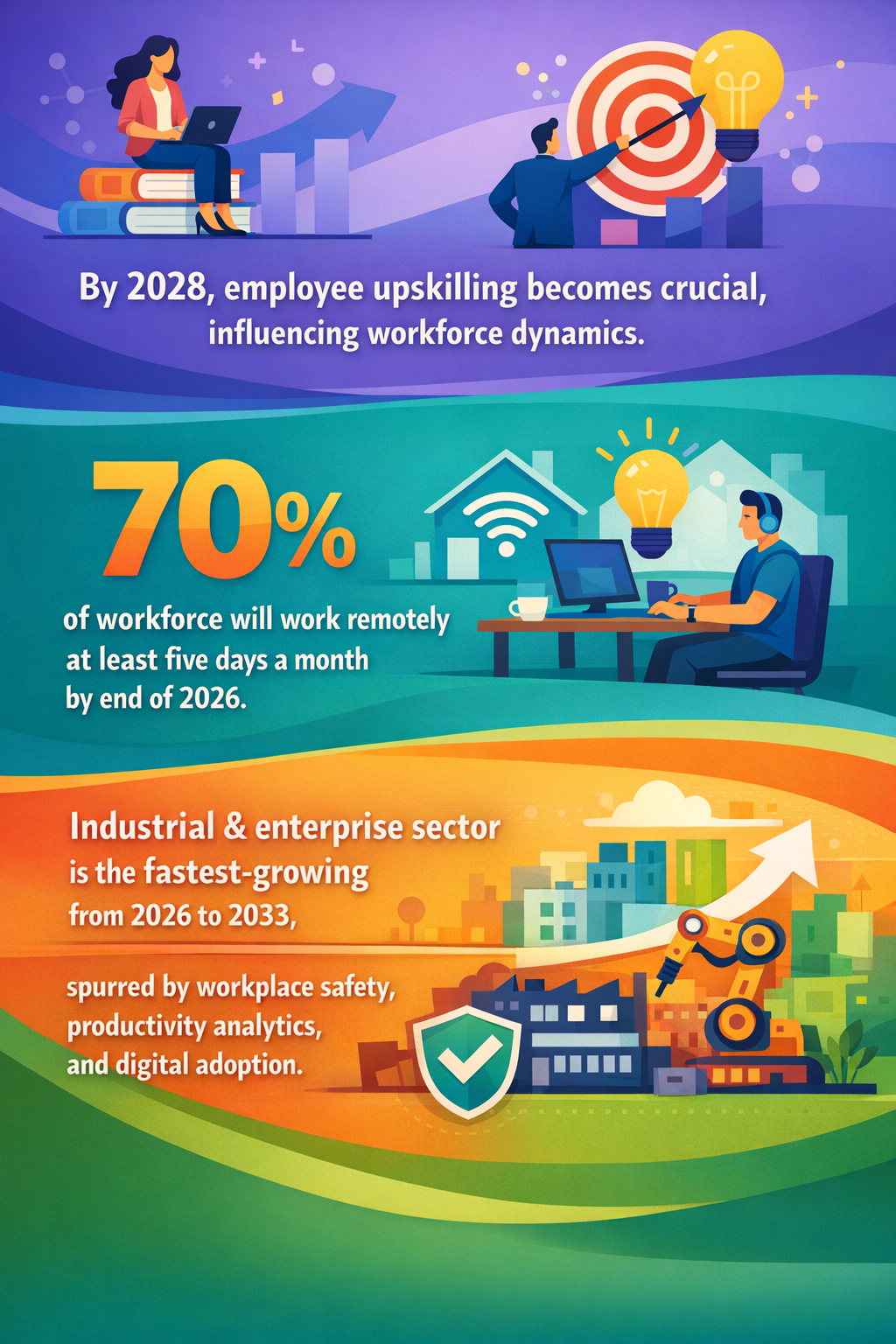
Individually, mental health workplace legislation (mandating management of psychosocial hazards) and digital monitoring (including remote work regulation policy frameworks) suggest a shift from episodic, reactive interventions to proactive, continuous risk management. The industrial & enterprise sector’s leading growth in smart wearable adoption foreshadows integration of biometric data streams with legal obligations on psychosocial safety (Persistence Market Research 13/03/2024).
Substantively new, and under-recognised, is the prospect that industrial wearable technologies designed primarily for physical safety and productivity may be adapted or augmented to capture mental health indicators—such as stress, fatigue, or cognitive load—that directly align with psychosocial hazard metrics in workplace regulations. This extends beyond existing Employee Assistance Programs (EAPs) and self-disclosed mental health surveys to potentially continuous, automated monitoring systems with compliance and risk governance applications.
This synthesized theme crosses the typical demarcations of occupational health, emerging tech, mental health policy, and digital work regulation into a hybrid nexus. For example, workplace mental health laws in Australia impose duties on employers to detect and mitigate psychosocial hazards (Subscribe HR 11/01/2024), but current enforcement and data instrumentation remain rudimentary and retrospective. The enhancement of these duties with biometric psychophysiological data capture methods may redefine regulatory expectations and worker-employer power dynamics.
Disruption Pathway
If the technological capacity to continuously monitor mental and physical states at scale converges with stringent psychosocial workplace regulations, organizations may be compelled to embed these systems to certify compliance and reduce liability. Early adopters in safety-critical sectors like healthcare and industrial manufacturing, already exposed to system stress from workforce strain and operational pressures (Alithya on LinkedIn 29/03/2024), may pioneer adoption as a risk mitigation strategy.
This could accelerate with conditions such as increased regulatory enforcement visibility, public reporting requirements, or worker bargaining power requesting more precise accommodation of mental health needs. The increase in wearables investment in the industrial & enterprise segment reflects broadening technology readiness (Persistence Market Research 13/03/2024).
Structural adaptation may follow: capital may flow disproportionately to integrated technology providers capable of combining psychophysiological sensing, secure data analytics, and compliance tooling. Regulatory frameworks might evolve from minimum standard-setting to detailed mandates on biometric data management, privacy, and usage. Industry standards bodies are likely to develop interoperable benchmarks to balance innovation with worker rights and data security.
This evolution can trigger feedback loops: improved monitoring drives better mental health outcomes, reducing absenteeism and healthcare costs, which incentivizes further adoption. Conversely, excessive data surveillance may provoke worker resistance, privacy litigation, or union opposition, creating political and reputational risks influencing governance models.
Dominant industrial structures dependent on episodic manual risk audits risk displacement. Similarly, governance models anchored solely in self-reporting or retrospective assessments may lose legitimacy as automated, continuous systems prove more effective. This signal could thus presage a paradigm shift towards data-driven psychosocial risk governance integrated inside the Employee Experience ecosystem.
Why This Matters
For senior decision-makers across government and industry, this signal affects capital allocation as investments in smart wearables and data platforms align with evolving psychosocial regulatory obligations. Ministries of Health and regulators must anticipate new compliance regimes integrating biometric monitoring, influencing legal liability frameworks and worker rights protections (Subscribe HR 11/01/2024).
Strategically, organisations not positioning to integrate continuous psychosocial monitoring risk being out-complied or outperformed as mental health becomes a calculable risk factor, impacting competitive positioning in sectors fraught with workforce strain such as healthcare (Alithya on LinkedIn 29/03/2024).
Supply chains and industrial structures might also shift as smart wearable manufacturers consolidate and expand into psychosocial domains. Governance implications include heightened data stewardship responsibilities and potential redefinition of employer-worker relationships, especially as work moves increasingly remote and hybrid controls require new policy codifications (Teamed Global 04/02/2024).
Implications
This signal might herald a structural transformation of Employee Experience governance by embedding psychophysiological data streams into occupational health ecosystems. It could reshape expenditure patterns towards integrated health-tech solutions and generate new regulatory classes governing data-driven psychosocial risk. Such change is likely to move beyond nascent mental health policies constrained by self-disclosure or traditional audits.
However, this is not a short-term fad tied to transient remote-work anxieties or incremental DEI (Diversity, Equity, and Inclusion) policy updates (SmartHCM 10/01/2024). Rather, it reflects an underappreciated technological-regulatory convergence with potential to structurally recalibrate capital deployment, workplace governance, and industrial safety norms.
Alternative interpretations may see privacy backlash, slow adoption due to cost or cultural resistance, or fragmented regulatory acceptance limiting scale. Yet, given the accelerating pressures in mental health governance and the rapid growth trajectory of smart wearables in industrial sectors, these countervailing forces might act more as brakes delaying than negating the eventual transformation.
Early Indicators to Monitor
- Regulatory consultations or drafts explicitly mandating biometric data use for psychosocial risk management.
- Venture funding surges in smart wearable startups pivoting towards mental health sensing and analytics.
- Formation of industry standards bodies or interoperability consortia integrating psychosocial biometrics.
- Public procurement by healthcare providers or large industrial firms for wearable technologies embedding stress/fatigue monitoring.
- Legal cases or liability claims referencing digital psychophysiological evidence in workplace mental health disputes.
Disconfirming Signals
- Legal rulings curtailing employer rights to collect or use biometric mental health data in workplace assessments.
- Negative worker union campaigns or mass resistance against in-workplace biometric surveillance.
- Technological failures in reliability or ethical data governance causing abandonment of pilot implementations.
- Emergence of equally effective non-digital psychosocial risk management frameworks preserving current governance models.
- Regulatory rollback or stagnation in psychosocial hazard law enforcement and scope expansion.
Strategic Questions
- How should capital be allocated to balance investment in biometric-enabled psychosocial monitoring against potential legal and ethical risks?
- What governance frameworks must be developed to align continuous psychophysiological data collection with privacy, equity, and worker autonomy standards?
Keywords
Employee Experience; Psychosocial Risk; Smart Wearables; Workplace Mental Health; Occupational Health Regulation; Biometric Data; Workforce Wellbeing; Industrial Safety; Mental Health Legislation; Digital Workplace Governance
Bibliography
- Fastest-growing Application: Industrial & enterprise is anticipated to be the fastest-growing segment from 2026 to 2033, driven by workplace safety, productivity analytics, and digital adoption. Persistence Market Research. Published 13/03/2024.
- 2026 mental health workplace in ANZ Several factors converge to make 2026 a watershed year: Regulatory evolution: Australia's world-leading legislation requiring employers to manage psychosocial hazards creates legal obligations around workplace mental health. Subscribe HR. Published 11/01/2024.
- Policy expectations: US staff expect explicit written work-from-home policies covering hours, equipment, expenses, and performance expectations. Teamed Global. Published 04/02/2024.
- Healthcare providers are entering 2026 with strong expectations for growth, but their ability to deliver hinges on how well they manage systemic risk, workforce strain, and mounting operational pressure. Alithya on LinkedIn. Published 29/03/2024.
- In 2026, DEI policies will focus on reducing bias in recruitment, promoting equal pay, supporting women in leadership, and fostering respectful workplace behaviour. SmartHCM. Published 10/01/2024.