
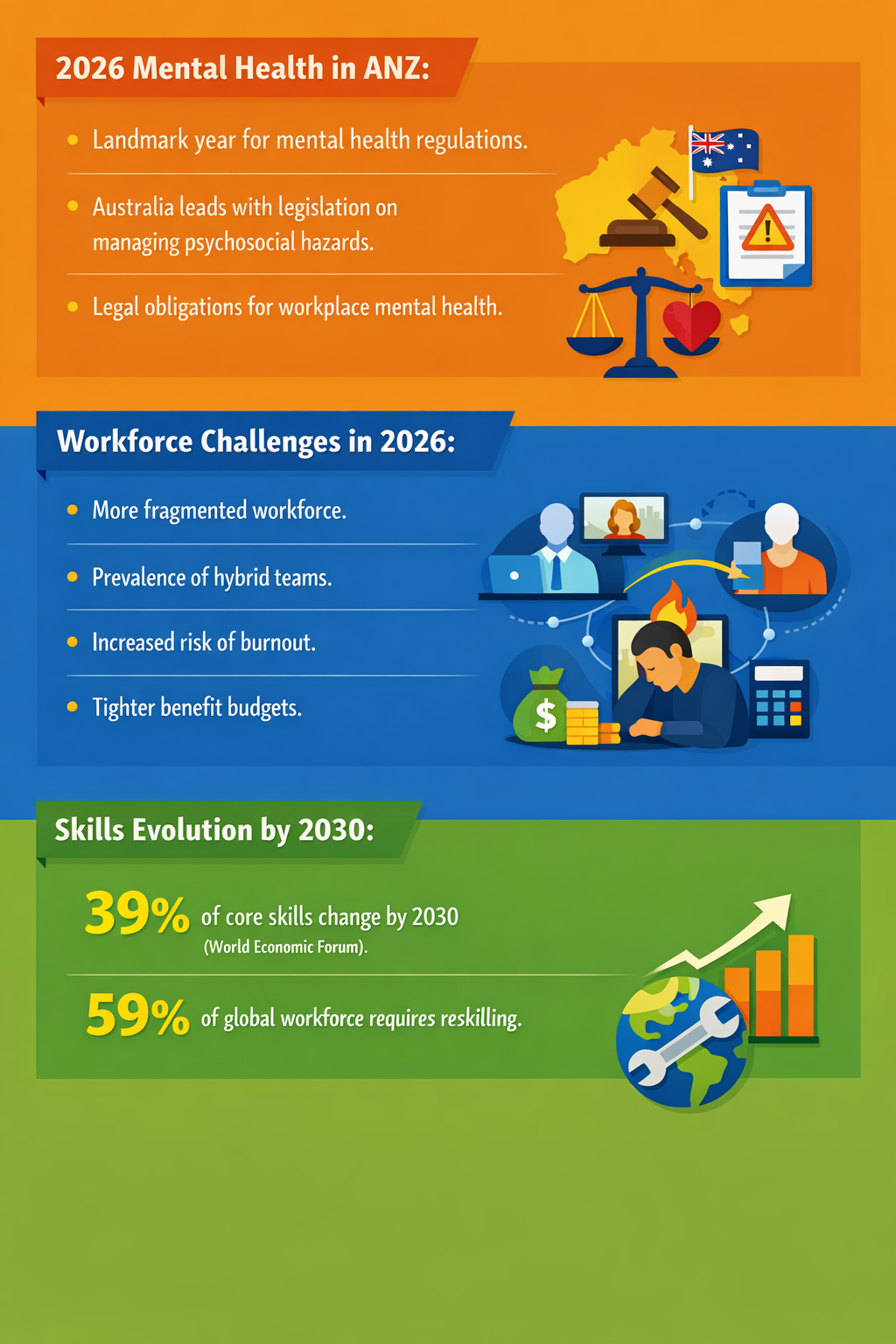
The Latent Fragmentation of Workforce Experience as a Catalyst for Structural Reconfiguration
Emerging disaggregation of workforce experience signals a nascent inflection in organisational design, employee engagement, and regulatory regimes. Beyond hybrid work or reskilling headline trends lies a subtler fragmentation of employee experience encompassing psychosocial, spatial, and systemic dimensions. This under-recognised dynamic could induce structural transformation in capital allocation, industrial boundaries, and governance over the next 5 to 20 years.
The fragmentation of workforce experience manifests in increasingly differentiated modes of work, wellbeing expectations, and skill ecosystems, complicating traditional workforce management and capital productivity. It extends beyond operational tweaks toward a foundational redefinition of how the workforce interface with industry and state stakeholders. Recognizing this fragmentation as an inflection indicator exposes opportunities and risks for senior decision-makers anticipating long-term industrial strategy, risk governance, and regulatory frameworks.
Signal Identification
This development is classified as an emerging inflection indicator because it evidences a fundamental alteration in the workforce’s configuration and institutional interface likely to scale structurally rather than remain a transient trend. While hybrid work and digital upskilling dominate discourse, the deeper disaggregation of workforce experience—psychosocial hazards, differentiated wellbeing needs, spatial hubs, and role fragmentation—remains underappreciated.
The plausibility band is high given mounting evidence across multiple sectors facing intensified fragmentation pressures. The time horizon for scaling into systemic change is medium to long term (5–20 years), as regulatory, capital, and industrial adjustments catch up to these workforce transformations. Exposed sectors include technology, microelectronics manufacturing, healthcare, government services, and global knowledge work, all experiencing overlapping stressors (Summit Health Benefits 01/02/2026; Microelectronics US 10/01/2026).
What Is Changing
Multiple intersections reveal a structural shift in workforce experience towards fragmentation across psychosocial, spatial, and functional dimensions. Mental health in the workplace is transcending wellness initiatives into legally mandated employer responsibilities around psychosocial hazards in jurisdictions like Australia (Subscribe HR 15/01/2026). This legal evolution expands employer liability and regulatory oversight, forcing deeper organisational accountability beyond traditional health and safety norms.
Simultaneously, physical and mental wellbeing interventions are increasingly tied to hyper-local engagement initiatives, as seen in Dubai’s ‘Vibrant Dubai’ and ‘Barzat Dubai’ schemes, which combine social cohesion with health imperatives (Economy Middle East 20/01/2026). These initiatives recognize that workforce experience fragmentation includes spatial and community dimensions, challenging conventional workplace boundaries and requiring new governance models that integrate urban planning and social infrastructure.
The digital shift reinforces fragmentation externally and internally. While 70% of the workforce will be remote at least five days monthly by end-2026 (Pact and Partners 05/02/2026), administrative and ancillary roles increasingly fragment into virtual assistant jobs, creating layered remote workforce niches (Work in Virtual 12/02/2026). This functional differentiation introduces complex challenges for workforce cohesion, operational integration, and compensation frameworks.
Upskilling and reskilling campaigns exemplify systemic response attempts to this fragmentation, but also deepen it by creating uneven skill trajectories within organisations and sectors. The Microelectronics US initiative highlights cooperation between corporate, government, and academia to secure talent pipelines—yet this sector-specific ecosystem bifurcates workforce experience depending on education access and occupational clustering (Microelectronics US 10/01/2026).
Repeated themes include employee burnout risk amidst tighter benefit budgets (Summit Health Benefits 01/02/2026), growing CEO prioritisation of AI-driven reskilling (83% by 2026) (Working Voices 08/01/2026), and the persistent need to reconcile productivity with mental health and physical wellbeing investments (Capital Analytics Associates 22/01/2026).
Disruption Pathway
The fragmentation of workforce experience may escalate through accelerating regulatory mandates that expand employer accountability for psychosocial as well as physical workplace hazards, starting in leading jurisdictions like Australia (Subscribe HR 15/01/2026). This imposes deeper operational complexity and requires novel governance frameworks integrating health, safety, and employee engagement in multidimensional ways.
Financial pressures from tightening benefit budgets amid rising wellbeing needs may intensify cost-benefit tensions, forcing firms to reconsider capital allocation toward employee experience investments as a strategic competitive factor (Summit Health Benefits 01/02/2026). Those who fail to internalize this shift risk workforce attrition and productivity loss.
The increasing spatial fragmentation, with hybrid and remote modalities blending synchronous and asynchronous controls, may stress existing organisational culture and collaboration models. Initiatives like Dubai’s local ‘hubs’ for physical engagement illustrate emergent hybrid governance structures layering community health and workforce wellbeing, hinting at a new social contract between employer and employee beyond traditional workplace perimeters (Economy Middle East 20/01/2026).
The nascent bifurcation within the workforce regarding skill pathways and job segmentation—augmented by AI-driven reskilling priorities—may exacerbate inequality within labour markets, catalyzing structural shifts in industrial composition. This could provoke adaptive responses in supply chains, with firms sourcing talent and subcontracting differently based on specialised skill clusters (Microelectronics US 10/01/2026; Working Voices 08/01/2026).
Feedback loops may arise as fragmented workforce experiences erode organisational loyalty and increase volatility in labour supply-demand dynamics, prompting iterative regulatory intervention and capital reallocation toward differentiated human capital strategies. Over time, this could induce paradigmatic shifts in industrial and regulatory models governing labour, from contract structures to occupational health mandates.
Why This Matters
Senior leaders face critical exposure regarding capital deployment into workforce experience infrastructure, balancing cost pressures with emergent wellbeing and legal obligations. Firms may need to anticipate segmented investment strategies that hedge across multiple workforce archetypes, including remote virtual roles, local physical hubs, and highly specialised reskilling pipelines.
Regulatory frameworks could shift from siloed occupational health and safety toward integrative psychosocial hazard management, with direct implications for compliance costs and litigation risk. This fragmentation challenges traditional industrial organisation assumptions by inserting workforce experience as a multidimensional variable driving productivity and risk governance.
Supply chains reliant on specialised skill clusters or remote/virtual workforces might confront resource allocation and talent reliability challenges, altering competitive positioning and potentially driving vertical or horizontal restructuring. Liability shifts toward workplace mental health could redefine employer obligations globally, with ripple effects on insurance, worker compensation, and social welfare systems.
Implications
This fragmentation may lead to structural change rather than transient noise, requiring firms and regulators to adopt multidimensional workforce experience frameworks that integrate spatial, psychosocial, and functional considerations. It is unlikely to be adequately addressed through current standard hybrid work or reskilling programs alone.
The development is not a mere extension of remote work or AI skills revolution per se, but a systemic reconfiguration of workforce segmentation encompassing well-being, legal, spatial, and industrial dynamics.
Competing interpretations might frame this as cyclical human capital management challenges or as an evolution of digital work modalities. However, the integration of legal psychosocial hazard mandates and local community health initiatives signals a broader paradigm shift in how workforce experience influences industrial and regulatory architectures.
Early Indicators to Monitor
- Emerging regulations expanding psychosocial hazard responsibilities beyond leading jurisdictions
- Investment patterns prioritising integrated wellbeing infrastructure combining digital and local physical hubs
- Fragmentation in labour market metrics indicating growing role and skill pathway differentiation
- Rising venture capital flow into segmented workforce experience technologies and services
- Standard-setting activity linking workplace mental health, spatial planning, and employment law
Disconfirming Signals
- Regulatory reversals or delays in adopting psychosocial hazard frameworks
- Reduction in capital allocation toward wellbeing or spatial engagement initiatives
- Corporate re-centralisation of workforce models reducing fragmentation
- Technological or organisational breakthroughs simplifying workforce experience management into traditional frameworks
- Economic shocks forcing short-term cost cutting on wellbeing and splintered workforce initiatives
Strategic Questions
- How should capital allocation strategies evolve to accommodate increasingly fragmented workforce experience demands?
- What governance models and regulatory compliance frameworks can effectively manage psychosocial hazards across diverse work modalities?
Keywords
Workforce fragmentation; Psychosocial hazards; Hybrid workforce; Workforce reskilling; Workplace wellbeing; Remote work; Industrial restructuring; Regulatory adaptation
Bibliography
- In 2026, the workforce is more fragmented: hybrid teams, high burnout risk, and tighter benefit budgets. Summit Health Benefits. Published 01/02/2026.
- 2026 mental health workplace in ANZ Several factors converge to make 2026 a watershed year: Regulatory evolution: Australia's world-leading legislation requiring employers to manage psychosocial hazards creates legal obligations around workplace mental health. Subscribe HR. Published 15/01/2026.
- The 'Vibrant Dubai' scheme was introduced to bolster the physical and mental health of Dubai Government staff, while the 'Barzat Dubai' project will create innovative local hubs for neighborly engagement. Economy Middle East. Published 20/01/2026.
- Microelectronics US will serve as the bridge between corporate HR, government, and academia - addressing upskilling, apprenticeships, and STEM pipeline expansion to secure the workforce of tomorrow. Microelectronics US. Published 10/01/2026.
- 70% of the workforce will be remote at least five days a month by end of 2026. Pact and Partners. Published 05/02/2026.
- 83% of CEOs are prioritising workforce reskilling to unlock AI's potential. Working Voices. Published 08/01/2026.
- Investments in workforce retention and operational efficiency are expected to remain strategic priorities throughout 2026. Capital Analytics Associates. Published 22/01/2026.