Our Scans
·
Energy Transition
·
Trend Tracker
Analysis of recent evidence across the Energy Transition domain reveals several distinct, high-momentum signals reflecting evolving risks and opportunities. These center on climate adaptation challenges, supply chain vulnerabilities related to critical minerals and infrastructure resilience, accelerating policy and technological shifts in decarbonization, and emerging socio-political dynamics influencing global trade and cooperation. Intersecting systemic risks from climate change and geopolitical fragmentation are becoming more pronounced as supply chains face compounded shocks. Meanwhile, innovation and resilience strategies such as circular economy adoption and carbon market evolution highlight transformational drivers shaping future pathways.
| Signal Name / Theme |
Direction |
Relative Frequency / % Change |
Short Commentary |
| Climate Adaptation Shortcomings and Increasing Extremes |
Accelerating |
High – growing policy attention and multiple reports in 2026 |
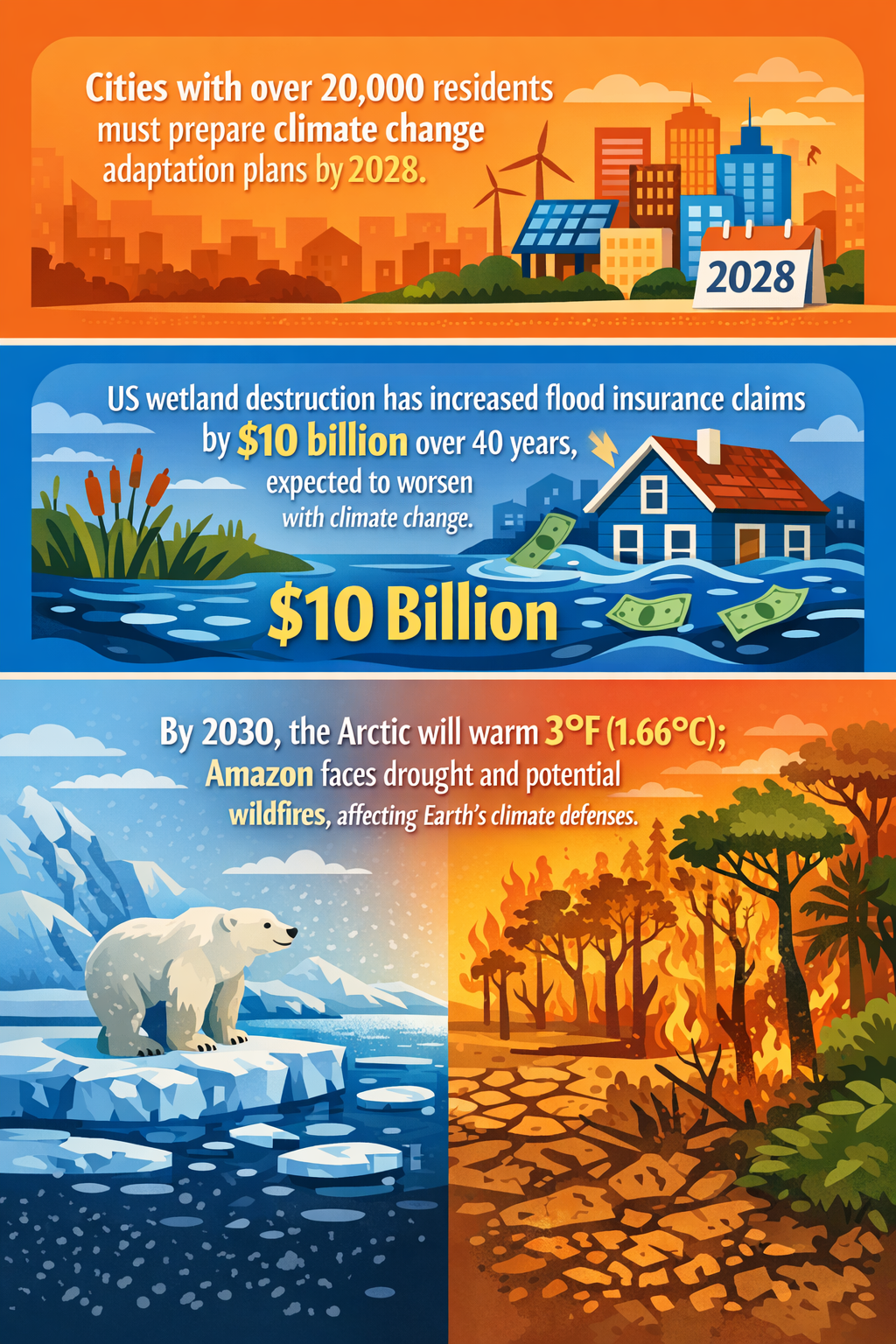
Multiple sources highlight rising climate disasters (heatwaves, droughts, floods), insufficient adaptive capacity especially in small/medium cities and supply chain infrastructure, signaling urgent and escalating risks to economic stability and critical goods access (UNEP Climate Action, MTA-LIRR Audit 2026, Springer Small/Medium Cities, NBCDFW Heat Records). |
| Supply Chain Vulnerability to Climate & Geopolitical Risks |
Accelerating |
High – wide coverage and emphasis in 2026 foresight reports |
Evidence stresses multi-layer supply chain fragility driven by concentrated critical minerals, chokepoints, and increasing climate/geopolitical shocks, pointing to systemic risk accumulation and calls for strategic resilience planning (UK Govt Science Foresight 2026). Emergence of friendshoring, nearshoring and strategic diversification reflects evolving firm and policy responses. |
| Decarbonization & Clean Energy Transition in Buildings and Infrastructure |
Accelerating |
Moderate to High – rising policy targets and technology rollout |
Ambitious electrification and energy intensity reduction targets for buildings signal faster momentum in sector decarbonization, focusing on heat pumps, grid-interactive buildings, and energy efficiency, yet highlight implementation gaps (UNEP Spotlight on Buildings). |
| Circular Economy as a Climate Adaptation and Decarbonization Resource |
Accelerating |
Growing visibility in policy and supply chain discourse |
Circular models are gaining ground as strategic levers to reduce raw material dependency, especially for critical minerals tied to clean tech, while reshaping international trade flows toward more sustainable value chains (UK Government Report Annex). |
| Increasing Air Pollution and Public Health Impacts Related to Energy Infrastructure |
Stable to Accelerating |
Steady coverage with signals of localized spikes |
Although overall US air quality has improved, localized air pollution tied to energy infrastructure, including fossil fuel reliance for data centers and their backup generation, creates growing public health concerns, especially in disadvantaged communities (US Air Pollution Analysis). |
Pattern Narrative
The strongest momentum clusters around growing awareness and evidence of climate adaptation deficits across municipalities, transport infrastructure, and supply chains. This accelerating risk pattern is driven by increasing frequency and severity of climate disasters and insufficient preparedness, amplified by governance gaps at local and national levels. The interconnection of climate and geopolitical uncertainties compounds the vulnerability of critical supply chains, especially around concentrated resources and chokepoints, necessitating systemic and coordinated resilience strategies.
Simultaneously, clean energy transition efforts, notably electrification of buildings and infrastructural modernization, display an accelerating trajectory but reveal significant implementation challenges that must be addressed to meet ambitious targets. The circular economy is rapidly emerging as a cross-sector transformational driver, offering opportunities for material circularity to mitigate supply constraints and environmental impact associated with the energy transition.
Underlying these are persistent environmental health concerns. Notwithstanding national progress in air quality, localized air pollution from energy systems, particularly fossil fuel-dependent backup generation and aging grid infrastructure, remains a stable to accelerating public health risk disproportionately borne by marginalized communities, exposing ethical and regulatory gaps.
Implications & Next Steps
- Monitor developing adaptation policies and climate disaster frequencies, prioritizing interventions in vulnerable urban and infrastructure contexts, especially small/medium municipalities lagging in planning (Springer Study).
- Advance systemic supply chain resilience through multi-level data transparency, network mapping, and targeted interventions in system-critical chokepoints and nexus suppliers for key minerals and components (UK Foresight Report).
- Accelerate and scale deep decarbonization in building sectors via policy incentives, stringent building codes, and investment in smart technologies (UNEP Climate Spotlight).
- Embed circular economy principles in industrial and trade policy to reduce new resource dependencies and foster innovation in material reuse (UK Govt Circular Economy).
- Enhance localized air quality management targeting industrial and energy sector emissions with particular focus on environmental justice communities (US Air Pollution Analysis).
Signals Gaining Momentum (Top 5)
- Escalating climate adaptation gaps and extreme weather impacts across urban, infrastructure, and supply chain systems.
- Growing strategic focus on supply chain vulnerabilities under combined climate and geopolitical pressures, especially related to critical minerals and chokepoints.
- Policy and technology acceleration in building electrification and energy efficiency efforts tied to decarbonization targets.
- Rapidly rising visibility and implementation of circular economy principles as key resource and resilience strategies.
- Localized air pollution concerns linked to energy infrastructure, especially in marginalized communities, with growing public health awareness.
Wild Cards to Watch
Sudden Shifts in Major Ocean Currents (e.g., Atlantic Subpolar Gyre)
- Potential Impact: Very High
- Surprise Characteristics: Low-frequency, nonlinear climate system change outside mainstream near-term expectations.
- Early Warning Indicators: Oceanographic measurements showing abrupt circulation changes; extreme weather anomalies in North Atlantic and European systems.
- Commentary: A rapid reorganization of ocean currents could dramatically alter regional climate patterns, disrupting agriculture, energy systems, and supply routes across multiple continents, creating correlated global shocks and unprecedented supply chain instability (UK Foresight Report).
Early, Extended Ice-Free Arctic Navigation Season
- Potential Impact: High (Opportunity and Risk)
- Surprise Characteristics: Earlier than expected operationalization of Arctic shipping routes with logistical and geopolitical ramifications.
- Early Warning Indicators: Satellite sea ice data; commercial Arctic transit records; insurance and maritime traffic shifts.
- Commentary: Earlier functional ice-free conditions could shorten shipping routes, altering global trade flows, reducing pressure on chokepoints but introducing new regulatory, security, and environmental challenges (UK Foresight Report).
Global Government Emergence
- Potential Impact: Very High (Disruptive Opportunity)
- Surprise Characteristics: Radical and rapid geopolitical convergence toward unified global governance beyond current multipolar fragmentation trends.
- Early Warning Indicators: Accelerated treaty formations; expansion of supranational regulatory frameworks; cross-bloc cooperation in climate/ trade policy.
- Commentary: Centralized global governance could drastically reduce trade barriers and improve cooperative disaster responses, fostering systemic resilience but also raising systemic failure risks if mismanaged (UK Foresight Report).
Cascading Climate Extremes Harden Rival Trade Blocs
- Potential Impact: Very High (Disruptive Risk)
- Surprise Characteristics: Rapid succession of severe climate shocks triggers abrupt geopolitical realignments and protectionist trade fragmentation.
- Early Warning Indicators: Multiple simultaneous crop failures; sustained maritime chokepoint disruptions; escalation of export controls and bilateral currency settlements.
- Commentary: Intensifying climate shocks could catalyze sharp geopolitical divides, economic fragmentation, and supply chain disruptions that amplify risks for medium-sized, trade-dependent economies (UK Foresight Report).
Large-Scale Cyber-Attacks on Critical Infrastructure
- Potential Impact: Very High (Disruptive Risk)
- Surprise Characteristics: Coordinated, widespread cyberattacks targeting civilian and critical infrastructure beyond current episodic patterns.
- Early Warning Indicators: Rising geopolitical tensions in cyber domain; increasing sophistication of cybercriminal networks; frequent isolated infrastructure disruptions.
- Commentary: Escalated cyber warfare could paralyze transport, power, and communication networks vital to supply chain continuity and national security, underscoring need for robust cybersecurity and contingency plans (UK Foresight Report).
Briefing Created: 20/06/2026