
Headline & Summary:
Analysis across multiple industry reports and articles for 2026 reveals converging momentum in key AI and automation signals. The most prominent patterns include accelerated adoption of AI-driven automation in workflows across sectors such as mining, marketing, construction, healthcare, workforce planning, and cybersecurity. Complementing these are emergent demands for hybrid human-AI skills, evolving risks linked to AI-enabled cybercrime, and transformative shifts in business operating models. Meanwhile, regional market dynamics and industry-specific deployments portray sectoral nuances, but overarching is the trend toward embedding AI deeply into operational, strategic, and talent frameworks. This suggests the next inflection points will revolve around governance maturity, human-machine collaboration, AI operationalization at scale, and risk management frameworks, driving both opportunity and challenges.
| Signal / Theme | Direction | Relative Frequency / Change | Short Commentary |
|---|---|---|---|
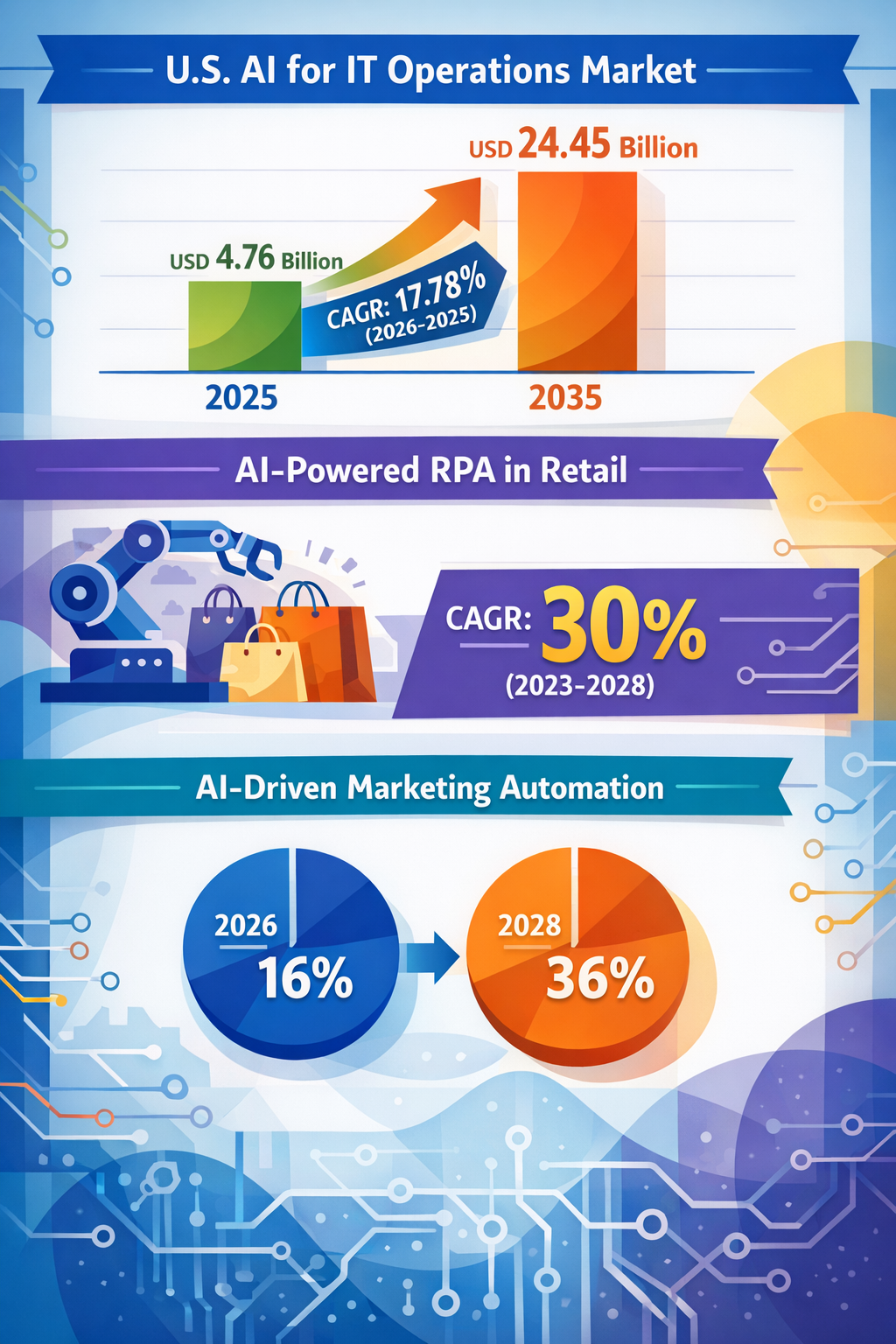
| AI-Driven Workflow Automation & Operational Integration | Accelerating | Significant increase in adoption and operational maturity; AI marketing workflows expected to more than double automation from 16% (2026) to 36% (2028) (Tru Performance) | AI is shifting from tool addition to full operating model redesign across sectors including marketing, healthcare, and mining, removing manual stitching layers and enabling continuous data-driven execution. |
| Acceleration of AI in Mining Automation and Autonomous Operations | Accelerating | Market projected to grow CAGR 10.8% (2026-2033), with major deployments of autonomous electric mining trucks and AI-based fleet solutions (Persistence Market Research) | Mining operations are moving toward fully autonomous, self-managing fleets supported by 3D mapping, AI analytics, and remote operation centers, driven by labor shortages and safety imperatives. |
| Workforce Transformation: Hybrid Skills and Role Redesign | Accelerating | 56% of employers see AI as key to productivity; 70% professionals open to upskilling; significant reshaping of entry-level roles (Reed.com) | AI automates low-complexity work, prompting demand for workers who combine technical AI literacy with human skills (empathy, judgment), necessitating redesign of career pathways and talent strategies. |
| Surging AI-Driven Cybersecurity Threats & Defensive Automation | Accelerating | AI-powered cyber attacks growing rapidly; increases in AI-enabled ransomware, phishing, and supply chain threats; parallel rise in investment in AI defense tools (Boston Institute of Analytics) | Cybercriminals leverage AI to scale attacks with automation and social engineering, propelling organizations to adopt AI threat detection, behavioral analytics, and Zero Trust models at unprecedented rates. |
| Broad AI Adoption in Marketing & Public Relations | Accelerating | 76% of PR pros use generative AI; AI and automation expected as top growth factor by 59% of PR professionals; 91% marketers actively use AI (Sprout Social, Tru Performance) | AI transitions PR and marketing teams from manual task execution to strategic, AI-augmented workflows with a focus on measurement, governance, and creative judgment. |
| Healthcare Workflow Automation and AI-Enabled Process Efficiency | Accelerating | Rapid expansion in automation for administrative, scheduling, and reporting functions across healthcare organizations (Amerit Consulting) | Automation reduces workforce burden amid staffing shortages, enhances patient access, supports compliance reporting, and transforms workflow consistency, emphasizing integration with workforce strategies. |
The analyzed evidence signals a robust acceleration of AI as an embedded operational driver rather than a standalone technology addition. Across sectors, AI is progressing from experimental pilots to mission-critical, integrated platforms managing complex workflows end-to-end. Mining exemplifies this with autonomous haulage evolving toward self-managing fleets empowered by AI and 3D mapping, highlighting cross-sector synergies in AI-enabled autonomy and safety improvements.
Simultaneously, the labor market and talent development models are undergoing transformation. The automation of routine roles is reshaping entry points into the workforce and elevating the premium on hybrid skills blending technical AI know-how with uniquely human abilities like empathy and judgment. This creates a feedback loop: increased AI assimilation drives demand for AI-savvy talent, requiring new educational partnerships and upskilling frameworks.
However, this progress invites evolving risks, notably from AI-enhanced cybersecurity threats, underlining the dual-use nature of AI technologies. Organizations face a balancing act between leveraging AI for efficiency gains and investing proportionately in defensive cyber capabilities. The PR and marketing domain echoes this shift, where AI adoption comes with governance, transparency, and authenticity challenges.