
Headline & Summary
Recent evidence within the domain of Urbanisation & Megacities indicates robust momentum in several transformative signals. Key themes include the rapid evolution of sustainable and digitally integrated urban mobility solutions, the demographic shifts driven by aging populations impacting urban economic and social structures, and innovative transportation infrastructure breakthroughs promising to reshape regional connectivity. These signals mostly show accelerating trajectories, underpinned by technological advances, policy shifts, and socio-economic challenges. Emerging clusters reveal a trend toward integrated, data-driven sustainable urban systems coupled with significant demographic-driven economic risks and opportunities.
| Signal Name / Theme | Direction | % Change / Relative Frequency | Short Commentary |
|---|---|---|---|
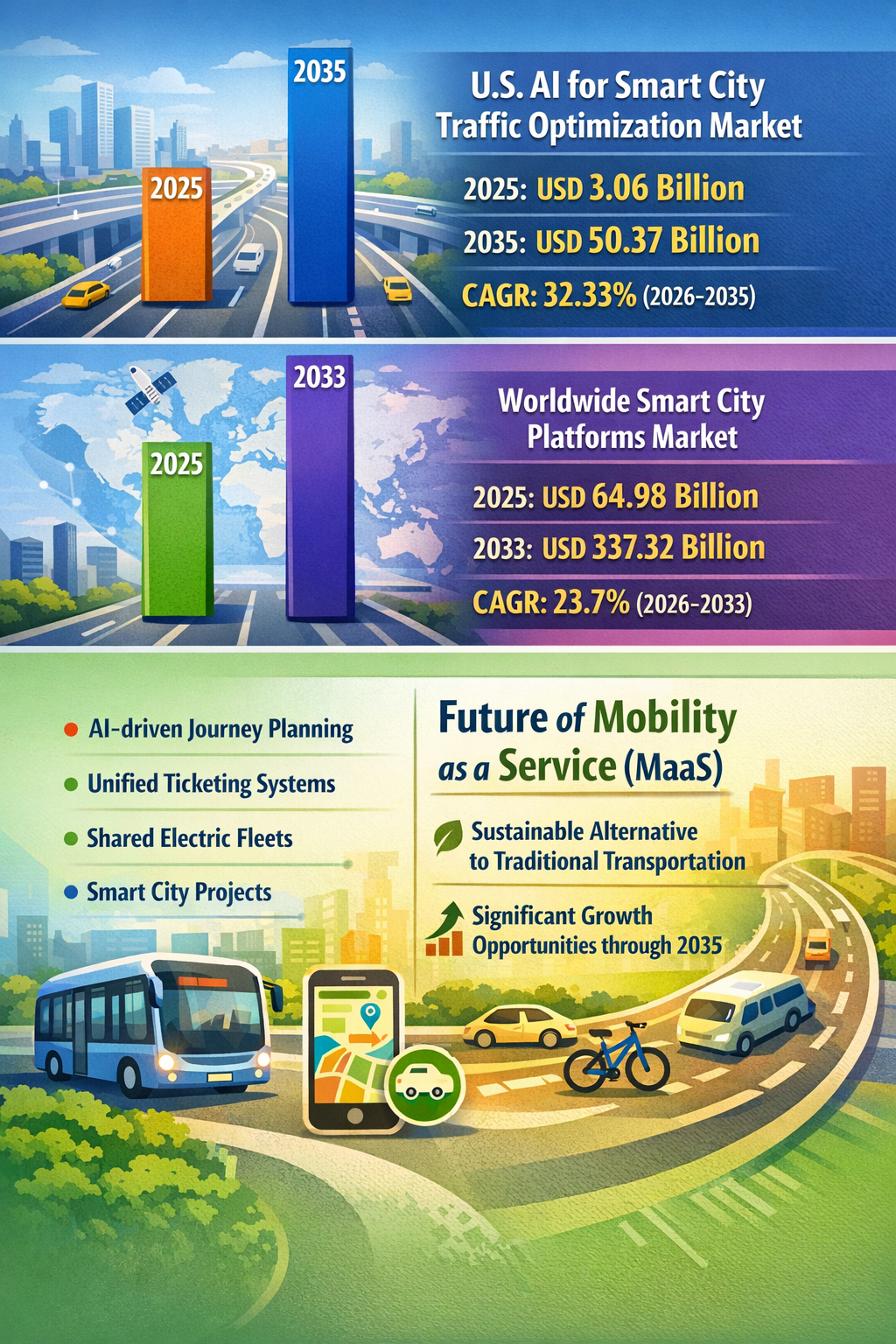
| Mobility as a Service (MaaS) Expansion & AI Integration | Accelerating | Market CAGR 16.7% (2026-2035) | Rapid growth driven by smartphone penetration, urbanization, and smart city projects; AI-enabled journey planning and integrated payment platforms drive adoption, shifting urban transport from ownership to service model (Precedence Research). |
| Demographic Aging & Urban Economic Impacts in China | Accelerating | Population aging ratio projected to rise to 55% elderly-to-working-age by 2050 | Rapid aging challenges workforce size, pension systems, and urban economic vitality; urbanization strategies and rural-urban mobility reforms key to mitigating economic slowdowns (RAND Corporation). |
| Built Environment-Driven Sustainable Transportation Transitions | Stable to Accelerating | 21% projected reduction in vehicle transport demand by 2060 via 5D urban design improvements | Localized, fine-grained urban design (density, diversity, design, destination accessibility, transit proximity) offers concrete pathways to achieving macro-level carbon goals, informing urban policy and renewal (Nature). |
| High-Speed Maglev Rail Innovation | Accelerating | Record speed achieved at 603 km/h; new technological benchmarks set | Breakthrough in ultra-high-speed rail offers potential to disrupt air travel and urban connectivity models; environmental benefits from electric propulsion align with sustainability goals (GSAP News). |
| Urbanization & Rural-Urban Economic Integration (China Hukou Reform) | Stable | Urbanization rate ~65%; potential growth hinge on migration policy relaxation | Continued reforms on internal migration system (hukou) critical to unlocking further urban economic growth via labor mobility and improved service access, yet challenges remain due to aging rural populations (RAND Corporation). |
Pattern Narrative
The intersection of rapid urbanization, demographic change, and technological advancement forms the backbone of current and emerging urbanisation dynamics. The accelerating adoption of Mobility as a Service (MaaS) platforms represents a systemic shift away from traditional transport paradigms towards integrated, AI-enabled, demand-responsive ecosystems that optimize multi-modal urban travel. This is a clear transformation driver with wide-reaching implications for city design, mobility economics, and environmental impact.
Concurrently, demographic aging, particularly in megacities like those in China, imposes evolving risks—manifesting in labor shortages, increasing dependency ratios, and rising pension and healthcare burdens—foreshadowing economic constraints and social stresses that urban policymakers must manage. These demographic signals gain urgency and are strongly entwined with urbanization policies, including internal migration reforms that remain a lever for maintaining economic growth momentum despite an aging rural base.
Complementing these, refined urban built environment interventions—applying the "5D" framework (Density, Diversity, Design, Destination accessibility, Distance to transit)—offer stable yet accelerating pathways toward sustainable urban transport demand reduction, serving as crucial enablers for meeting climate commitments. Innovations such as cutting-edge maglev rail technology illustrate disruptive infrastructural transformations that enhance inter-city connectivity while advancing environmental sustainability, positioning high-speed rail as a potential substitute for short-haul aviation.
Implications
Stakeholders should monitor evolving federal and municipal policies that facilitate MaaS platform diffusion and AI application, especially as urban consumer preferences shift toward subscription services and integrated offerings. Concurrently, demographic data on aging and migration trends must be prioritized to identify limits to urban labor market growth and potential economic slowdowns. Investment in urban renewal and infrastructure should continue to emphasize the 5D framework to maximize carbon emissions reductions.
The development and rollout of new maglev infrastructure require vigilance regarding technological readiness, regulatory environment, and competitive responses from aviation and traditional rail sectors. Urban migration reforms, especially reforms to China's hukou system, represent policy inflection points that could unlock latent urban growth potential and influence megacity configurations and services demand.
Signals Gaining Momentum
Wild Cards to Watch