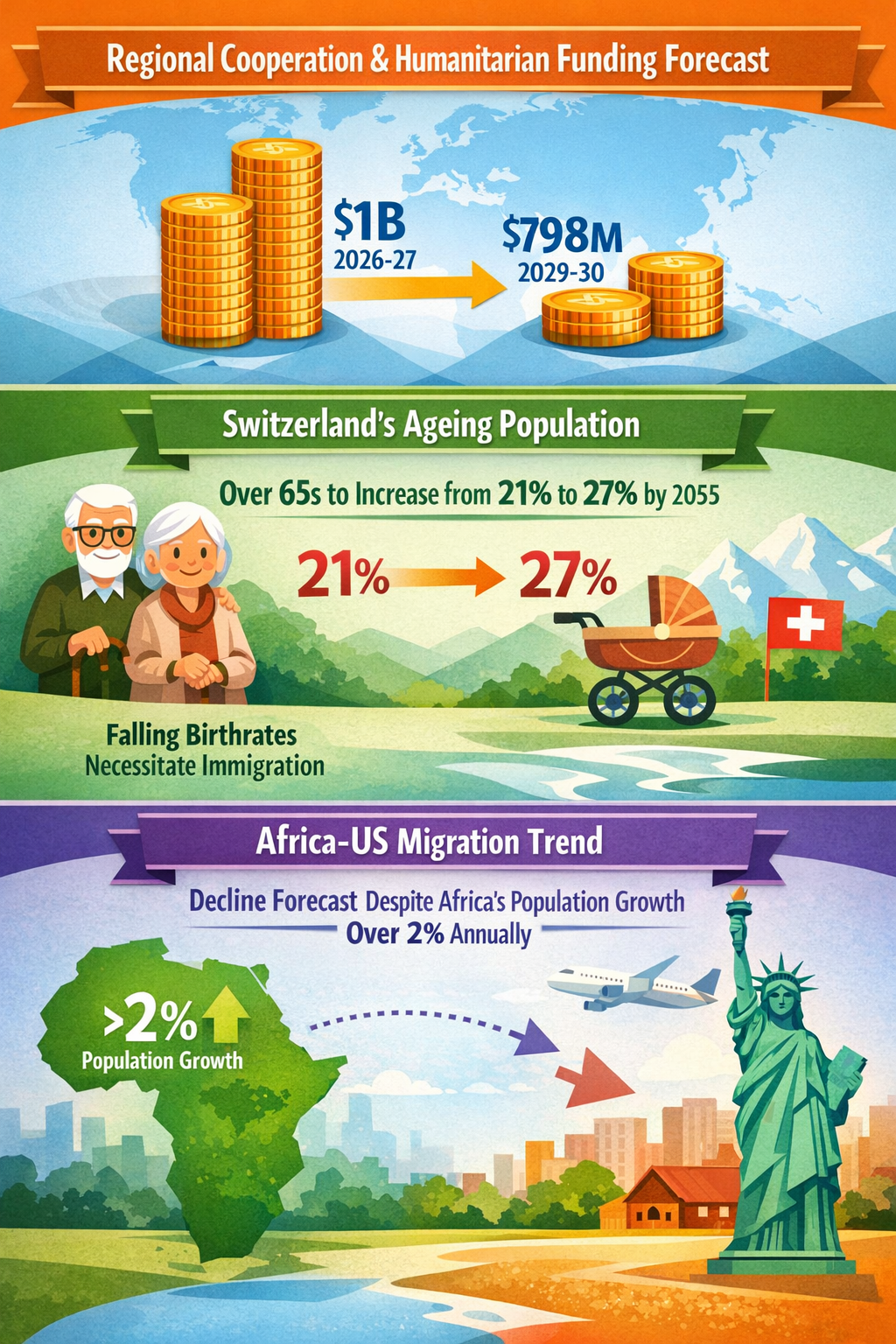
Migration & Mobility Shifts: Navigating Complex Futures
- Global migration is shaped by demographic shifts, climate change, geopolitical tensions, and evolving policy frameworks.
- Europe faces an aging population and workforce shortages, increasing reliance on migration to sustain economies.
- Climate-driven displacement, particularly drought-induced migration, is expected to rise significantly by century’s end.
- Political responses are fragmented—ranging from restrictive policies and externalized border controls to digital migration management tools.
- These dynamics create uncertainty for businesses like Atradius, whose credit risk exposure and coverage strategies depend on global mobility and economic activity.
A Fearful Future – Fortress Europe and Fragmented Mobility
In this scenario, restrictive migration policies harden worldwide. Europe and Switzerland, reacting to political pressure and social fears, impose strict caps and barriers on immigration. Return hubs outside EU borders intensify, and humanitarian funding drops sharply. Skilled migrants bypass restrictive countries, opting for more open economies like the US and Singapore. Climate-driven displacement accelerates, overwhelming already limited resettlement schemes. Economic stagnation follows in aging societies unable to replenish their labor force.
What could Atradius do?
- Reduce exposure in highly restrictive markets vulnerable to economic stagnation by diversifying portfolios geographically and sectorally.
- Enhance risk assessment models to factor in migration policy volatility and related economic impacts.
- Partner with governments or NGOs on alternative approaches to manage humanitarian risks and maintain coverage in regions impacted by forced displacement.
An Uncertain Future – Volatility and Fluid Mobility
The global migration landscape remains volatile with abrupt policy shifts, inconsistent cooperation, and fluctuating humanitarian funding. Technological advances in border control coexist with emergent informal migration routes. Climate impacts cause localized displacement, but political and economic responses vary widely by region. Corporate supply chains and consumer markets experience intermittent disruptions tied to mobility shifts.
What could Atradius do?
- Invest in agile data analytics and scenario planning capabilities to respond rapidly to migration-related market changes.
- Develop flexible insurance products that accommodate evolving mobility patterns and emerging risk clusters.
- Foster closer collaboration across international partners to enhance information sharing and risk mitigation strategies.
A Cautious Future – Balanced but Risk-Aware Mobility
This future embodies a moderate but cautious approach. Migration policies balance the need for labor mobility against social and political concerns. Switzerland and other key economies implement controlled immigration reforms focused on highly skilled workers. Digital migration management improves transparency and efficiency, supported by sustained—but restrained—humanitarian funding. Climate migration is acknowledged but managed with regional cooperation frameworks.
What could Atradius do?
- Consolidate market presence in countries with progressive, risk-aware migration policies to ensure steady economic growth.
- Promote credit insurance schemes that support sectors reliant on skilled migrants, balancing opportunity with risk.
- Engage policymakers with evidence-based insights to advocate for pragmatic migration solutions conducive to economic stability.
A Confident Future – Mobility as a Growth Engine
Migration is embraced as a strategic asset by governments and businesses. Europe, including Switzerland, reforms to compete globally for talent, leveraging streamlined digital systems and flexible asylum and labor migration policies. Climate migration spurs innovation in international cooperation and resilient urban planning. This openness fuels economic dynamism, mitigates demographic decline, and strengthens global interconnectedness.
What could Atradius do?
- Leverage momentum by expanding offerings tailored to industries and regions benefiting from skilled migration and demographic renewal.
- Invest in innovation for risk assessment integrating mobility trends with economic forecasts.
- Position Atradius as a thought leader and strategic partner helping clients capitalize on mobility-driven growth opportunities.
A Hopeful Future – Inclusive Mobility for Shared Prosperity
This scenario envisions a transformative, collaborative approach integrating migration, climate resilience, and development policies. Funding for humanitarian assistance is stabilized and increased through global partnerships. Migration pathways are diversified and accessible, with an emphasis on protecting human rights and sustaining communities. Mobility enables equitable economic participation and demographic balance worldwide.
What could Atradius do now?
- Build frameworks incorporating lessons from restrictive, volatile, and moderate futures to manage risks proactively.
- Champion sustainability-aligned risk products that support ethical and inclusive migration policies.
- Engage multi-stakeholder initiatives to foster systemic resilience and enable Atradius’s role in shaping a sustainable mobility future.
Sources: (UNHCR on resettlement needs), (PMC on drought-induced migration), (SWP Berlin on demographic decline), (The Guardian on Swiss population cap), (The Week on EU asylum pact), (The Globalist on Swiss immigration), (The Week on immigration impact), (David Pocock on humanitarian funding cuts)