
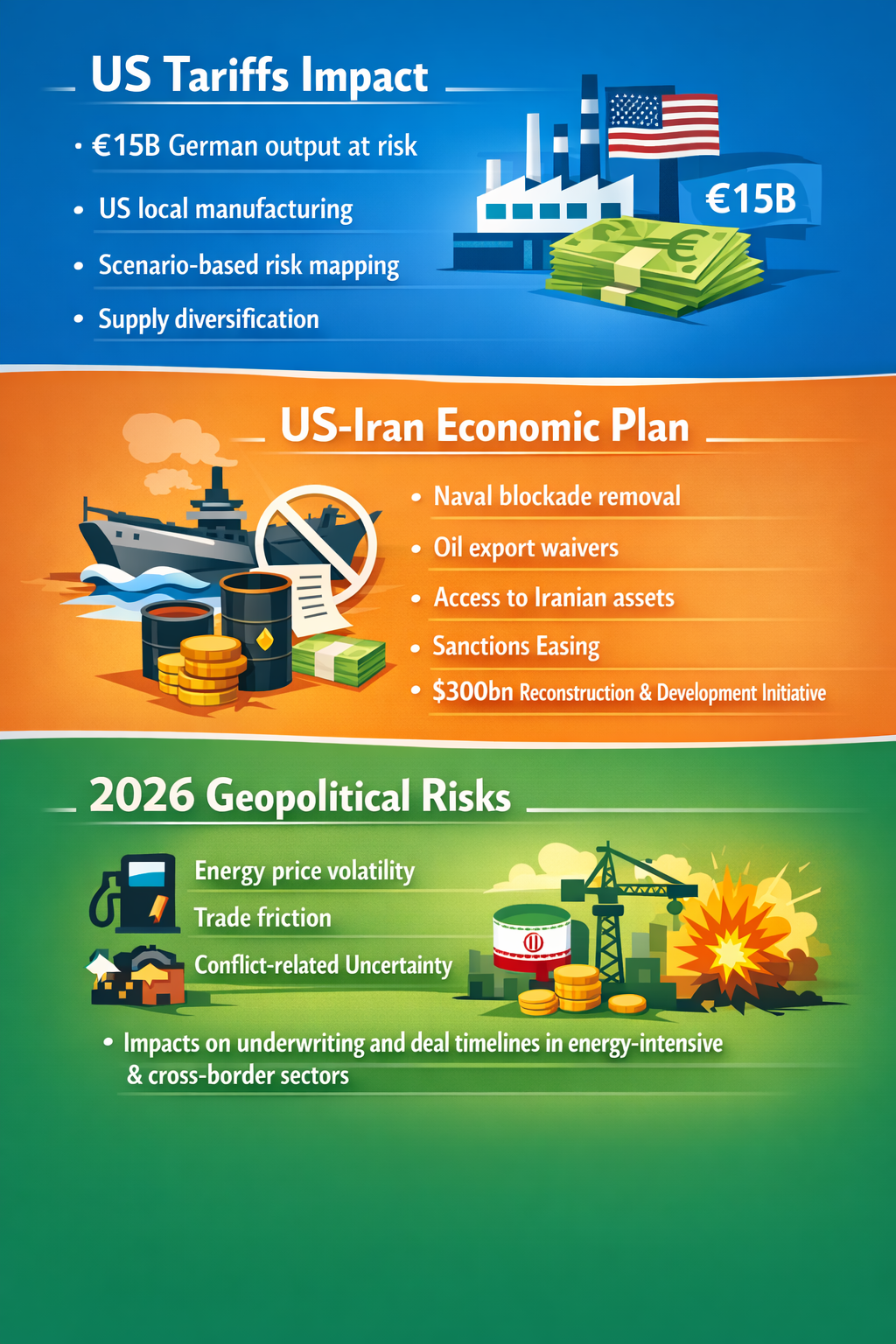
Analysis of recent evidence reveals several recurring and interconnected signals within the domain of Power Shifts: Geoeconomics, Regulation & Political Risk, especially as they relate to geopolitical tensions, economic fragmentation, and technological disruption. These signals exhibit varying momentum trajectories and coalesce into broader thematic clusters that suggest evolving risks and transformation drivers shaping the strategic landscape ahead.
| Signal / Theme | Direction | Relative Frequency / Change | Short Commentary |
|---|---|---|---|
| Geopolitical Fragmentation & Trade Realignment | Accelerating | High - frequent discussion in 2025-2026 reports | Renewed U.S. tariffs under Section 301, EU’s 21st sanctions against Russia, and increased regional trade agreements are pushing global supply chains towards fragmentation and bloc-based realignments. Emerging trade deals like EU-Mercosur and EU-India illustrate responses to U.S. protectionism, indicating a shift away from traditional U.S.-centered trade flows (Al Jazeera, Global Sanctions and Export Controls Blog). |
| China-Russia Strategic Partnership & Asymmetric Interdependence | Stable with potential for escalation | Consistently referenced through 2025-26 with growing analytical depth | The Sino-Russian partnership deepens strategically but is asymmetrical—China dominates economically and technologically. Military cooperation remains limited to signaling and parallel play rather than integrated alliance. Economic ties enable Moscow’s war effort but also raise risks of Russia’s deindustrialization and leverage for Beijing (CEPA). |
| Geopolitical Risks from Middle East Conflict Affecting Energy & Supply Chains | Accelerating | Elevated - pervasive discussion in 2026 risk assessments | The Iran war and related disruptions around the Strait of Hormuz are causing sustained energy price shocks, impacting EU/EEA banks’ lending risk, increasing inflation pressures, and challenging global supply chain resilience. Second-order effects on critical sectors and financial markets amplify macro uncertainty (EBA Risk Assessment Report). |
| Supply Chain Resilience under Climate Change and Structural Vulnerabilities | Accelerating | Rising – increasing focus in foresight and systemic risk reports | Reports highlight multi-tier supply chain vulnerabilities supported by network analysis, emphasizing critical chokepoints, upstream bottlenecks, and nexus suppliers. Climate change exacerbates these risks by increasing extreme weather disruptions and chronic shocks, demanding coordinated adaptation strategies (GOV.UK Foresight Report). |
| AI-Driven Risks & Economic Infrastructure Vulnerabilities | Accelerating | Growing attention post-2025 | The rise of advanced AI, including frontier large language models, introduces heightened cybersecurity risks through rapidly evolving exploit capabilities. Financial institutions face amplified cyber threats requiring increased operational capacity and regulatory coordination. AI-driven private credit expansion raises financial market fragility, especially in funding/demand mismatches for data center infrastructure (EBA Risk Assessment Report). |
| U.S. Debt Sustainability and Fiscal Risk Amid Tariff-Driven Trade Uncertainty | Stable with downside risk | Persistent in 2025-2026 publications | Rising U.S. debt-to-GDP ratio approaches theoretical fiscal limits imposing growing risks of default or fiscal crisis. Tariff policies potentially shorten fiscal leeway and reduce capital inflows, compounding macroeconomic uncertainty and fragility (Fortune). |
Geoeconomic power shifts manifest through accelerated fragmentation of global trade, as protectionist policies and sanctions reshape supply chain networks (Al Jazeera, Global Sanctions Blog). The Sino-Russian partnership remains a core axis within this reordering, characterized by economic asymmetry and calibrated political-military cooperation that challenges traditional Western-aligned structures but lacks full alliance integration (CEPA).
The Middle East conflict acts as a regionally destabilizing factor, with sustained energy price shocks increasing banking sector vulnerabilities, inflationary pressures, and credit risks across Europe, thereby amplifying global financial volatility and trade uncertainty (EBA Risk Assessment Report). Simultaneously, climate change introduces systemic supply chain fragility, where environmental hazards interact with geopolitical tensions to fracture global production networks, demanding multilevel coordination and adaptive resilience planning (GOV.UK Foresight Report).
Technological evolution, especially in AI, acts as both a transformation driver and emerging risk. AI increases cybersecurity threats and financial market interconnectedness, exposing operational vulnerabilities that demand enhanced regulatory oversight and infrastructure investment. In the U.S., fiscal sustainability concerns compounded by trade disruptions exacerbate systemic economic risks (Fortune).
| Wild Card Name | Potential Impact | Surprise Characteristics | Early Warning Indicators | Commentary |
|---|---|---|---|---|
| Sudden Ocean Circulation Shift (e.g., Atlantic Subpolar Gyre Reorganisation) | Very High | Outside common climate projections over 10–20 years; rapid regional climate alteration | Changes in ocean temperature/current monitoring, abrupt shifts in regional weather patterns, maritime insurance cost spikes | This event could produce rapid and unanticipated climate variations across Europe and North America impacting agricultural productivity, energy demands, and transport reliability. Its complexity and scale make it a systemic disruptor of supply chains and economies. Monitoring oceanographic data and early meteorological anomalies is critical (GOV.UK Foresight Report). |
| Large-scale coordinated cyberattacks on critical global infrastructure | Very High | Exploits newly developed AI-driven vulnerabilities; simultaneous attacks on multi-national supply chains and financial systems | Rising sophistication and frequency of cyber intrusions, AI vulnerability disclosures, intelligence on state-sponsored cyber operations | A coordinated wave of cyberattacks could cripple transport, energy, and financial sectors worldwide, causing cascading failures and systemic market instability. Early detection hinges on intelligence sharing and AI risk monitoring (EBA Risk Assessment Report). |
| Arctic Sea Routes Become Operationally Viable at Scale Earlier Than Anticipated | High | Geopolitical realignments enable cooperation or control; climatic conditions improve beyond established trends | Shipping route usage reports, satellite imagery showing ice cover decline, investments in Arctic port infrastructure | Earlier commercial viability of Northern Sea Routes affects global trade flows, reducing reliance on traditional chokepoints and enabling new geopolitical leverage. This may accelerate regional competition and reshape energy and resource markets (Polemics Magazine). |
| U.S. Fiscal Crisis Triggered by Loss of Market Confidence | Very High | Rapid bond market repricing triggered by fiscal shocks and policy gridlock, leading to sovereign instability | Bond auction demand decline, rising Treasury yields, political deadlock on debt ceiling, credit rating actions | A sudden fiscal crisis would heavily disrupt capital markets, increase borrowing costs globally, and induce economic contraction. It could accelerate global reallocation of capital and exacerbate geopolitical tensions (Fortune). |
| Breakthrough in Lab-Grown or Synthetic Agricultural Goods | High | Rapid adoption disrupts traditional food supply chains and reduces climate vulnerability | Commercial-scale production announcements, regulatory approvals, investment flows, consumer adoption rates | Could drastically reduce reliance on climate-sensitive agriculture, altering global trade and food security dynamics, creating both opportunities and disruptions for economies dependent on traditional farming (GOV.UK Foresight Report). |