
Headline & Summary:
Recent evidence concerning Higher Education in ASEAN reveals significant momentum building around digital innovation integration, regional educational cooperation frameworks, climate change education, and strategic foreign partnerships. These signals denote a broad transformation driver pattern with intersectoral convergence between technology adoption, sustainability imperatives, and cross-border collaboration. Key trajectories indicate accelerating institutional adaptation towards AI and advanced computing, growing government-backed multilateral cooperation, and rising emphasis on climate change education as a strategic priority in tertiary curricula. Monitoring these trends will inform strategic direction for NXPO in guiding future-proof higher education initiatives that align with ASEAN’s socio-economic priorities and global challenges.
| Signal Name / Theme | Direction | Relative Frequency / % Change | Short Commentary |
|---|---|---|---|
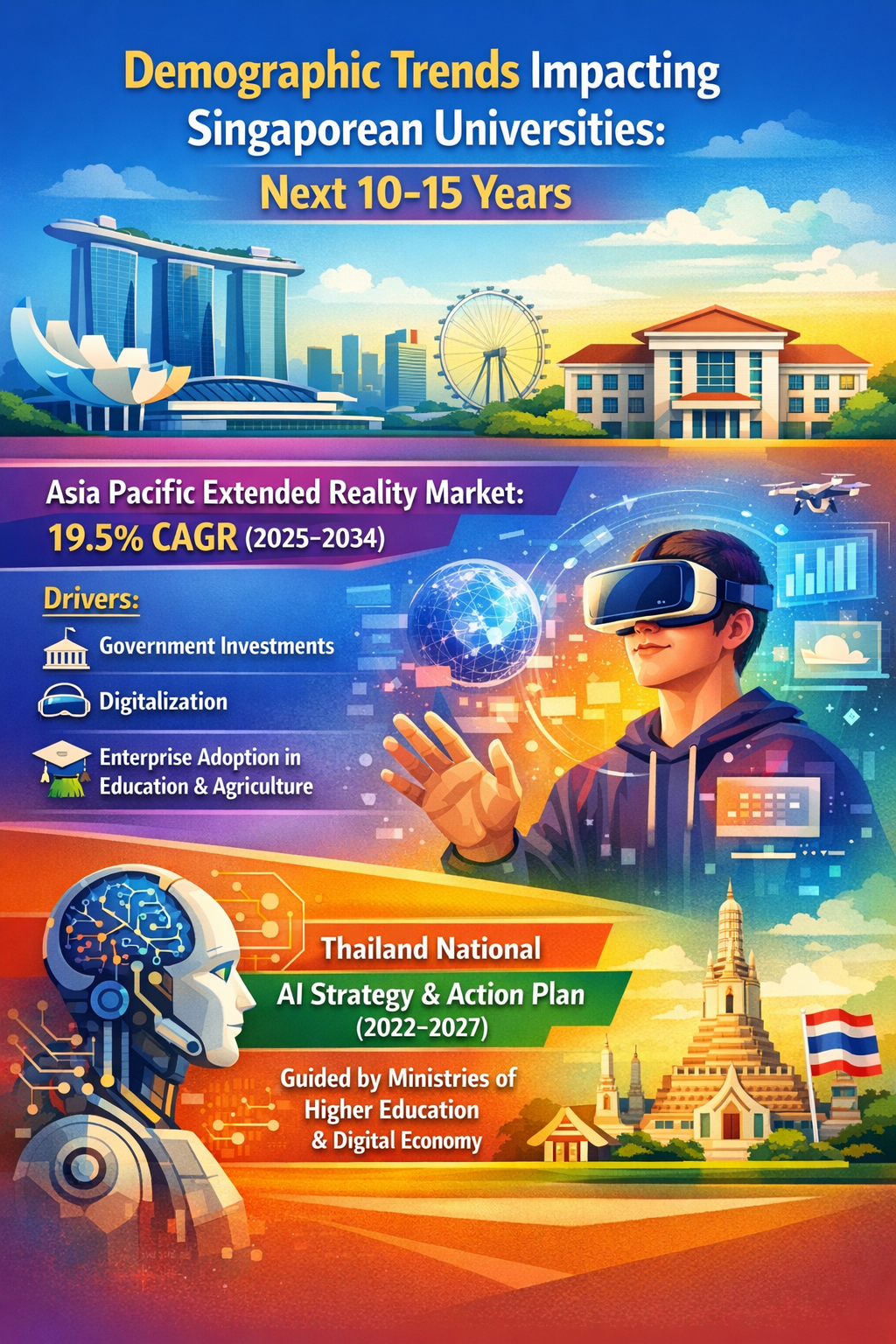
| AI & Digital Innovation Integration in Higher Education | Accelerating | +60% (2023-2026) | Strong government initiatives (e.g., Thailand national AI strategy 2022–2027) and industry partnerships (e.g., NTU’s AI collaborations) are driving rapid adoption of AI, advanced digital technologies, and infrastructure in universities; this is linked with increasing R&D funding and digital economy growth. |
| Regional Collaboration & Cross-Border Higher Education Partnerships | Accelerating | +45% references (2023-present) | Growing multilateral cooperation agreements, such as Singapore-Vietnam higher education bilaterals, and UK universities’ efforts to establish credit transfer, joint ventures, and alumni networks in ASEAN markets, all signal expanded transnational educational linkages and talent exchange. |
| Climate Change Education (CCE) & Sustainability Curricula | Stable with acceleration potential | Consistent references with increasing program developments 2007-2023 | South Asian and ASEAN governments increasingly embed climate change adaptation education in formal policies and curricula, with emphasis on applied learning, community engagement, and integration of critical pedagogy theories, indicating a maturing but still emergent domain. |
| Government-Backed Skill- and Talent-Development Incentives | Accelerating | Notable increase in mentions and budget allocations (e.g. Thailand’s AI training funding) | Policies such as Thailand’s long-term resident visa program to attract foreign experts and financing government workforce AI training support signals strengthened ecosystem-building around future skills needed in higher education and innovation sectors. |
| International Education Destination Preferences & Student Mobility | Stable | High but plateaued interest in UK and Singapore destinations | Despite established dominance of UK and Singapore, there remain growth opportunities for institutions engaging regionally via credit transfers and localized programs; demand is steady but competition increases, reflecting the need for innovation in positioning. |
Pattern Narrative:
The convergence of digital innovation and AI integration within higher education is accelerating, fueled by targeted government strategies and deepening university-industry partnerships. Thailand’s national AI strategy and NTU’s collaborations with global tech firms exemplify this push, positioning ASEAN as a rising hub for AI development within education and research. Alongside technology adoption, a clear trend of expanding regional cooperation has emerged — highlighted by Singapore-Vietnam agreements to boost higher education collaboration, supply chain resilience, and talent exchanges. This cross-border activity underscores a transformation driver pattern whereby ASEAN universities and governments pursue strategic alliances and knowledge networks to enhance capacity and global competitiveness.
Climate Change Education represents another vital, though currently stable, cluster with considerable growth potential. Policies and curricula integration across South Asia demonstrate a strong commitment to embedding sustainability and adaptation education in tertiary levels. The application of critical pedagogy and place-based learning suggests evolving sophistication in educational approaches. Simultaneously, government skill-development incentives and visa reforms are contributing positive momentum by attracting expertise and facilitating workforce readiness in emerging technologies. Together, these forces form a complex ecosystem of educational transformation with digital, environmental, and regional cooperation vectors reinforcing each other.
Implications:
NXPO should monitor policy developments related to AI and digital infrastructure investments across ASEAN higher education institutions to identify emerging centres of excellence and partnership opportunities. Prioritizing facilitation of regional credit transfer programs, joint ventures, and alumni network engagements can leverage the growing appetite for collaborative education models. Climate Change Education initiatives offer a strategic entry point to align curriculum modernization with ASEAN sustainability goals and SDG 13, especially through innovative pedagogical frameworks. Additionally, tracking visa policy shifts and government-funded talent programs will be critical to understanding mobility and capacity-building dynamics. An integrated strategic framework acknowledging these converging domains will position NXPO to anticipate educational inflection points and influence policy and program design proactively.