
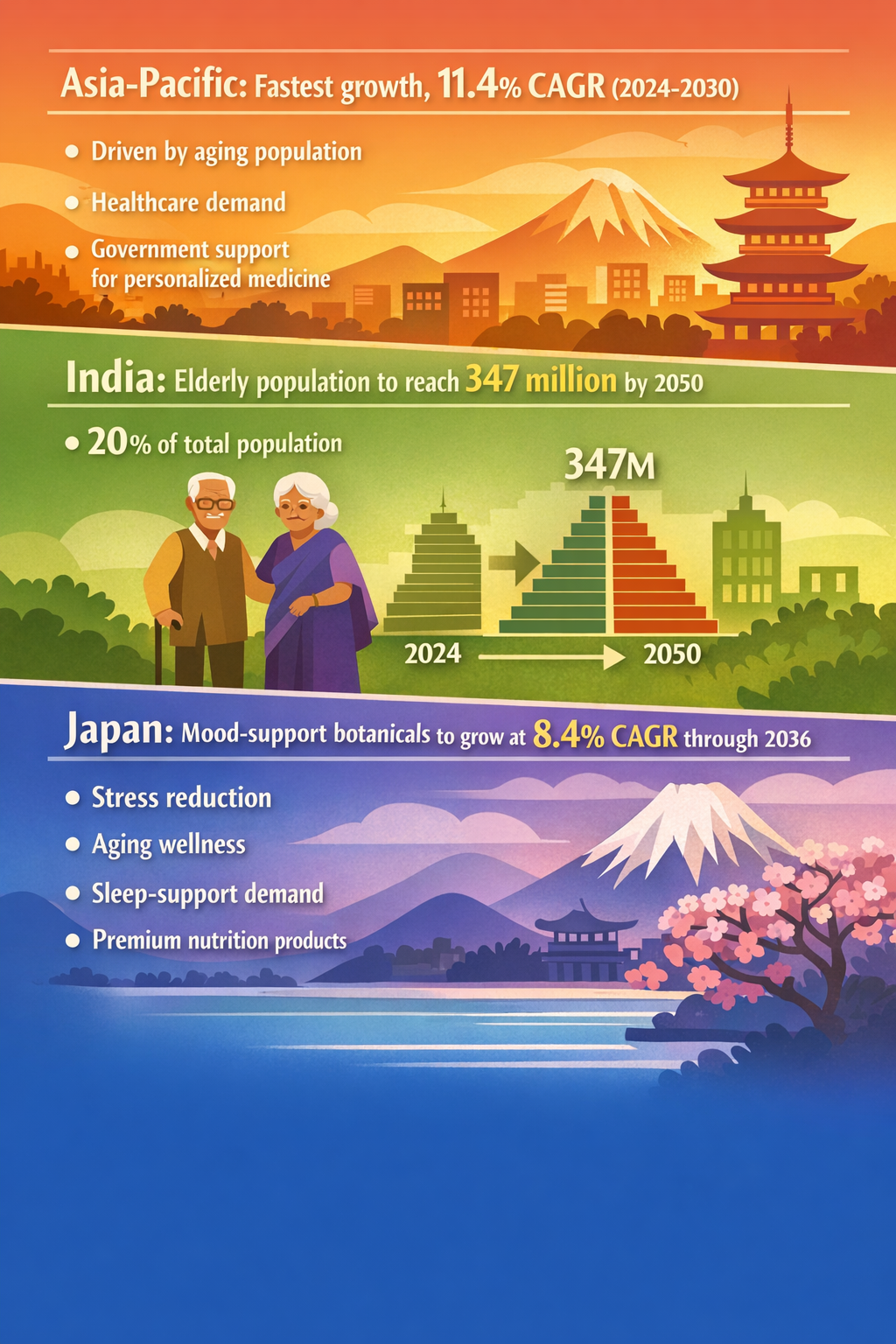
The evidence set reveals a dynamic landscape of aging society-related trends across Asia, with particular emphasis on the intersection of demographic shifts, healthcare infrastructure and policy responses, and emerging wellness markets targeting elderly well-being. Key signals revolve around rapidly expanding elderly populations, evolving caregiving models, and innovative product and service offerings. These signals show varying momentum profiles that reflect the urgency of demographic change alongside innovation-driven market responses, especially in mental and emotional health sectors.
| Signal / Theme | Momentum Direction | Relative Change / Frequency | Commentary |
|---|---|---|---|
| Rapid Demographic Ageing in Asia (India, Japan, Malaysia, etc.) | Accelerating | Multiple recent official data points confirm faster elderly growth (e.g., India's 41% decadal elderly growth; Japan 8.4% CAGR for mood-support botanicals driven by aging) | Asia, particularly India and East Asian countries, face a sharply rising elderly population driven by low fertility and rising longevity, creating urgent social, fiscal, and healthcare challenges. |
| Care Economy Development and LTC (Long-Term Care) Infrastructure | Stable to Accelerating | Ongoing establishment of policies and pilot programs in Malaysia, Indonesia, Singapore, Vietnam with growing LTC services and insurance schemes; regional variation noted | Countries are increasingly investing in long-term care frameworks to manage an aging population, but infrastructural and workforce gaps remain, especially in lower-income or rural areas. |
| Mental Wellness and Adaptogenic Botanicals Market Growth | Accelerating | 6.5% CAGR, projected near doubling in market size over 10 years with growing demand in Japan, India, China and South Asia | Consumer interest in natural botanical supplements for mood and cognitive support shows rapidly increasing demand linked to aging populations’ mental health needs and preventive wellness trends. |
| Technology Adoption in Elder Care and Wellness | Emerging / Stable | Incremental but growing adoption of digital health records, teleconsultation, AI-powered wellness personalization, and e-commerce wellness channels | Technology integration into elderly health management and wellness product distribution provides scalability and accessibility, though at varying levels across Asia. |
| Policy and Institutional Innovation (e.g., India’s National Demographic Mission, Kerala’s state initiatives) | Accelerating | New specialized departments, demographic monitoring systems, and elder welfare programs launched recently | Governments are establishing dedicated institutional frameworks to respond to demographic ageing, reflecting recognition of ageing as a strategic, multidimensional challenge. |
| Gender and Social Equity in Elder Care | Stable | Consistent references to feminisation of ageing and care burden on women | Gendered vulnerabilities are well-recognized but are more a stable systemic issue needing targeted policy intervention rather than a rapidly changing one yet. |
Three interconnected clusters emerge from the data:
Combined, these patterns illustrate a systemic shift toward more integrated, cross-sectoral approaches where demographic realities are pushing healthcare innovation, policy reorientation, and market transformation. The convergence is particularly acute around mental health and caregiving support for aging populations, a previously under-served segment now gaining prioritized investment and research.
Stakeholders should monitor:
Timely investment and policy shifts toward scalable LTC infrastructure, combined with innovation in wellness product offerings and tech-enabled services, are predicted as key inflection points over the next 3-5 years.
| Wild Card Name | Potential Impact | Surprise Characteristics | Early Warning Indicators | Commentary |
|---|---|---|---|---|
| Major Disruption in Elder Care Workforce due to Migration Shifts | Very High | Provincial/Global migration policies unexpectedly tighten or reverse, causing acute caregiver shortages in aging societies that rely heavily on migrant labor. | Changes in migration laws, geopolitical tensions, unexpected repatriation/return migration waves, labor market reports on shortages | The fragility of elder care systems dependent on migrant workers in countries like Singapore, Indonesia, and Malaysia can become a critical bottleneck. A sudden workforce shortfall could disrupt LTC services and accelerate policy crises. |
| Breakthrough in Botanical Adaptogen Clinical Validation and Regulatory Approval | High | Robust clinical evidence leads to official medical endorsement of adaptogenic botanicals as standard care supplements for mental health in the elderly. | Release of landmark scientific studies, major regulatory approvals, institutional adoption in senior healthcare guidelines | This would dramatically increase market legitimacy, consumer trust, and adoption, potentially transforming the mental health supplement landscape and healthcare approaches to elder stress/dementia management. |
| Rapid Digital Health Integration in Low-Income Asian Regions | High | An unexpected inflection in digital infrastructure rollout triggers rapid adoption of tele-geriatric services in rural or traditionally underserved areas. | Policy announcements, telecom infrastructure investments, digital health pilot expansions, elder care service usage data spikes | Could significantly expand access to elder care where it’s currently lacking, shifting dependency away from family-based informal care and accelerating care economy growth. |
Sources: (FactMR), (Anantam IAS), (Khazanah Research Institute), (Business Model Analyst)