
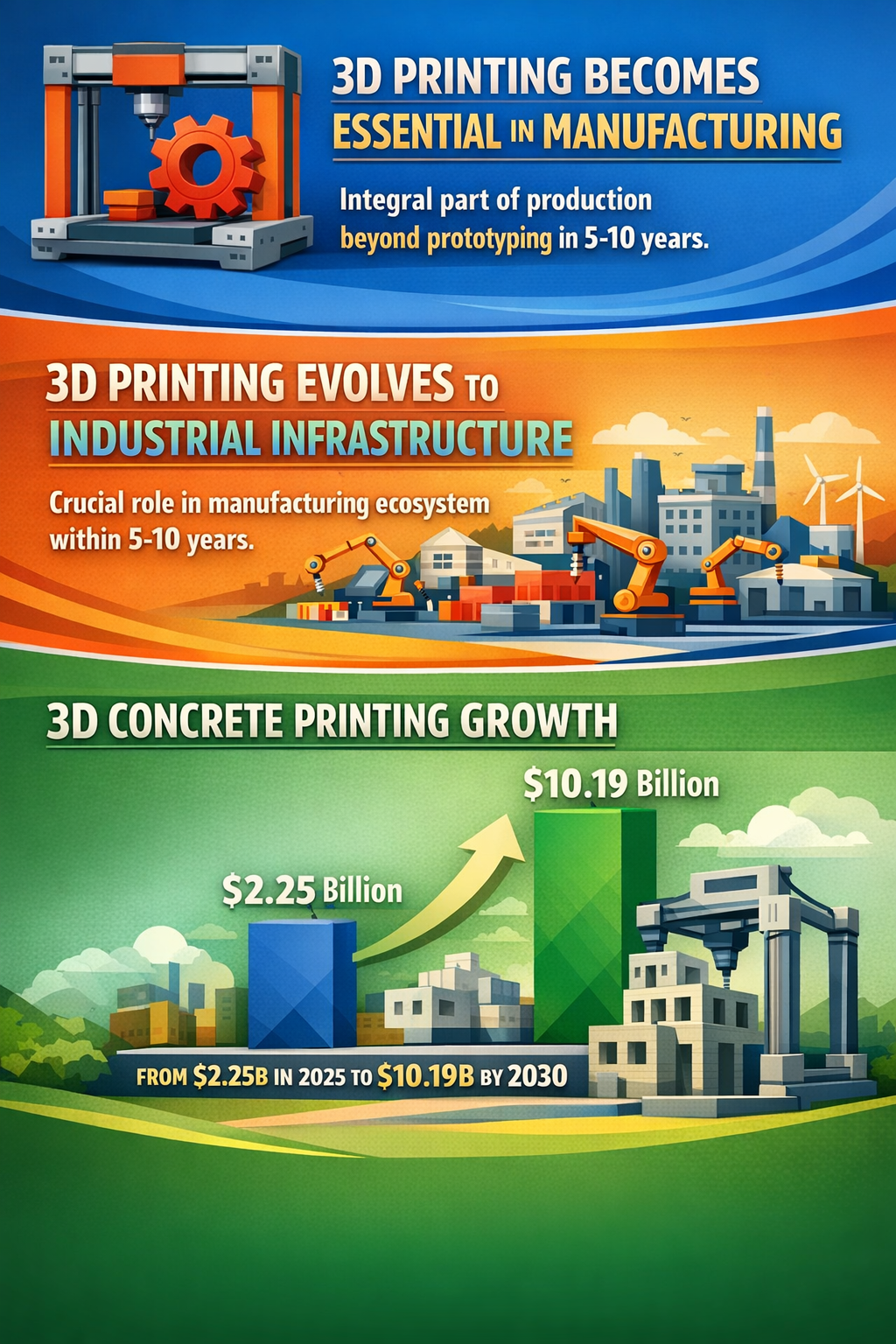
Modular and additive manufacturing have matured beyond novelty, now driving faster, greener, and more cost-effective industrial construction and production at scale—anchored by AI-enabled automation, ecosystem consolidation, and expanded materials innovation. Strategic adoption of these technologies offers QMarkets a competitive advantage in agile, sustainable development and supply resilience (Vista Builder Inc., 3D Printing Industry).
| Scenario | Adaptation Strategy |
|---|---|
| Most Likely: Steady adoption of modular and AM with incremental AI automation, standardization, and geographic consolidation. | Prioritize scalable pilot projects focusing on high ROI sectors (data centers, healthcare, aviation), invest in workforce reskilling, and establish compliance-ready certification pathways. |
| Best Case: Breakthroughs in AI-driven autonomous manufacturing and materials science enable fully digital, distributed production with circular economy dominance. | Expand digital twin and AI platforms, lead innovation consortia, prioritize sustainability as a market differentiator, and cultivate ecosystem partnerships for rapid diversification. |
| Worst Case: Regulatory fragmentation, financing constraints, and supply chain shocks stall adoption, preserving traditional construction dominance. | Emphasize modular hybrid projects that mitigate risk, advocate for regulatory harmonization, seek alternative funding models, and enhance supply chain transparency and local sourcing. |
| Dimension | Short-Term (1–3 years) | Mid-Term (3–7 years) | Long-Term (7–15 years) |
|---|---|---|---|
| Technology |
Integrate AI-enabled process monitoring and error correction tools; Deploy BIM and digital twin platforms for pilot projects; Adopt modular and prefabricated design standards. |
Mature hybrid additive-subtractive production workflows; Scale AI-driven autonomous factory cells; Develop advanced multifunctional materials. |
Establish fully networked, distributed autonomous manufacturing ecosystems; Implement Industry 5.0 human-centric automation; Integrate synthetic biology & biofabrication. |
| Governance |
Advocate for standardization of modular and AM codes; Collaborate with industry and regulators on certification protocols; Establish clear contractual frameworks for off-site production. |
Lead cross-jurisdictional regulatory harmonization efforts; Embed sustainability requirements in procurement and finance; Develop advanced IP and data governance policies. |
Mature resilient governance for global distributed production networks; Adopt AI-driven compliance and audit systems. |
| Infrastructure |
Launch modular and AM production hubs aligned with market hotspots; Invest in connectivity and digital infrastructure; Develop local supply chains for materials. |
Scale regional autonomous manufacturing gigafactories; Deploy interoperable software platforms across sites; Integrate circular economy-enabled logistics. |
Build global manufacturing ecosystems with dynamic job routing; Achieve end-to-end digital supply chain traceability. |
| People |
Invest in workforce reskilling programs for AI and digital manufacturing; Develop interdisciplinary teams combining engineering, data science, and construction; Foster culture of innovation and continuous learning. |
Embed additive manufacturing curricula in technical education; Scale AI-human collaboration models; Promote diversity and inclusion to support transformation. |
Enable fully autonomous knowledge work with human oversight; Establish lifelong learning infrastructure aligned with tech advances. |
| Partnerships |
Form consortia with technology providers, regulators, and developers; Collaborate on pilot projects with supply chain partners; Develop trusted data-sharing agreements. |
Expand alliances for materials R&D and AI tool development; Engage in collaborative certification and standards bodies; Build multi-sector innovation ecosystems. |
Orchestrate global distributed manufacturing coalitions; Lead industry ecosystem for synthetic biology and hybrid manufacturing. |
| Sustainability |
Embed waste reduction and energy-efficient design in projects; Pursue certifications like LEED/BREEAM for modular builds; Establish ESG-aligned reporting. |
Optimize material circularity and reuse; Implement carbon accounting and reduction across manufacturing networks; Adopt bio-based and multifunctional materials. |
Achieve closed-loop industrial ecosystems with net positive environmental impact; Leverage AI to optimize sustainability across life cycles. |