
Underground Hydrogen Storage in Depleted Hydrocarbon Reservoirs: A Catalytic Weak Signal for Green Hydrogen’s Structural Evolution
This paper examines a non-obvious development in green hydrogen infrastructure—the potential largescale underground storage of green hydrogen in depleted oil and gas fields, which could fundamentally reshape hydrogen markets, capital deployment, and regulatory frameworks over the next two decades.
While much attention centers on electrolyzer capacity growth and renewable power inputs, the systemic challenge of green hydrogen storage and seasonal balancing remains underemphasized. The UK’s emerging strategy to repurpose North Sea oil and gas fields for hydrogen storage signals a latent inflection point. This could unlock new industrial structures, long-term asset value chains, and cross-sector regulatory integration if scaled effectively.
Signal Identification
This development qualifies as a weak signal with high plausibility over a 10–20 year horizon, affecting energy infrastructure, regulatory policy, industrial investment, and climate transition strategies. It is weak because large-scale subsurface hydrogen storage has historically been sidelined in green hydrogen discourse relative to production and distribution innovation. Its recognition is growing but remains partial. The sectors exposed include renewables, fossil fuel legacy infrastructure, natural gas, chemical processing, and energy storage technologies.
What Is Changing
First, the UK demonstrates feasibility by evaluating storage capacities in the depleted North Sea oil and gas reservoirs sufficient to meet electricity demand for up to seven years (Electricity Info 01/06/2026). This indicates an untapped latent infrastructural asset capable of decoupling hydrogen production and consumption temporally and spatially.
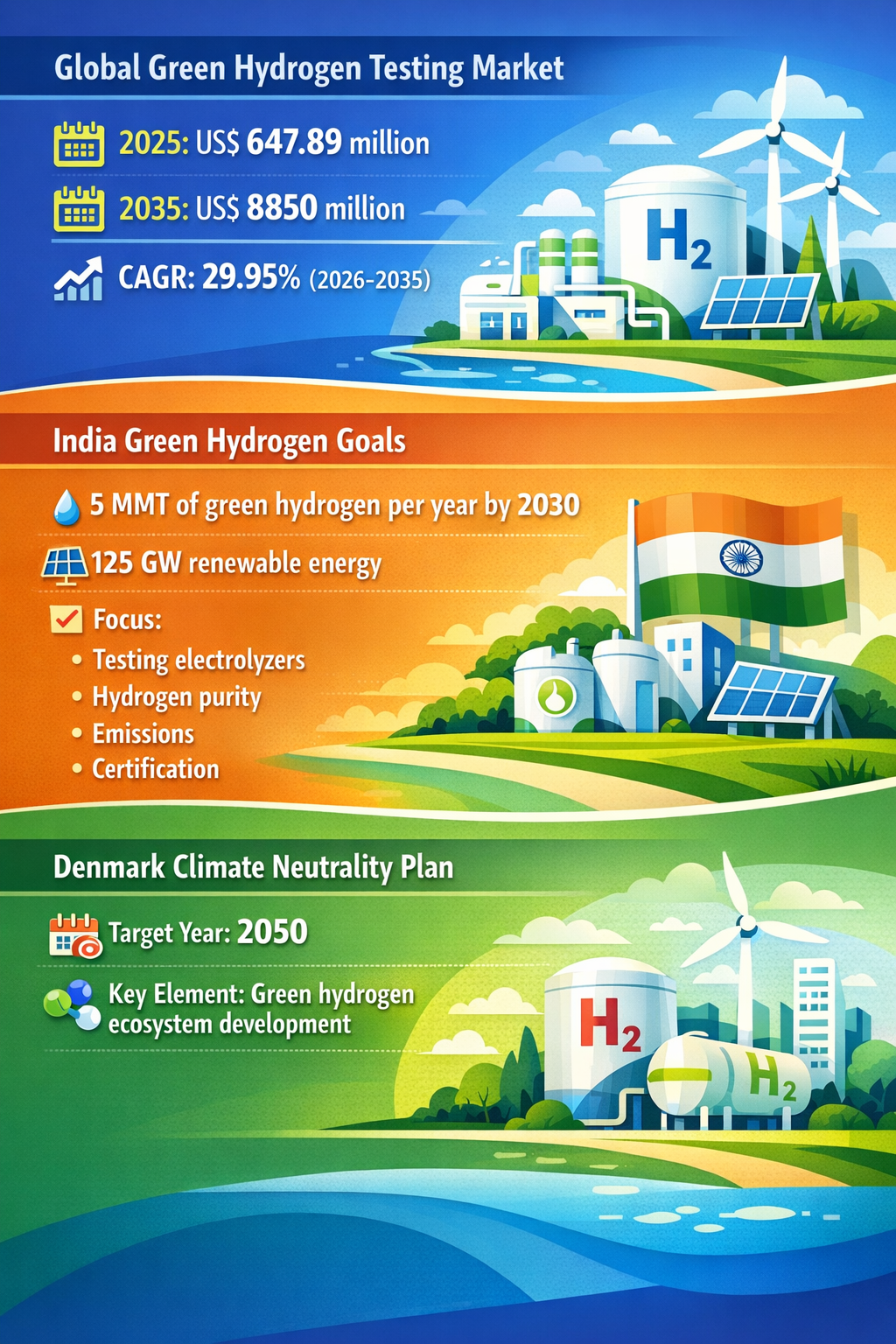
Second, multiple jurisdictions are accelerating electrolyzer deployments to meet ambitious capacity targets—Germany aims for 10 gigawatts by 2030 (PMC 22/05/2026), India plans 5 million metric tonnes of production via 125 gigawatts of renewables (Data Mintelligence 15/06/2026), and the EU projects a combined 20 million tonnes target with EUR 18.8 billion in funding (Evolvan 10/04/2026). However, these production targets are often implicitly assumed to be paired with immediate consumption or export, ignoring storage bottlenecks.
Third, climate change-driven variability and location-dependent production costs (with possible 20% cost increase in some areas due to warming effects) will amplify the need for flexible, reliable storage to manage intermittency risk (PMC 30/05/2026). This environmental pressure compounds challenges in maintaining hydrogen purity and infrastructure integrity over time.
Finally, Denmark and Chile emphasize ecosystem ecosystems that incorporate certification, electrolyzer testing, and systemic integration of hydrogen into energy portfolios (Green Hydrogen Denmark 05/06/2026; Medium 02/06/2026). These efforts push regulatory and capital frameworks towards system-level integration, including storage considerations.
Disruption Pathway
Green hydrogen’s future viability hinges not only on production but on resolving storage and balancing challenges at scale. The UK’s North Sea hydrogen storage potential unlocks an underutilized asset class that could fundamentally alter the supply-demand paradigm.
Accelerating conditions include technological advancements in hydrogen injection and retrieval safety, public and regulatory acceptance of repurposed fossil fuel infrastructure, and rising renewable generation that necessitates seasonal energy buffers. Significant investment into subsurface hydrogen compatibility and monitoring will be critical.
Current systems face stresses as increasing electrolyzer capacity without commensurate storage risks driving market imbalances, price volatility, and underutilized production assets. Without viable large-scale storage, electrolyzer projects may face curtailment or stranded assets, limiting capital inflows and slowing hydrogen ecosystem development.
Structural adaptation could follow with policy frameworks incentivizing underground hydrogen storage development as a parallel infrastructure pillar alongside generation and transmission. This might lead to hybridized firms operating at the intersection of traditional oil/gas midstream, renewables, and hydrogen infrastructure, blurring sector silos.
Feedback loops may intensify as storage capacity enables more confident, large-scale investment in electrolyzers, allowing surplus renewable generation to be efficiently stored and dispatched via hydrogen. This could also ease grid integration and support harder-to-electrify sectors, catalyzing hydrogen’s systemic adoption.
Unintended consequences include potential regulatory challenges over subsurface rights, hydrogen leakage risks, or technical failures of legacy reservoirs. Industry incumbents might resist or leverage this opportunity differently, potentially marginalizing newer entrants or reshaping competitive landscapes.
Over 10–20 years, this could shift industry configurations from fragmented production-centric models to vertically integrated value chains that span generation, storage, distribution, and end-use coordination. Regulatory models may evolve towards subsurface resource management, blending energy and environmental governance in novel ways.
Why This Matters
This weak signal’s escalation directly impacts capital allocation decisions by highlighting storage infrastructure as a critical enabler, not just production assets. Investors may need to diversify beyond electrolyzers to subsurface storage development, including new risk assessment and lifecycle management approaches.
Regulators could face pressure to develop integrated hydrogen frameworks linking permitting, safety, environmental liability, and market design. The legacy hydrocarbon industry’s role may be transformed from decommissioning actors to hydrogen storage custodians, affecting labor, skills, and regional economic transitions.
Strategically, early movers who secure storage rights or develop associated technologies may establish durable competitive moats in the hydrogen value chain. Supply chains for injection technologies, monitoring instrumentation, and retrofitting services could grow, reshaping industrial sourcing and innovation trajectories.
Implications
Underground hydrogen storage may significantly enhance green hydrogen’s scalability by mitigating intermittency and transport constraints. It might be central to unlocking seasonal and multi-year balancing, which is vital for broad sectoral decarbonization beyond power generation, including industry and mobility.
This signal should not be confused with transient hype around electrolyzer capacity expansions or short-term export ambitions. Unlike these, storage infrastructure addresses fundamental system flexibility required for sustainable hydrogen economies.
Alternative interpretations might argue that battery storage, ammonia or other hydrogen carriers, or emerging conversion technologies could challenge or complement subsurface storage. Nevertheless, the scale and duration potential of geological storage provides a discrete pathway to structural longevity.
Early Indicators to Monitor
- Regulatory developments enabling hydrogen injection and storage in depleted hydrocarbon reservoirs
- Investment flows into geological hydrogen storage technology and pilot projects
- Formation of multi-sectoral consortia combining fossil, renewable, and chemical industries to pursue storage exploitation
- Standards or certification frameworks emerging for underground hydrogen storage safety and environmental compliance
- Deployment of monitoring and leakage detection technologies specific to hydrogen in subsurface formations
Disconfirming Signals
- Persistent technical failures or economic infeasibility in scaling underground hydrogen storage
- Regulatory prohibitions or public opposition to repurposing geological formations for hydrogen
- Widespread breakthroughs in alternative long-duration hydrogen storage technologies (e.g., liquid organic carriers) rendering underground storage obsolete
- Unmanageable environmental risks such as significant hydrogen leakage or induced seismicity
Strategic Questions
- Should capital allocation prioritize hydrogen storage infrastructure development alongside renewable hydrogen production, and how should such investments be balanced over the next decade?
- How must regulatory frameworks evolve to integrate subsurface hydrogen storage safety, environmental liability, and market operation with emerging renewable energy policies?
Keywords
Green Hydrogen; Hydrogen Storage; Depleted Oil and Gas Fields; Energy Infrastructure; Electrolyzers; Hydrogen Regulation; Energy Transition
Bibliography
- The UK could store enough green hydrogen in depleted North Sea oil and gas fields to meet future electricity demand for up to seven years. Electricity Info. Published 01/06/2026.
- We find climate change could raise the cost of green-hydrogen production by up to 20% in some global locations, and about 16% of global locations could see LCOH increases or decreases exceeding 5%. PMC. Published 30/05/2026.
- The German government is focusing on green hydrogen and aims to build around 10 GW of electrolysis capacity by 2030. PMC. Published 22/05/2026.
- By 2030, total public-private investment in 'green hydrogen' is expected to balloon to $45 Billion. / Chile. Medium. Published 02/06/2026.
- The European Union's 2030 goal of 10 million tonnes of domestic renewable hydrogen plus 10 million tonnes of imports has mobilized EUR 18.8 billion in EU funding for renewable hydrogen projects. Evolvan. Published 10/04/2026.
- Denmark's commitment to achieving climate neutrality by 2050 hinges significantly on its ability to develop a comprehensive green hydrogen ecosystem. Green Hydrogen Denmark. Published 05/06/2026.
- India plans to generate 5 MMT (million metric tonnes) of green hydrogen production every year by 2030, utilizing approximately 125 GW of renewable energy, thus requiring testing for hydrogen production electrolyzers, hydrogen purity, emission, and certification. Data Mintelligence. Published 15/06/2026.