Our Scans
·
China
·
Future Wheel
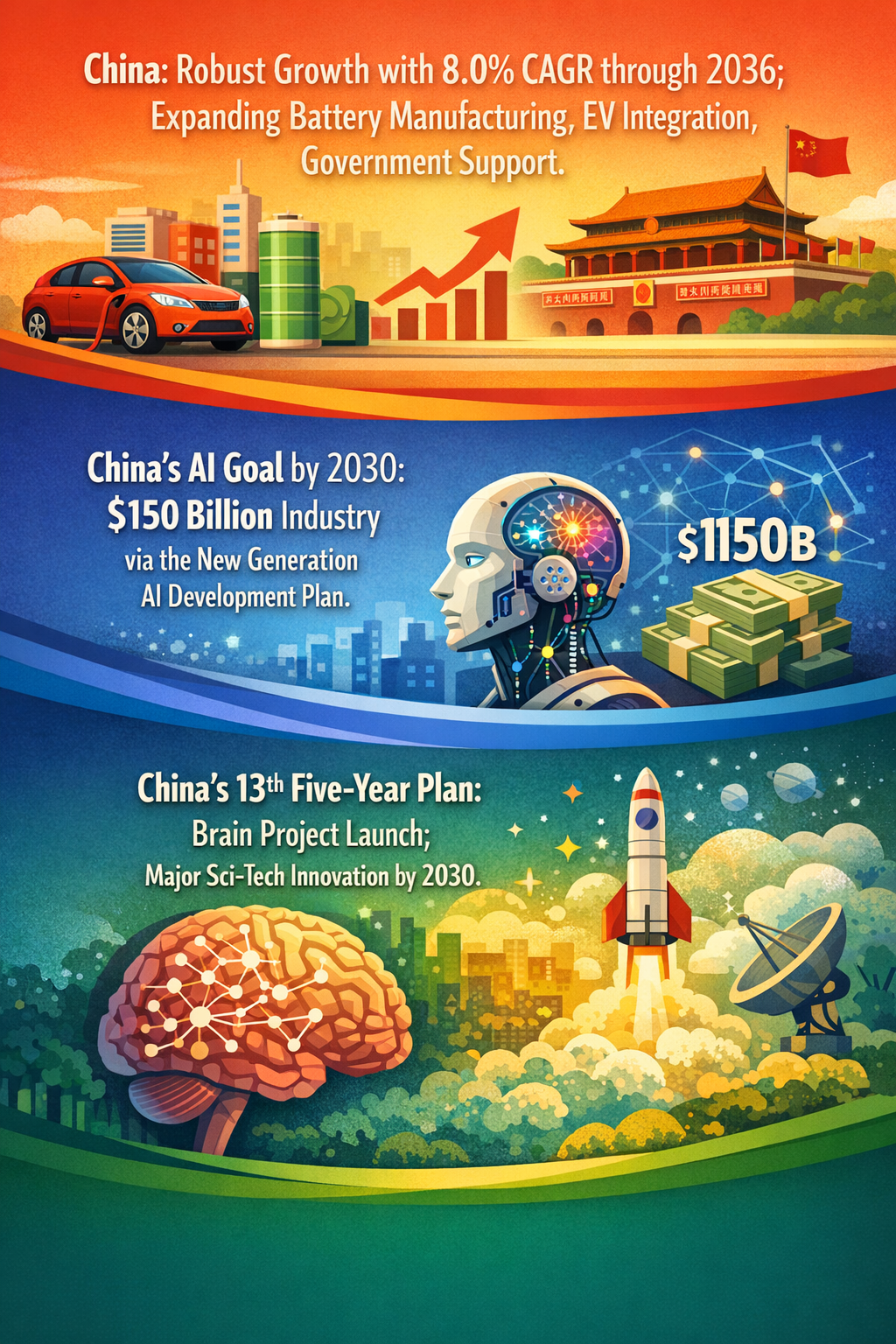
FUTURES WHEEL: China
Central Event / Trend:
China is rapidly advancing as a global technological and economic powerhouse, particularly in AI, battery manufacturing, and electric vehicles,
while intensifying governance of technology ethics and facing geopolitical competition, especially with the US. This multifaceted rise reshapes
global innovation, security, and governance landscapes.
First-Order Impacts (Direct):
- Robust growth in China's AI industry targeting $150 billion by 2030.
- Expansion of battery manufacturing and electric vehicle integration with proactive government support.
- Strengthened national governance on technology ethics via a three-tier review system.
- Increased scrutiny and protection measures by the US and allies against Chinese scientific and technological influence.
- Heightened geopolitical tensions around emerging technologies and market competition.
Second-Order Impacts (Indirect):
-
AI industry growth →
- Acceleration of domestic innovation ecosystems and global AI market share.
- Rising concerns over AI ethics, data sovereignty, and international standards divergence.
-
Battery manufacturing expansion →
- Increased demand for critical raw materials and potential environmental stresses.
- Boost in global EV adoption influencing energy grids and emission patterns.
-
Technology ethics governance →
- Enhanced public trust and legitimacy in AI and emerging tech deployment within China.
- Potential export of China's governance model influencing global tech ethics debates.
-
US-led scrutiny of Chinese tech investments →
- Disrupted global research collaborations with increased decoupling risks.
- Investment shifts favoring domestic innovation ecosystems in multiple countries.
-
Geopolitical tensions →
- Acceleration of tech nationalism and potential bifurcation of global tech supply chains.
- Increased volatility in financial markets linked to tech sector competition.
Third-Order Impacts (Systemic):
-
AI and tech leadership competition →
-
Emergence of separate global technology blocs with distinct standards, innovation pathways, and geopolitical alliances,
possibly leading to a "tech cold war."
-
Long-term shifts in global power balances favoring nations controlling foundational technologies, influencing economic, military, and cultural dominance.
-
Environmental and resource pressures from battery and EV industry growth →
-
Potential ecological degradation and resource conflicts, prompting innovations in sustainable mining, recycling, or alternative materials.
-
Transformative impacts on energy systems worldwide, facilitating a renewable and electrified transportation future but requiring comprehensive infrastructure adjustments.
-
Divergence in tech governance models →
-
Competing ethical frameworks may fracture the global digital commons, complicating cooperation on AI safety, privacy, and human rights.
-
Possible erosion or renegotiation of global norms, triggering new multilateral institutions or regulatory regimes.
Emerging Patterns:
-
Technological Sovereignty and Decoupling: Increasing efforts by major powers to control critical tech assets and reduce dependencies.
-
Governance and Ethical Divergence: Multiplicity of ethical frameworks for technology reflecting differing political systems and values.
-
Sustainability Challenges within Technological Growth: Balancing environmental impacts with industrial expansion and innovation.
Strategic & Policy Implications:
- Develop multilateral frameworks to harmonize technology ethics and standards, mitigating fragmentation risks.
- Invest in secure and sustainable supply chains for critical raw materials supporting the clean tech industry.
- Enhance international research collaborations with safeguards to balance security and innovation openness.
- Monitor and adapt to evolving geopolitical tech landscapes, promoting resilience in national innovation systems.
- Foster public engagement and transparency in AI governance to build trust domestically and globally.
Sources: Lawfare Media, Market Data Forecast, FactMR, PMC, The Guardian
Briefing Created: 23/08/2026