
Heat Stress Blindspot: A Non-Obvious Inflection in Health, Equity, and Human Resilience
Heat stress risk remains a globally under-recognized health and equity threat despite accelerating climate warming. Emerging evidence suggests that its uneven geographic, regulatory, and socio-economic impacts could profoundly disrupt health systems, labor markets, and capital allocation in the coming decades. This paper highlights a non-obvious weak signal—systemic under-preparedness for chronic and acute heat stress—that could catalyze structural shifts across industries and governance frameworks by 2040.
While climate change and biodiversity loss receive growing attention, heat stress remains inadequately integrated in national adaptation plans and risk assessments outside narrow geographic zones. Yet recent models indicate that heat stress hazards will escalate in both expected and unexpected regions, with cascading consequences for morbidity, productivity, and inequality. This calls for a reframing of health resilience investments and regulatory mandates—loosening traditional boundaries between environmental risk, occupational health, and social equity paradigms.
Signal Identification
This development qualifies as an emerging inflection indicator, as it reveals early-stage but accelerating gaps in policy and industrial response to a climate-driven health risk that is currently underestimated. Identified through patchy national adaptation plans (NAPs) and uneven geographic vulnerability not aligning with economic and population centers, this signal points to latent systemic fragility.
The time horizon for significant structural impact is 10–20 years, given current climate trajectories and policy inertia. The plausibility band is medium, constrained principally by limited recognition in regulatory frameworks but amplified by observed health impacts and economic risk potential. Sectors exposed include public and occupational health, insurance and risk management, agriculture, manufacturing, urban infrastructure, and capital allocation linked to labor productivity and social welfare.
What Is Changing
A key recurring theme in multiple datasets and analyses is the geographic mismatch between rising heat stress risks and institutional awareness or action. Only Kuwait’s National Adaptation Plan explicitly acknowledges heat stress risks in the Gulf region, despite growing evidence of dangerously high heat exposure (ORF Online 06/05/2023). This blindspot is mirrored in pockets of the U.S. East Coast, such as Washington, D.C., and parts of Virginia, where climate models forecast increasing frequency of life-threatening heat waves but local planning remains sparse (Scientific American 21/07/2023).
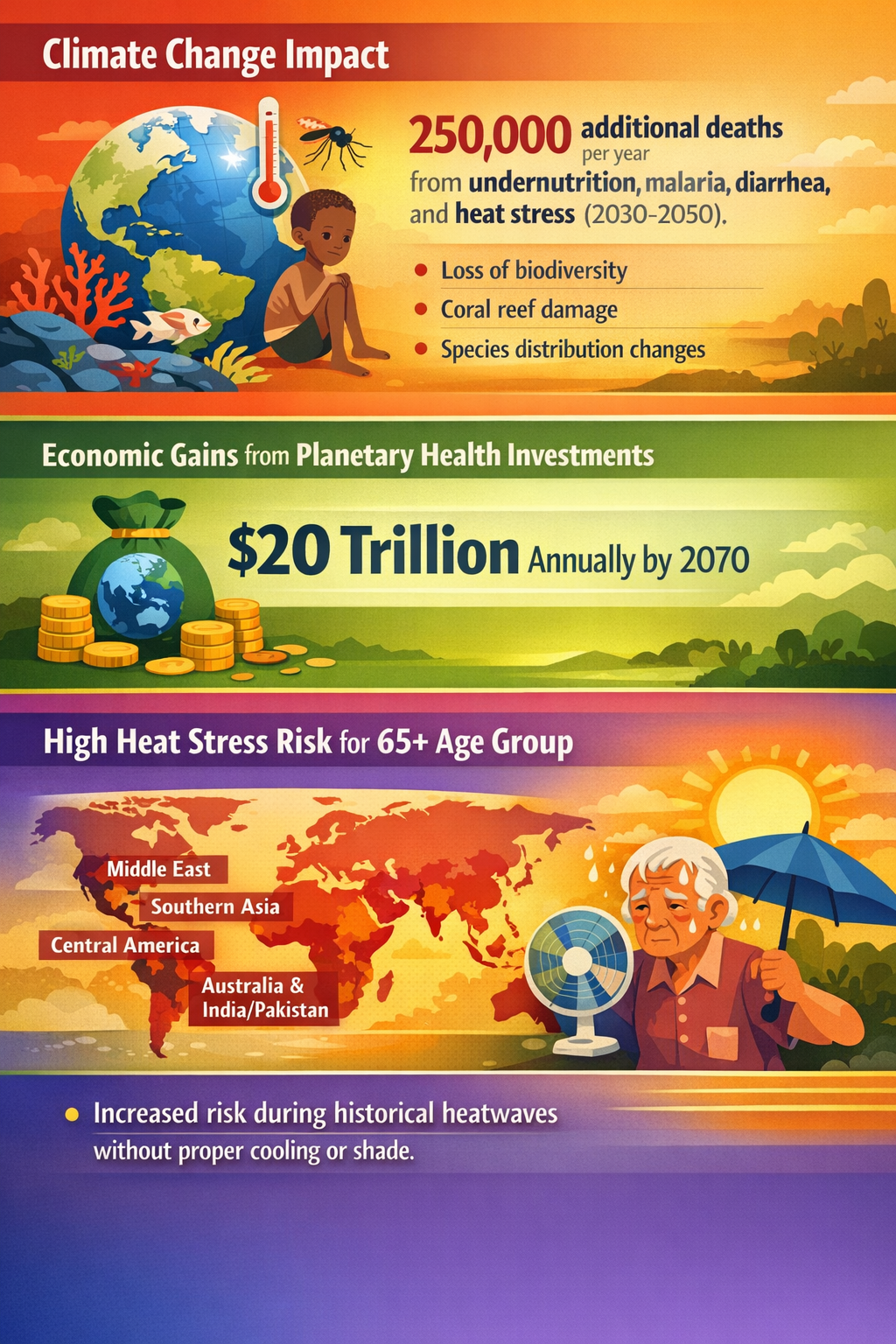
Simultaneously, the global health burden linked to climate-related heat stress is forecast to cause approximately 250,000 additional deaths annually by mid-century, mainly through increased vulnerability to malaria, diarrhea, undernutrition, and direct heat impacts (The Nation Online NG 17/01/2023). Yet despite this looming rise in morbidity and mortality, health systems, insurance markets, and labor standards are not aligned for systematic heat resilience—potentially exacerbating inequities among vulnerable populations exposed to these conditions.
The inattention to heat stress as a health, equity, and economic factor is compounded by the macroeconomic framing of planetary health risks. Recent macroeconomic modeling argues that investments into planetary health—encompassing climate adaptation and biodiversity protection—could unlock $20 trillion in annual economic gains by 2070 (Overpopulation Project 15/03/2023). However, heat stress remains under-integrated in such investment frameworks, limiting a full economic-risk valuation, especially regarding productivity drag and healthcare cost spikes tied to heat.
The systemic under-recognition of heat stress risk signals an urgency to reassess capital flows and regulatory architectures. Policy neglect in certain geographies may create uninsurable labor ecosystems and intensified social health inequities, with industries relying heavily on outdoor or non-climate-controlled labor especially exposed. This emerging pattern departs from conventional climate resilience approaches that focus on severe weather events or long-term temperature rises, revealing a nuanced but profound structural vulnerability.
Disruption Pathway
As global average temperatures rise alongside increased frequency of extreme heat days, chronic and acute heat stress may escalate faster than expected due to urban heat islands, sea-level insecurities, and regional atmospheric shifts. This escalation could trigger amplified health expenditures and degrade labor productivity, especially in sectors with outdoor workers, informal labor markets, and less adaptive infrastructure.
The lack of comprehensive regulatory frameworks acknowledging heat stress as an occupational and public health risk may accelerate systemic fragility. Existing models are often reactive rather than preventive, which introduces stresses such as rising insurance claims, lost productivity, and increased health disparities. For example, localized hotspots on the U.S. East Coast or Gulf region, typically unaddressed in NAPs, may experience compounding effects of heat stress combined with socio-economic deprivation, driving spatial inequity and industrial relocation pressures.
In response, industries and governments may need to implement structural adaptations such as enforceable heat exposure labor regulations, real-time heat monitoring linked to occupational safety, and diversified capital investments prioritizing climate-resilient infrastructure. Such adaptations could reshape labor markets by raising operational costs but also opening opportunities in emerging technologies like heat-resilient building materials, climate-adaptive urban design, and health-monitoring wearables.
Feedback loops may deepen as failures to adapt intensify health inequalities, leading to political mobilization and regulatory intervention. These dynamics could ultimately upend dominant governance models by shifting capital allocation toward “heat-resilience integrated” portfolios and challenging the viability of traditional growth models in at-risk regions. Predictive heat risk analytics may become a regulatory baseline, triggering new compliance requirements across insurance, investment, and public health domains.
Why This Matters
For senior decision-makers, the heat stress blindspot poses a critical challenge to health, equity, and economic resilience planning. Capital deployment may increasingly require integration of fine-grained heat risk analytics to avoid stranded labor assets and rising liabilities in health and insurance sectors.
Regulatory frameworks may shift to mandate explicit heat exposure limits and monitoring, especially in vulnerable geographic zones. Competitive positioning will favor organizations that proactively invest in heat-resilient infrastructure and labor protections, while industrial clusters in heat-vulnerable regions may face relocation or transformation pressures.
Supply chains reliant on heat-sensitive labor could experience disruptions, while social governance structures will be tested to mitigate inequities arising from uneven heat stress burdens. Liability exposure for health-related claims tied to heat stress may rise, prompting firms to reconsider their risk governance and human capital strategies.
Implications
This emerging heat stress risk may compel a paradigm shift toward integrative planetary health frameworks that embed granular climate-health equity considerations into capital and policy decisions. Investments in urban heat mitigation, occupational safety innovation, and public health surveillance could become economic imperatives rather than optional CSR or niche sustainability programs.
The evolution of heat stress as a recognized systemic risk could likely accelerate regulatory interventions within the next decade, especially as heat-related mortality and economic losses rise. However, this is unlikely to be uniform; pockets of inertia may sustain under-preparedness, especially in low-to-middle income geographies and industries with informal labor practices.
Competing interpretations might frame this issue narrowly as a labor or occupational safety concern, diluting the broader health and equity implications. Conversely, it might be dismissed as a marginal climate impact overshadowed by more visible biodiversity or air quality crises.
Nonetheless, the signal represents a material departure from conventional health risk framing, indicating that adaptation and resilience investments that neglect heat stress vulnerabilities may face escalating systemic and financial risks.
Early Indicators to Monitor
- Inclusion and expansion of heat stress risk assessments in national and regional climate adaptation plans (NAP reforms)
- Growth in venture capital and R&D funding for heat-resilient technologies, especially occupational heat monitoring and cooling solutions
- Patent filings related to heat adaptive building materials, personal cooling wearables, and heat stress diagnostic tools
- Insurance industry adjustments in underwriting heat-related worker compensation and health claims
- Public health reporting trends on heat-related morbidity and mortality, especially in emerging hot zones outside traditional tropical areas
Disconfirming Signals
- Robust geopolitical or regulatory moves standardizing comprehensive heat stress risk governance globally
- Material breakthroughs in rapid climate cooling or geoengineering reducing ambient heat exposure
- Significant downward revisions in climate models predicting regional heat stress severity
- Strong industry self-regulation and widespread investment in heat adaptation prior to widespread health impacts
Strategic Questions
- How can capital allocation frameworks integrate granular heat stress risk to preempt stranded assets and workforce health liabilities?
- What regulatory and industrial governance models need to evolve to address the emerging spatial and equity dimensions of heat stress?
Keywords
Heat Stress; Climate Adaptation; Occupational Health; Health Equity; Climate Risk; Planetary Health; Regulatory Frameworks; Capital Allocation; Urban Heat Islands; Social Resilience
Bibliography
- Making necessary investments in planetary health, on the other hand, would generate $20 trillion in annual economic gains by 2070. Overpopulation Project. Published 15/03/2023.
- Climate change is projected to cause approximately 250,000 additional deaths per year from undernutrition, malaria, diarrhea, and heat stress between 2030 and 2050, Ecosystems: Loss of biodiversity, damage to coral reefs, and changes in species distribution. The Nation Online NG. Published 17/01/2023.
- Only Kuwait's NAP acknowledges heat stress risk. ORF Online. Published 06/05/2023.
- Parts of North Carolina, Virginia, New Jersey and Pennsylvania would have a moderate risk of heat-related health effects such as heat stress, with pockets of major risk around Washington, D.C. Scientific American. Published 21/07/2023.