
The Hidden Fragmentation in AI Governance: A Wildcard for Global Industrial and Regulatory Realignment
Emerging fragmentation in AI governance, coupled with live compliance mechanisms and cross-border regulatory tensions, signals a potentially transformative shift in how AI risks and opportunities are managed globally. This less-noticed disaggregation could catalyse shifts in capital flows, reshape industrial alliances, and prompt new regulatory paradigms over the next two decades.
While many focus on AI regulation’s broad expansion and harmonization efforts, a subtler but critical development is the fracturing of governance architectures into fragmented, dynamic “live” systems requiring continuous adaptation. This weak signal undermines the assumption that AI compliance will settle into stable frameworks, instead suggesting persistent regulatory flux and a contest for normative supremacy. Its ripple effects threaten to realign competitive positioning across sectors and jurisdictions, challenging conventional foresight on AI governance’s evolution.
Signal Identification
This development qualifies as an emerging inflection indicator due to its potential to disrupt traditional centralized governance models by 2031–2041 (10–20 years), with a high plausibility given ongoing regulatory trajectories and industry feedback loops. The exposed sectors include technology platforms, financial services, healthcare, international trade, and regulatory bodies. It is not mere noise or incremental change; rather, it represents a systemic break in the AI governance continuum, transitioning from static rulebooks towards dynamic, multilayered compliance ecosystems that vary by jurisdiction and use-case complexity (Fifthrow 13/05/2026
What Is Changing
Several strands within the AI governance landscape converge on a core structural theme: fragmented, real-time AI compliance in a legally plural world.
Firstly, Gartner’s elevation of information integrity risk, fueled by opaque AI decision-making and ambiguous transparency mandates (Gartner 13/05/2026), illustrates mounting pressures on enterprises to manage the dual burden of technology adoption and data veracity in shifting regulatory environments. This challenge will expand beyond IT departments, implicating entire governance apparatuses with evolving standards increasingly difficult to reconcile across borders.
Secondly, Fifthrow’s analysis of “live fragmentation” identifies a tectonic shift away from centralized, monolithic AI governance towards interoperability of fragmented national and regional frameworks. Enterprises must now embed “live compliance” systems that adapt to real-time regulatory updates, national variations, and sector-specific guidelines (Fifthrow 13/05/2026). This challenges legacy compliance approaches and prefigures a new paradigm of continuous, distributed control.
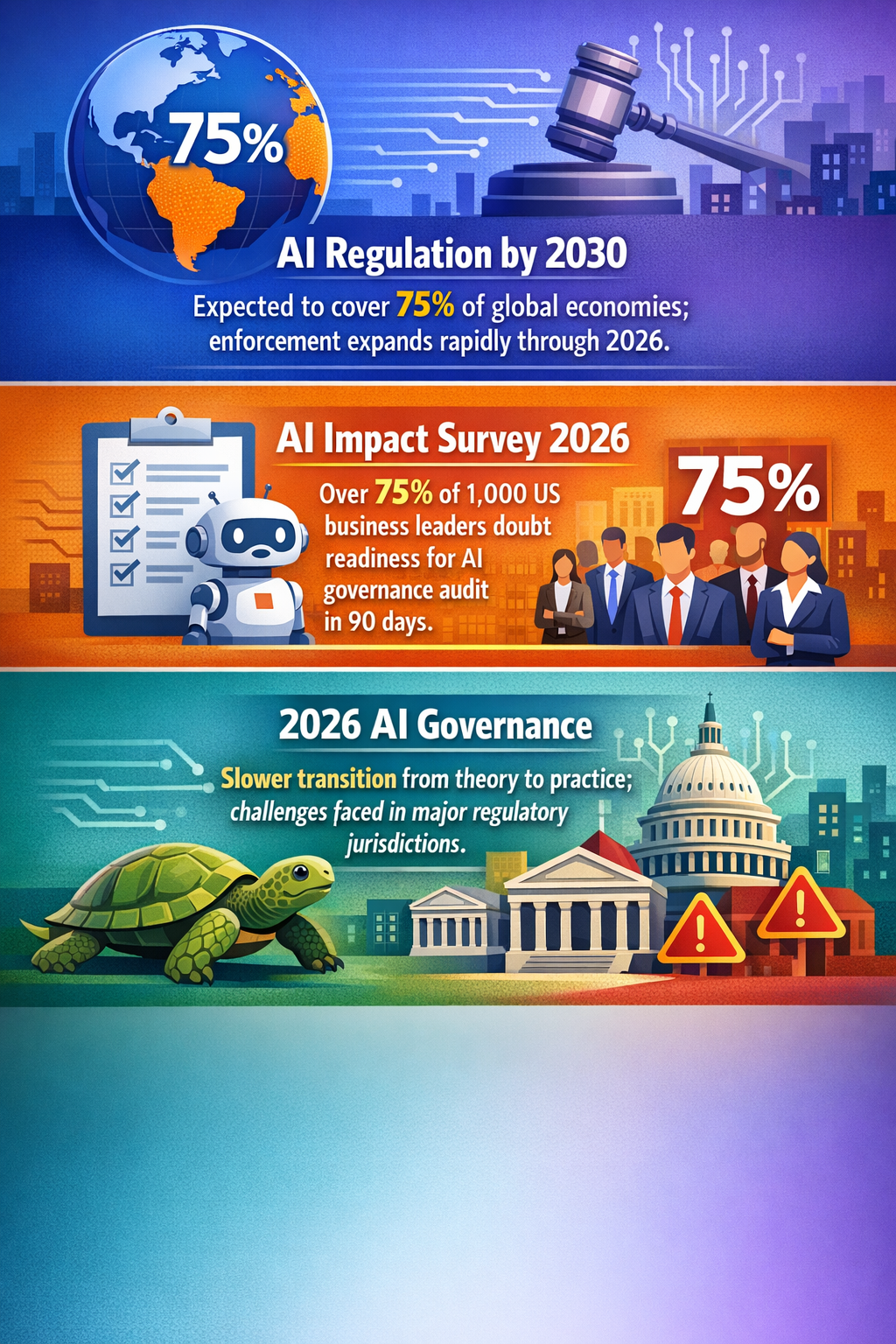
Thirdly, the rapidly expanding scope of AI regulation—set to cover approximately 75% of global economies by 2030, with enforcement accelerating through 2026 (SQ Magazine 14/05/2026)—reinforces that the governing landscape is proliferating regulatory nodes rather than converging. This expansion increases complexity for multinational firms and fragmentizes the industrial landscape, leading to diverse competitive advantages based on localized regulatory navigation capabilities.
Fourthly, emerging responses from governments such as Colombia with a National AI Policy roadmap exemplify how middle-tier economies deploy AI governance to capture regional leadership niches (Alcor 20/03/2026). These regional policies do not mirror dominant powers but create variegated governance systems, further entrenching fragmentation.
Collectively, this constellation of developments signals a systemic governance shift that is less hierarchical and more networked, demanding agile compliance and investment strategies cognizant of persistent regulatory disequilibrium.
Disruption Pathway
This signal could evolve into structural change through several reinforcing mechanisms. The acceleration condition lies in ongoing AI innovation combined with geopolitical divergence in risk tolerance and governance philosophy. As AI use proliferates in critical sectors—healthcare, finance, consumer products—capacity to embed “live compliance” will become a strategic differentiator.
This introduces stresses by elevating compliance costs and fragmenting supply chains along regulatory fault lines. Firms may face duplication of controls or costly adaptations for specific jurisdictions, which would favor those with advanced regulatory intelligence and local partnerships, potentially sidelining smaller players. Such pressure could catalyse industry federations or consortiums to negotiate mutual recognition or “governance bridges,” adding another governance layer.
Structural adaptations may include the rise of AI governance service providers embedding compliance engines within software management platforms (SMPs), a trend supported by projections that 50% of organizations will adopt SMPs with AI governance features by 2027 (Fungies 05/02/2026). This could commoditize governance expertise and accelerate differential industrial configurations pivoting around compliance capability hubs.
Feedback loops may reinforce divergence as non-harmonized standards incentivize “regulatory arbitrage,” where firms base operations in jurisdictions with more permissive or rapidly evolving AI rules. This may prompt regulatory bodies toward either cooperative convergence mechanisms or escalatory decoupling, depending on political dynamics and economic stakes.
Over time, dominant governance models could shift from nation-state-centric frameworks toward polycentric, platform-driven ecosystems focusing on “live,” real-time compliance orchestration. This ecosystem shift could disrupt traditional regulatory enforcement, elevating private sector-led governance architectures in a reconfigured industrial order.
Why This Matters
Decision-makers face heightened exposure in capital allocation as the fracturing governance landscape may reroute investments towards jurisdictions with competitive regulatory infrastructure or governance innovation. Traditional benchmarks based on static regulatory environments will become less reliable.
Regulatory implications include increased operational complexity, compliance risk, and liability exposure, particularly for enterprises operating cross-border. Failing to embed adaptive governance capabilities could lead to punitive enforcement, reputational damage, or constrained market access.
For competition, firms with proprietary live compliance systems and governance controls may establish barriers to entry and capture first-mover advantages. Supply chains could bifurcate or localize due to compliance imperatives, disrupting global industrial strategies.
Governance consequences extend beyond legal frameworks to organizational design, demanding multidisciplinary AI governance, risk, and compliance leaders, mirroring healthcare’s emerging roles in AI interoperability and compliance (Senior Executive 22/11/2026). Governments may need to rethink enforcement, oversight, and international coordination models to keep pace.
Implications
This signal could plausibly scale into fundamental structural change if firms and regulators fail to establish stable, interoperable AI governance systems. The transition from centralized certainty to live fragmentation might become the new normal, transforming industrial ecosystems.
Capital may increasingly flow to platforms and service providers that enable “live compliance” architectures, potentially overshadowing AI product innovation alone. Regulatory frameworks might pivot from prescriptive rules to adaptive, context-driven mandates, with enforcement relying on embedded monitoring rather than periodic audits.
However, this development is not inevitable; alternative outcomes include effective international harmonization or technology-enabled standardization that re-centralize governance models. Some interpretations view fragmentation as transitional “noise” before convergence rather than a permanent shift.
Distinguishing structural change from transient complexity requires close monitoring of regulatory alignment efforts, investments in compliance automation, and geopolitical shifts in AI governance philosophies.
Early Indicators to Monitor
- Proliferation of AI governance features embedded in software management platforms and governance-as-a-service solutions
- Regulatory draft releases showing increased divergence or novel “live compliance” mandates by key jurisdictions
- Growth in industry consortiums or federated compliance frameworks across multiple countries
- Venture funding clustering around compliance automation startups focused on dynamic, multi-jurisdictional AI risks
- Capital reallocation trends favoring regions with distinctive AI policy roadmaps or governance innovation hubs
Disconfirming Signals
- Rapid global harmonization of AI governance rules via coordinated supranational bodies reducing fragmentation
- Technological advancements enabling universal, automated AI compliance validation across jurisdictions
- Widespread adoption of a dominant regional AI governance framework that others emulate or incorporate
- Political or economic incentives driving de-fragmentation rather than competition among regulatory regimes
Strategic Questions
- How can organizations build flexible, real-time compliance capabilities that adapt across fragmented AI governance regimes?
- What governance architectures and partnerships will position jurisdictions and firms as preferred AI hubs amid regulatory disaggregation?
Keywords
AI governance; live compliance; regulatory fragmentation; capital allocation; governance automation; AI compliance; industry disruption; risk governance
Bibliography
- Information integrity risk, caused by the proliferation of AI-enabled decision-making and uncertain AI transparency requirements, gained the top rank of emerging risks for the first quarter of 2026. Gartner. Published 13/05/2026.
- AI governance fragmentation in 2026 compels enterprises to adopt live compliance, manage cross-border AI risks, and adapt quickly to evolving regulations. Fifthrow. Published 13/05/2026.
- By 2030, AI regulation is expected to cover around 75% of the world’s economies, with enforcement already expanding rapidly through 2026 and tightening global compliance requirements. SQ Magazine. Published 14/05/2026.
- On the policy side, Colombia’s government approved the National AI Policy (CONPES 4144) in early 2025 - a multi-year roadmap through 2030 with 106 specific actions and $115.9 million earmarked to position Colombia as a leader in responsible AI innovation across Latin America. Alcor. Published 20/03/2026.
- Looking ahead, 50% of organizations will adopt SMPs with AI governance features by 2027. Fungies. Published 05/02/2026.
- By 2030, the highest-demand roles will likely be health informatics and clinical data leaders, AI governance and compliance leads, and healthcare interoperability and automation managers. Senior Executive. Published 22/11/2026.