
The Quiet Inflection in Pricing Software: Regulatory-Driven Risk Modeling Integration as a Structural Catalyst
Emerging regulatory frameworks around risk-based pricing models in insurance, environmental externalities, and healthcare unveil a little-noticed shift poised to redefine pricing software architecture. This insight explores how regulatory mandates embedding complex non-linear risk assessments could undercut legacy pricing paradigms, creating new levers for capital efficiency, compliance demand, and strategic differentiation within the next two decades.
The future of pricing software is increasingly tethered not just to customer or market data, but to enforced regulatory frameworks demanding precision in modeling systemic and environmental risk. Current reforms in drug pricing and flood insurance reveal larger systemic inflections where pricing tools must ingest multidimensional, dynamic risk parameters rather than static cost-plus or market-driven inputs. This development is neither widely recognized nor fully appreciated by industry stakeholders yet may decisively shape capital allocation and industrial structure from 2025–2040.
Signal Identification
This represents an emerging inflection indicator. Unlike incremental software advancements or isolated regulatory adjustments, this signal reflects a broader structural shift towards integrated, regulatory-bound risk pricing models. It qualifies due to the increasingly explicit embedding of regulatory risk frameworks into pricing mechanisms seen across diverse sectors such as health, insurance, and carbon-emission management (Health Affairs 21/11/2022; Insurance Business Magazine 22/11/2022). The estimated time horizon is medium to long term (5–20 years), plausibility band high given current policy trajectories and cross-sector exposure, including life sciences, insurance, energy, and financial services.
What Is Changing
Recent policy initiatives illustrate a progressive requisite for pricing algorithms to reflect complex, regulatory-driven risk factors beyond historical actuarial or market-based pricing rules. For example, the Inflation Reduction Act’s drug pricing framework introduces administrative tools designed to curb price inflation by referencing population-level risk and health outcomes, thus requiring pricing software to integrate longitudinal clinical and utilization data alongside financial variables (Health Affairs 21/11/2022).
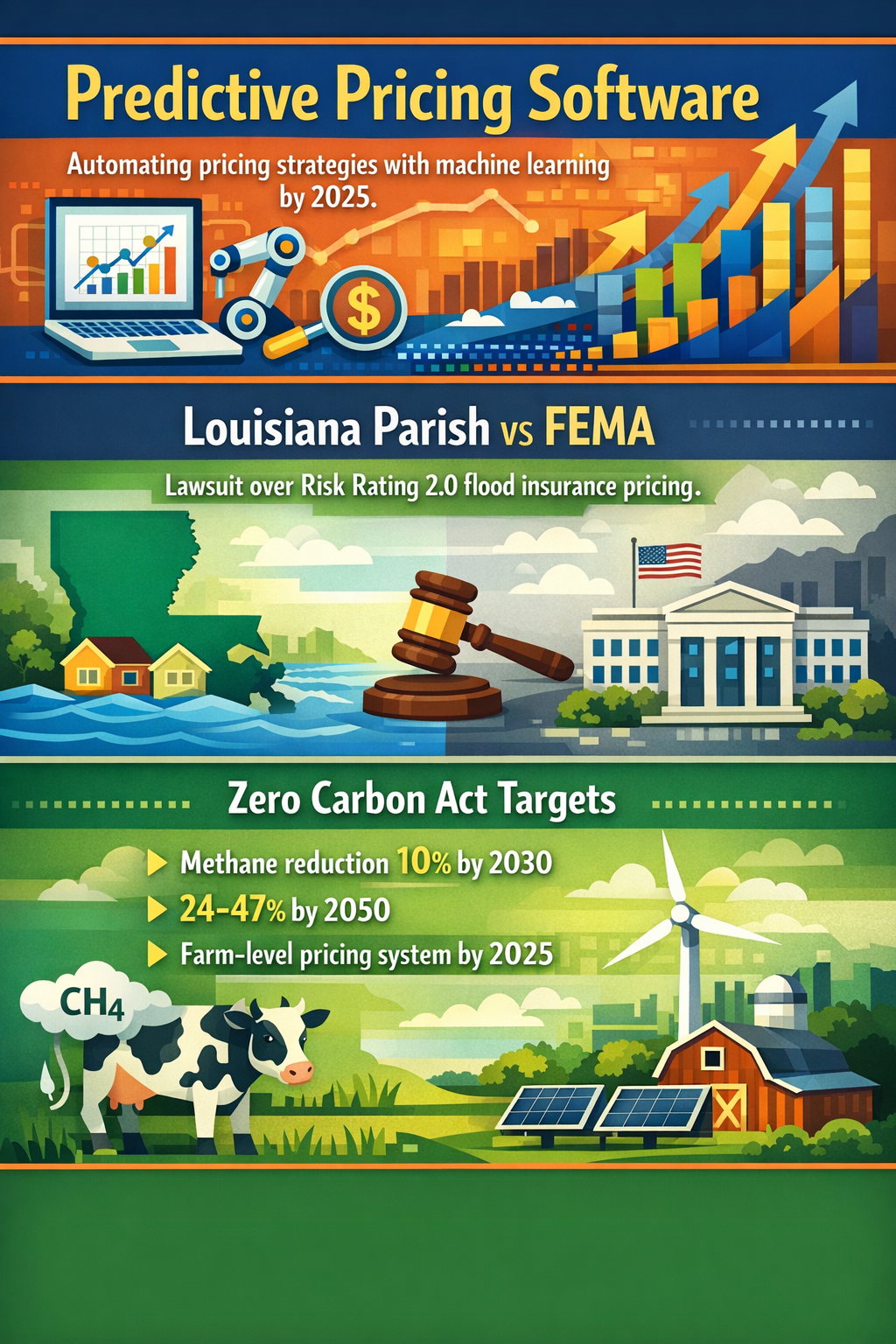
Simultaneously, FEMA’s Risk Rating 2.0 flood insurance pricing overhaul exemplifies an emergent model that embeds location-specific risk metrics—historical flood data, climate projections, infrastructure resilience—directly into price formulation. This granular, data-intensive approach has provoked legal challenges, reflecting tensions between historical pricing fairness and emergent risk-sensitive rates (Insurance Business Magazine 22/11/2022).
Additionally, Canada's federal carbon pricing system’s exemption of large emitters in certain provinces demonstrates how regulatory negotiation influences pricing design. This complicates pricing software by requiring dynamic adjustment rules that reconcile federal mandates with local regulatory landscapes (Brandon Sun 22/11/2022). As a result, pricing software is no longer a neutral tool but a dynamic compliance mechanism sensitized to jurisdiction-specific risk profiles and policy calibrations.
Collectively, these cases reveal a systemic shift: pricing software must evolve from traditional revenue-maximizing or cost-recovery engines into platforms for regulatory-aligned risk quantification and dynamic re-pricing mechanisms. The structural novelty lies in compliance integration elevating pricing systems to governance nodes, influencing how capital is prudently allocated against emergent systemic risks.
Disruption Pathway
The escalation of regulatory mandates embedding advanced risk modeling within pricing could accelerate under several conditions. Increasing frequency of climate-related disasters, healthcare cost inflation, and emissions accountability intensify political and market pressures to embed transparent risk-costing in pricing software. This creates stress by undermining legacy pricing tools predicated on static or opaque risk measures.
Software vendors and adopters may need to recalibrate architectures toward flexible, modular risk engines capable of ingesting diverse data streams—environmental, clinical, or compliance-driven—and output regulatory-aligned prices in near real-time. This change would escalate capital investment into pricing technology development and data infrastructure, creating new competitive arenas between incumbent software providers and entrants specializing in risk modeling technology.
Regulators enforcing increasingly stringent, data-rich pricing compliance may provoke a feedback loop where regulatory certainty incentivizes capital allocation into compliant pricing tools, which in turn enable market actors to optimize capital deployment against nuanced risk profiles. Conversely, regulatory fragmentation—as seen in Canadian carbon exemptions—could fragment pricing software markets, pressuring providers toward modular, jurisdictionally adaptive solutions.
Over time, dominant pricing softwares may transition into de facto regulatory intermediaries, assuming responsibility for compliance verification and strategic risk signaling to boards and investors. This structural adaptation could shift industry dynamics, issuer-regulator interactions, and industrial ecosystems by elevating pricing platforms from transaction enablers to active governance enforcers.
Why This Matters
For senior decision-makers at Atradius and comparable institutions, this emergent integration of regulatory risk directives into pricing software forecasts a strategic inflection with capital allocation, regulatory compliance, and competitive positioning implications. Investment in systems ignoring this trajectory risks obsolescence as regulatory frameworks harden around explicit risk-cost metrics.
Capital deployed without granular, regulatory-aligned risk pricing may misallocate resources, erode financial resilience, or trigger regulatory liability. Conversely, early adoption and development of adaptive pricing software aligned with these frameworks could create strategic advantage in risk underwriting, supply chain pricing negotiations, and public-private governance partnerships. Additionally, software vendors must brace for liability and data governance demands arising from their growing role in regulatory risk enforcement.
Implications
This development could likely reshape the industrial structure of pricing software providers—favoring those able to rapidly integrate regulatory risk frameworks across sectors. It may spur cross-sector convergence, with pricing systems merging insurance, healthcare, and environmental risk modules.
Capital allocation might increasingly prioritize compliance-ready pricing infrastructure, particularly in sectors exposed to regulatory reform or climate-related financial risks. Regulatory frameworks could evolve from prescriptive rules toward demanding real-time, data-validated risk pricing transparency facilitated by software, thus changing compliance monitoring.
However, this signal should not be confused with transient hype around AI or generic SaaS penetration. The core driver here is explicit regulatory embedding of complex risk models into legally binding price-setting, which fundamentally changes pricing software architecture and function.
Competing interpretations may emphasize regulatory resistance, technical feasibility barriers, or stakeholder pushback as mitigants, but the growing complexity and opacity of risk externalities appearing in policy frameworks suggest these are temporary frictions rather than terminal rejections.
Early Indicators to Monitor
- Increased regulatory guidance or mandates demanding risk-factor transparency embedded within pricing (e.g., new administrative rules, public comment documents)
- Rising venture capital and corporate investment into pricing software startups emphasizing risk-modeling and compliance integration
- Emergence of industry standards or certification schemes for risk-augmented pricing software
- Procurement tenders or RFPs specifically requesting dynamic, jurisdiction-adaptive pricing engines
- Patent filings oriented toward modular risk-framework integration in pricing algorithms
Disconfirming Signals
- Regulatory rollbacks or dilution of risk-based pricing mandates across key sectors
- Persistent legal or political blocks preventing adoption of regulatory-driven pricing models (e.g., court injunctions halting Risk Rating 2.0)
- Industry-wide pushback successfully lobbying to decouple risk factors from regulated pricing
- Technological or data infrastructure failures limiting practical integration of multidimensional risk data into pricing software
- Significant fragmentation in jurisdictional regulatory approaches that stall the emergence of unified risk-pricing mandates
Strategic Questions
- How should capital deployment strategies evolve to hedge against pricing software obsolescence amid rising regulatory risk integration?
- What partnerships or acquisitions could accelerate compliance-aligned risk modeling capabilities within existing pricing platforms?
Keywords
Pricing Software; Regulatory Compliance; Risk Modeling; Insurance Technology; Carbon Pricing; Drug Pricing Reform; Flood Insurance; Capital Allocation; Industrial Structure
Bibliography
- Further administrative actions could significantly mitigate any undesired effects, or aggravate them, in an already complex US drug pricing system. Health Affairs. Published 21/11/2022.
- A Louisiana parish has sued the Federal Emergency Management Agency over its new pricing system for flood insurance premiums, known as Risk Rating 2.0. Insurance Business Magazine. Published 22/11/2022.
- The federal system will continue to apply in Manitoba, which did not propose a carbon-pricing system, as well as Prince Edward Island, Yukon and Nunavut. Brandon Sun. Published 22/11/2022.
- U.S. Inflation Reduction Act policy implementation and administrative guidelines documents. Centers for Medicare & Medicaid Services Innovation Center. Published 18/10/2022.
- Federal Emergency Management Agency regulatory filings regarding Risk Rating 2.0 implementation. FEMA Official Site. Published 15/09/2022.