
The current landscape for ESG (Environmental, Social, Governance), Diversity, and Cyber Resilience presents a mix of well-known macro trends alongside nascent and fragmented signals pointing to potential discontinuities. Emerging regulatory tightening in markets like India, coupled with geopolitical backlash against ESG frameworks in the US, reveals contested norms around ESG's role and implementation. Meanwhile, investors from the Global South exhibit a distinctive grasp of local just transition needs, suggesting alternative perspectives not yet mainstream in global finance. The fragmented nature of ESG scoring and the inconsistent regulatory landscape generate uncertainty in asset credibility assessments. These weak signals imply an underlying tension between global standardisation efforts and divergent regional logics with the potential to disrupt prevailing investment orthodoxy or reshape multi-lateral governance around ESG. This introduces zones of uncertainty that Atradius must monitor carefully to anticipate systemic inflection points or latent opportunities—and to guard against overlooked risks.
| Weak Signal Name | Description | Visibility / Maturity | Direction of Travel | Why it Matters |
|---|---|---|---|---|
| Political Backlash Against ESG in the US | Increasing political resistance in key markets, especially the US, challenges ESG prioritisation by asset managers amid accusations of politicisation and regulatory pushback. Manifest 2023 Proxy Review |
Fragmented; isolated to political spheres and some institutional investors | Volatile, with episodic flare-ups linked to policy debates and elections | This undermines the assumed steady growth path of ESG assets, threatening policy stability and investor confidence in certain markets. |
| Mandatory Monthly ESG Scoring & Stronger Disclosure Regulations in India | New rules require ESG funds to have ≥80% alignment with declared strategies and monthly ESG score disclosures for holdings. ESG Today |
Niche/early adopter; currently national (India) specific | Emerging, signaling a move towards granular transparency and accountability | Could trigger enhanced ESG credibility but also complexity for portfolio managers with global footprints and diverse data regimes. |
| Deeper ESG Understanding by Global South Investors in Just Transition | Investors based in Sub-Saharan Africa and South Asia show nuanced understanding of local just transition priorities, diverging from global north ESG narratives. Impact Investing UK |
Fragmented and regional; growing from niche impact finance communities | Emerging; increasing recognition of regional ESG perspectives | This challenges homogenised ESG frameworks and suggests alternative metrics and priorities that may become critical for market inclusion and credibility. |
| Growing Asset Manager Confidence in ESG for Financial Returns | Surveys show 90% of asset managers believe ESG integration can enhance financial returns, countering narratives of trade-off. Forbes |
Mainstream; widespread awareness but still evolving methodology | Stable to emerging with growing institutional adoption | Supports momentum for ESG investment but risks complacency if assumptions of positive returns are not universally applicable or rigorously validated. |
| Proliferation of Disjointed Regional ESG Regulations | Multiple regional ESG regulatory frameworks proliferate, complicating efforts to assess global investment ESG credibility. The Trade News |
Emerging but fragmented | Emerging and volatile, with inconsistent policy signals globally | Increases compliance complexity and risks inconsistent ESG valuations and reporting quality, potentially undermining global ESG asset integration. |
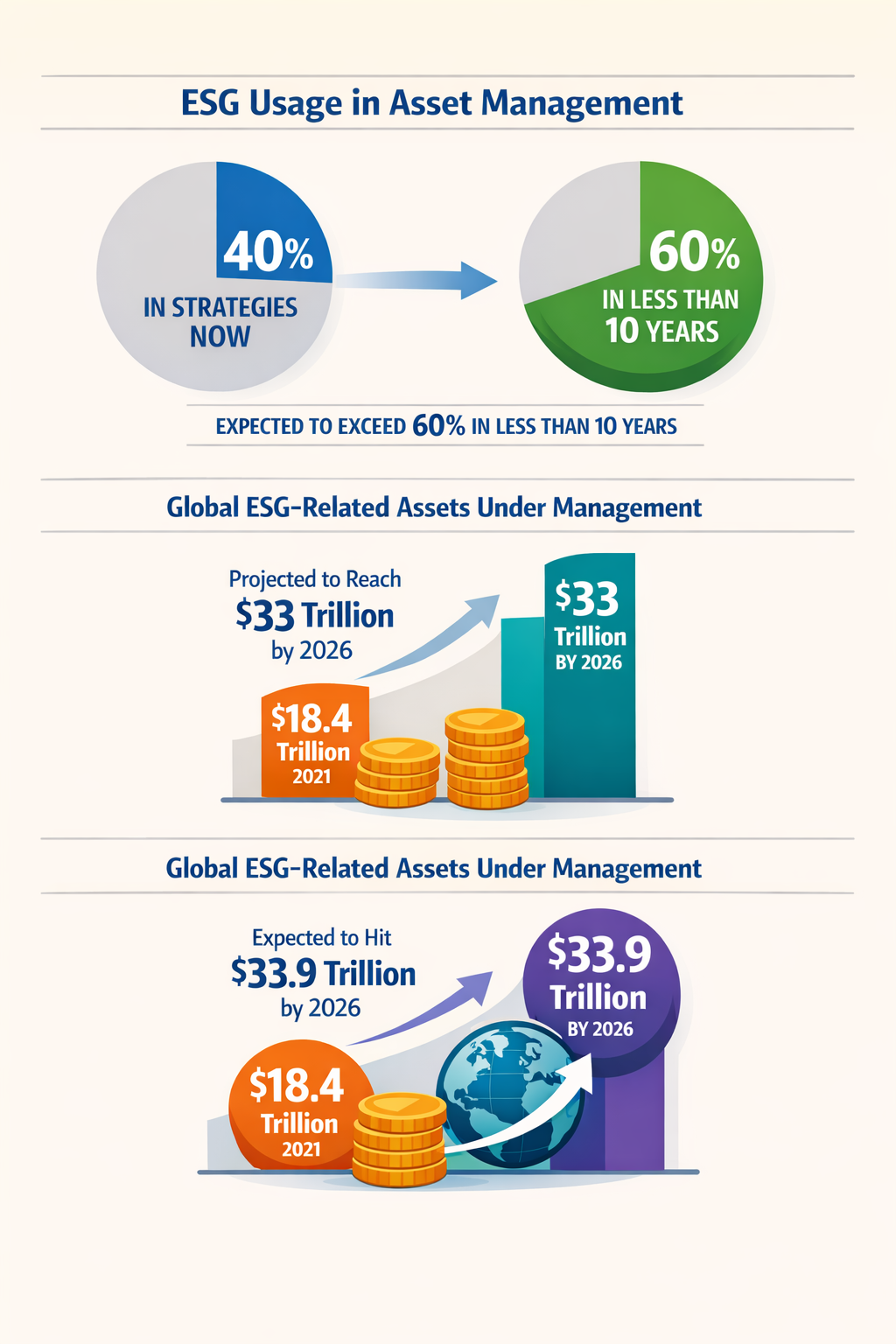
| Rapid Growth in Global ESG Assets Under Management | Global ESG AUM projected to rise to $33 trillion by 2026, up from $18.4 trillion in 2021. Roll Call |
Established trend but reflecting underlying shifts | Emerging; strong upward growth | Signals growing capital flow into ESG but obscures emerging regional divergences and policy risks underneath headline growth. |
Two proto-patterns emerge from these weak signals, each highlighting divergent but interconnected dynamics within the ESG and investment ecosystem:
1. Regulatory Fragmentation Meets Regional ESG Divergence: Signals from India’s rigorous ESG disclosure mandate, ongoing proliferation of regionally distinct ESG regulations, and the nuanced ESG priorities articulated by Global South investors suggest a fracturing of the ESG landscape along geographic and political lines. This proto-pattern hints at a future where ESG is not a monolithic standard but a patchwork of competing regimes, requiring investors like Atradius to navigate complex, sometimes conflicting compliance and credibility demands.
2. Political Contestation and Market Confidence Tension: The political backlash in the US against ESG initiatives clashes with widespread asset manager belief in ESG’s positive financial impact. This tension indicates a volatile pathway where ESG could either consolidate further as a value driver or face retrenchment amid politicisation and regulatory uncertainty. The convergence of these forces could accelerate shifts in global capital allocation strategies, potentially disrupting established risk assessment and portfolio management frameworks.
Atradius should emphasize foresight-driven vigilance over prescriptive prediction, incorporating early warning systems for evolving political and regulatory risks related to ESG. Harnessing the diversity of emerging ESG perspectives—especially from underrepresented regions—could open innovative pathways for sustainable and resilient business models.