
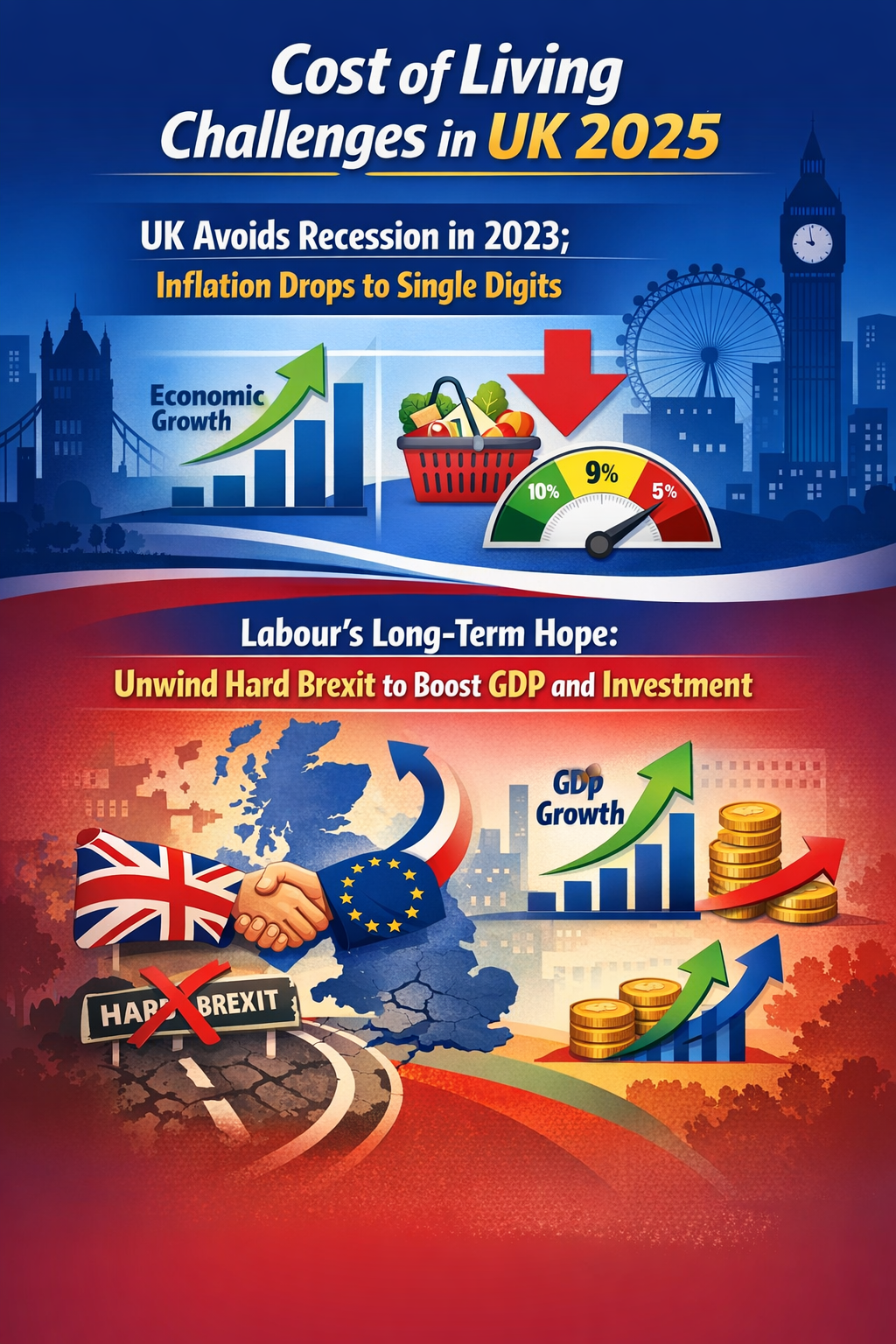
Headline & Summary
Analysis of recent evidence reveals a complex landscape evolving within the domain of the Consumer Savings Crisis, marked by intensifying cost-of-living pressures, housing and mortgage cost shocks, and shifting macroeconomic dynamics in the UK. Key signals denote an accelerating mortgage repayment crisis juxtaposed with an easing inflation trajectory that may soon tip towards deflation, while government interventions such as cost-of-living payments persist as stabilizing factors. Backdrop geopolitical and policy shifts, especially around Brexit-related trade and EU relations, add systemic transformation elements influencing household and business financial resilience. Understanding these patterns is critical for Atradius to anticipate emerging risks and identify potential economic resilience or vulnerability clusters.
| Signal / Theme | Direction | % Change or Relative Frequency | Short Commentary |
|---|---|---|---|
| Mortgage Payment Crisis and Rising Borrowing Costs | Accelerating | Mentions increased significantly in mid-2023 (peak June 2023 coverage) | Mortgage rates rising sharply, especially in London, are driving steep payment increases (up to £8,000 annually for some homeowners), with rising repossessions and lender withdrawal of fixed-rate deals, intensifying household financial distress (Standard). |
| Cost of Living Support Payments & Welfare Interventions | Stable | Consistent annual coverage; continuing government commitment through 2025 | UK Government maintains cost-of-living financial support (2025 payments), aimed at vulnerable households. Eligibility remains tied to means-tested benefits with automatic distribution reducing friction (London Business Mag). |
| Inflation Trends & Risk of Near-Term Deflation | Accelerating | Spike in inflation rates in early 2023, followed by increased forecasts of deflation in 2024–2025 | Inflation remains elevated but food and energy prices show signs of easing, potentially leading into deflation by 2024–2025. Monetary policy may have overshot, risking economic drag, with Bank of England forecasts and economist warnings highlighting deflation possibility (FD Capital). |
| Brexit Aftereffects and UK-EU Relations Impacting Economic Confidence | Stable to Slightly Accelerating | Steady discourse with increasing mentions of re-alignment or pragmatic rapprochement | Political and economic debate reveals gradual UK pivot towards closer EU alignment, partly driven by economic erosion post-hard Brexit and geopolitical pressures. This could influence trade flows, regulatory alignment, and ultimately cost structures (The Guardian). |
| Trade Agreements & Tariff Reduction Impact on Consumer Prices | Emerging Opportunity | Low frequency but forward-looking with implementation due after 2023 | The Australia-UK FTA promises tariff elimination on goods within five years, potentially easing import costs and therefore consumer prices, offering long-term mitigation of cost pressures for households and businesses (PM.gov.au). |
Pattern Narrative
The accelerating mortgage repayment crisis forms the most acute and immediate consumer savings pressure point, reflecting a destabilising risk pattern as households face sharply increased outgoings amid persistent wider cost-of-living challenges. This distress is primarily driven by monetary tightening and banking market dynamics exacerbating the cost of borrowing for homeowners, especially in expensive urban centers like London. Concurrently, inflation trends, while still elevated, are showing signs of backward bending towards deflation within a forecast horizon of 1-2 years. This suggests that monetary policy may have overshot its mark with risks of over-restriction possibly stifling consumer spending further, highlighting a delicate balancing act for policymakers.
Cost-of-living payments and welfare supports provide a moderating influence, continuing to stabilize vulnerable population segments and thus partially buffering downside consumption risks. This signal remains stable with government commitment expected to persist at least through 2025, indicating ongoing recognition of consumer financial strain.
Strategically, the UK’s evolving trade and political restructuring post-Brexit—including gradual rapprochement with the EU and emergence of new trade deals, such as the Australia-UK FTA—constitute transformation drivers with the potential over the mid- to long-term to reshape supply chains, reduce import costs, and ease consistent upward price pressures on consumer goods. However, these are longer-horizon factors currently emerging in discourse but not yet fully changed the immediate consumer savings landscape.
Implications
Signals Gaining Momentum
Wild Cards to Watch