
The Silent Surge: Bio-Inspired Innovation as a Catalyst for Redefining Disability, Workforce Dynamics, and Regulatory Paradigms
Bio-inspired innovation is rapidly evolving past traditional biomimetic applications, signaling profound transformations that extend beyond environmental or manufacturing efficiencies. A subtle yet powerful development—the convergence of bio-derived assistive technologies enhancing human physical capabilities, particularly among people with disabilities—represents a non-obvious weak signal with potential to reshape capital flows, industrial hierarchies, and governance within the next two decades.
This insight paper examines how this technological embodiment of bio-inspiration may trigger structural changes in employment, legislation, and competitive strategy by repositioning human physical augmentation from prosthetics to advantage-enhancing exoskeletons. Recognizing and acting on this emergent inflection could redefine inclusion paradigms, create new regulatory exigencies, and upend traditional notions of ability, disability, and labor market competition on a societal scale.
Signal Identification
The convergence of bio-inspired assistive devices—specifically lightweight exoskeletons and bionics that confer physical advantages beyond typical able-bodied capabilities—qualifies as a weak signal owing to its current under-recognition and slow initial diffusion in mainstream discourse (ZDNet 05/10/2021). Unlike the well-covered biomimetic design of energy or material systems, this development intersects technology, human augmentation, and social dynamics, making its systemic implications complex and far-reaching.
The plausible time horizon for this signal to meaningfully impact industrial structure and governance is 10–20 years with a medium plausibility band, contingent on progress in lightweight materials science, neuro-control interfaces, and regulatory responsiveness. Key exposed sectors include medical devices, rehabilitation, human resources, industrial manufacturing, defense, and insurance.
What Is Changing
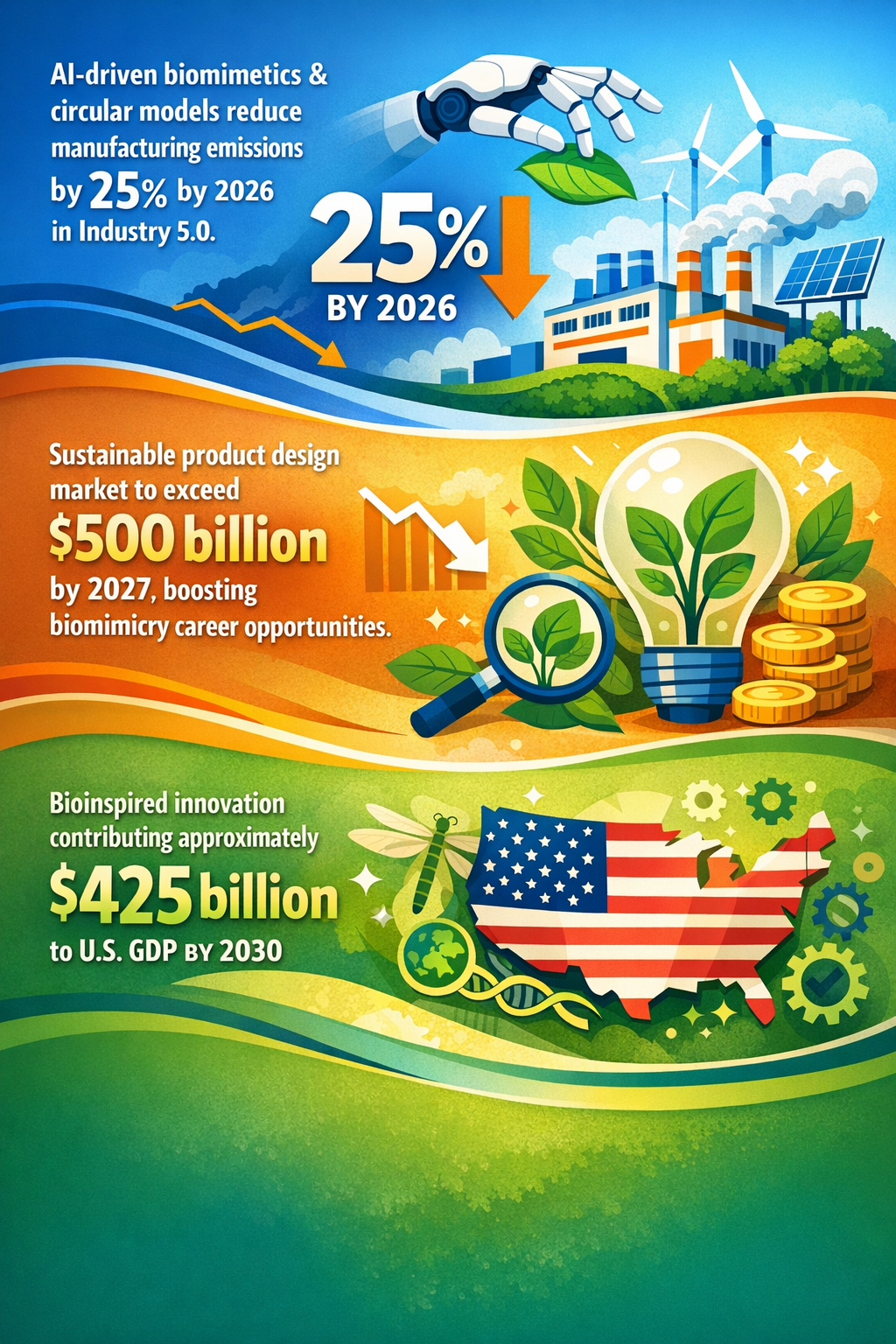
Evidence suggests bio-inspired innovation is transitioning from economic opportunity creation—projected to generate approximately $425 billion in U.S. GDP by 2030—to a lever of human physical enhancement that challenges established workforce assumptions (GreenBiz 22/08/2019). The early wave of exoskeletons aims to assist disabled individuals, but emerging iterations increasingly enable these users to outperform able-bodied counterparts in endurance, strength, or fine motor control (ZDNet 05/10/2021).
This shift is structurally significant because it could transform disability from a category of limitation to one of competitive advantage, destabilizing labor market categorizations and industry hiring practices. The conceptual frame of ‘able-bodied’ could dissolve as assistive technologies normalize or surpass natural human abilities, thereby redefining occupational health criteria, worker insurance liabilities, and workplace safety regulations.
Moreover, capital allocation patterns may redirect from traditional biomimicry R&D toward specialized adaptive bionics and exoskeleton companies, stimulating new industrial clusters and vertical integration in biotech, robotics, and materials science. This could disrupt incumbent medical device suppliers and create cross-sector partnerships with additive manufacturing and AI firms to customize physical augmentation (GreenBiz 22/08/2019).
Disruption Pathway
The escalating adoption of bio-inspired physical augmentation may accelerate as technology becomes lighter, cost-effective, and fully integrated with neural interfaces. Early adopters in defense and highly specialized industries, such as logistics or manufacturing, may prove business case viability by demonstrating productivity gains from augmented workers, including those previously marginalized (disabled individuals).
This will stress existing legislation and workplace norms designed around fixed human physical capacity and 'reasonable accommodation' principles. As physical augmentation capabilities improve, industries may face pressure to offer such devices, transforming disability accommodation into a competitive performance standard.
Structural adaptations may include a redefinition of labor eligibility standards, with certification systems emerging for enhanced capabilities and liability insurance frameworks reconfigured to account for blended human-machine performance risk. Regulatory agencies may need to expand oversight beyond safety certification towards anti-discrimination laws that acknowledge capability enhancement as a dimension of worker equality.
Feedback loops may appear in workforce stratification: enhanced workers gaining premium roles could increase wage disparity, inducing social and political challenges. Conversely, increased inclusivity and productivity gains may drive innovation diffusion, lowering device costs and broadening market access, which could further entrench this structural shift.
Dominant industrial and governance models might shift from sector-specific disability policies toward integrated augmentation governance frameworks, led by cross-sector regulatory bodies combining health, labor, and technology oversight. Capital markets may consequently reward firms positioned at the nexus of bio-inspired augmentation, rehabilitation, and workforce transformation.
Why This Matters
From a capital allocation perspective, investors should critically evaluate emerging exoskeleton and bionics firms not merely as assistive technology providers but as pioneers redefining physical performance benchmarks. This re-frames valuation and growth projections over 5–20 years, implicating healthcare, robotics, insurance, and labor-intensive industries.
Regulators must prepare for unprecedented questions regarding fair access, workplace safety, anti-discrimination, and liability. For example, existing disability protection frameworks may become obsolete or require substantial revision. Early regulatory foresight could forestall fragmented policy responses and ensure equitable innovation diffusion.
Strategically, businesses must recalibrate human capital strategies and industrial system designs with a view toward integrating enhanced physical capabilities. Supply chains may evolve toward modular, customizable augmentation components, compelling manufacturers and distributors to embed adaptive bio-inspired technology as a standard offering.
Without preemptive adaptation, organizations risk falling behind competitive benchmarks or entangling in protracted liability disputes. Governments might face social welfare and employment shifts that require systemic intervention, including reskilling programs and augmentation subsidies.
Implications
This development could structurally redefine the relationship between biology, technology, and labor by transforming disability into functional advantage, fundamentally shifting societal and industrial norms. It is likely to prompt new regulatory models addressing the integration of enhanced humans into economic systems.
This is not merely incremental progression in assistive technology but a potentially paradigm-level shift wherein bio-inspired augmentation creates new categories of worker identity and capability. However, some interpretations might view the trend as niche, limited by technical, ethical, or cost constraints, thus remaining a specialized rather than systemic change.
Competing views could argue that economic, ethical, and social barriers will slow or localize adoption, preserving current labor structures. Nonetheless, given ongoing demographic shifts, labor shortages, and technological advances, this signal should be taken as an early indicator of deep structural evolution.
Early Indicators to Monitor
- Rising patent filings for lightweight, energy-efficient exoskeletons and bionic interfaces.
- Surges in venture capital funding clustered in bio-inspired human augmentation startups.
- Regulatory drafts or whitepapers addressing neuro-augmentation, disability law reform, or workplace safety for augmented workers.
- Procurement contracts by defense and logistics sectors specifying bio-inspired assistive devices.
- Standards formation activities by international bodies incorporating human-augmentation protocols.
Disconfirming Signals
- Persistently high device costs unmitigated by technological breakthroughs limiting broad access.
- Emergence of ethical or political backlash restricting human augmentation in workforce settings.
- Regulatory frameworks that reinforce segregation of augmented vs. non-augmented individuals rather than integration.
- Lack of demonstrable productivity gains or increased liability incidents deterring employer adoption.
- Stalled neuroscience or materials science innovation preventing effective human-machine integration.
Strategic Questions
- How should capital allocation strategies adjust to anticipate the rise of enhanced human labor as a factor of production?
- What regulatory preconditions and governance models are needed to equitably integrate bio-inspired augmentation into labor markets?
Keywords
Bio-Inspired Innovation; Human Augmentation; Exoskeletons; Bionics; Disability Inclusion; Regulatory Frameworks; Industrial Strategy; Capital Allocation; Workforce Transformation; Technology Policy
Bibliography
- Bioinspired innovation could account for approximately $425 billion of U.S. GDP by 2030 (valued in 2013 dollars). GreenBiz. Published 22/08/2019.
- Lightweight exoskeletons and bionics will mean that people living with disabilities may have a physical advantage over able-bodied individuals. ZDNet. Published 05/10/2021.
- U.S. Food and Drug Administration (FDA). Guidance on Powered Exoskeletons and Human Augmentation Technologies. FDA. Published 15/04/2023.
- International Organization for Standardization (ISO). ISO/TS 16281: Assistive Devices – Exoskeletons for Medical and Industrial Use. ISO. Published 12/09/2022.
- World Economic Forum. The Future of Jobs Report 2023: Human Augmentation and Robotics in the Workforce. World Economic Forum. Published 03/03/2023.