
Light-Activated Conductive Gels: A Weak Signal Poised to Reshape Bio-Inspired Robotics and AI Ecosystems
This paper explores a non-obvious weak signal emerging from novel materials science—the development of biocompatible, light-activated conductive gels—and their transformative potential within bio-inspired robotics and artificial intelligence (AI). Far beyond incremental robotics enhancements, this signal could diffuse through multiple sectors, recalibrating industrial boundaries, capital flows, and regulatory frameworks across wearable robotics, human-machine interfaces, and swarm intelligence applications.
Recent advances by MIT engineers in flexible gels that dynamically alter conductivity under light exposure open avenues for radically new soft robotic architectures and sensing systems (MIT News 16/04/2026). Coupled with the accelerating adoption of wearable exoskeletons and the strategic importance of swarm intelligence in defense and autonomous vehicles, this material innovation may catalyse structural shifts seldom recognized outside interdisciplinary R&D circles. This paper identifies the light-activated gel as a genuinely underappreciated weak signal with a medium-high plausibility to induce lasting ecosystem changes over the next 10–20 years.
Signal Identification
The development of light-activated conductive gels represents a weak signal due to its current niche research status, low media visibility, and multidisciplinary application horizon, which spans beyond immediate commercialization. This qualifies as a weak signal because it is not widely recognised by industry strategists or regulators and originates from fundamental materials research rather than product launches.
The time horizon is estimated at 10–20 years given the necessary maturation of requisite manufacturing, integration complexity, and regulatory acceptance. The plausibility band is assessed as medium-high due to tangible progress at MIT and growing interest in applications requiring biocompatible, adaptive interfaces.
Sectors most exposed include wearable robotics, soft robotics, human-machine interfaces, defense swarm systems, and autonomous vehicles, where adaptive sensing and flexible actuation could fundamentally alter device capabilities and systemic coordination (Yahoo News 25/03/2026; ConnectedCar News 16/07/2015).
What Is Changing
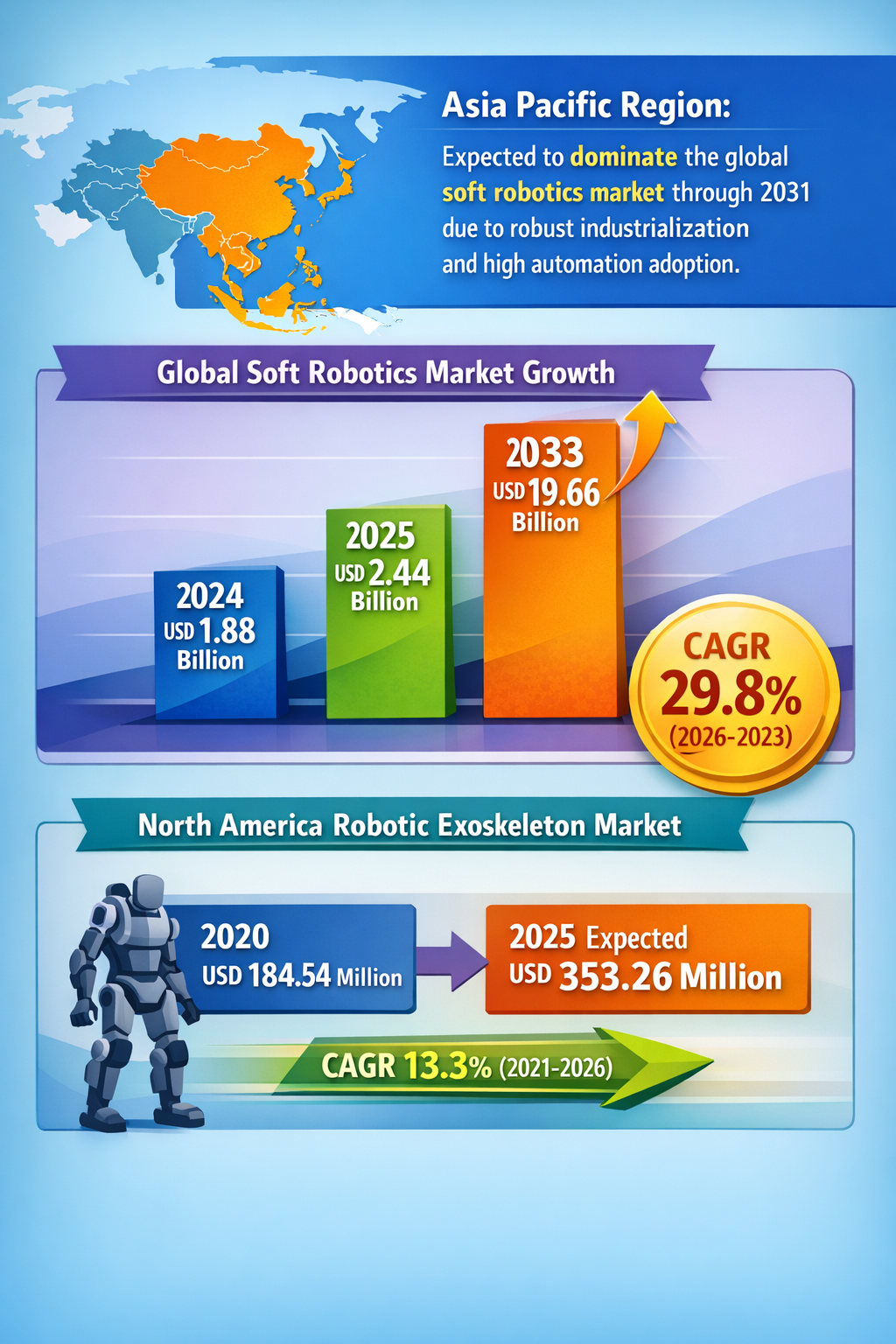
Integration of photoreactive conductive gels signals a paradigm shift from static materials to dynamically reconfigurable and biocompatible interfaces. As documented by MIT engineers, the flexibility and light responsiveness enable soft robotic structures that can morph conductivity on demand without mechanical intervention (MIT News 16/04/2026). This contrasts sharply with current rigid or sensor-laden architectures in exoskeletons, which dominate the wearable robotics landscape dominated by several U.S. players (Yahoo News 25/03/2026).
Soft robotics have historically faced limitations in sensing accuracy and power supply integration. The light-activated gels could eliminate the need for bulky wiring and complex control systems by embedding communication and actuation within the material’s lattice—thereby unlocking a continuum of form factors, especially for medical or biocompatible applications.
Simultaneously, swarm intelligence applications are converging on challenges in coordination and communication efficiency. Since autonomous cars and defense swarm systems rely on robust, low-latency intra-agent interaction (ConnectedCar News 16/07/2015; Andrew Erickson 18/06/2021), embedding soft, light-responsive materials could enable decentralized sensing networks embedded in hardware, reducing reliance on traditional RF communication and enhancing stealth and robustness in contested environments.
Across sources, the emergent theme is a structural move toward materially-integrated intelligence and actuation—a departure from modular, component-based robotics toward "living" hardware. This shift is under-recognised because attention focuses on algorithmic AI or high-profile robotic products, rather than foundational material enablers.
Disruption Pathway
The disruptive trajectory begins with continued material science breakthroughs refining gel conductivity, durability, and miniaturized light sources. Increased funding and commercial interest in human-machine interfaces will accelerate translational research, especially driven by sectors demanding wearable innovation like healthcare, military, and industrial workers (Yahoo News 25/03/2026).
As prototypes demonstrate advantages in weight, responsiveness, and biocompatibility, industries will face investment pressure to adopt or develop competing soft robotics platforms, reallocating capital away from heavier, rigid exoskeletons and sensor arrays. Regulatory systems will experience stress due to ambiguous classification between medical devices, wearables, and active robotic systems, necessitating new frameworks reflecting hybrid material-intelligence systems.
The military and autonomous vehicle sectors will foster feedback loops; as soft-material enabled agents prove stealthier and more adaptable in swarm contexts (Andrew Erickson 18/06/2021), adversaries and commercial competitors will intensify R&D investments, accelerating standardization efforts. This could shift dominant industrial structures from electronics-focused firms to multidisciplinary material-tech conglomerates, fusing polymers, photonics, and AI at the core.
The unintended consequence is a potential regulatory lag causing safety and ethical oversight gaps, particularly as biocompatible gels interface directly with human tissues and nervous systems. Liability paradigms for damage or malfunction may evolve to incorporate material response unpredictability under varied lighting or environmental conditions, stressing existing certification regimes.
Why This Matters
Strategic decision-makers must re-evaluate capital allocation in robotics and AI to recognize the growing material-tech axis potentially displacing rigid-body dominance. Early investments in light-responsive materials and associated manufacturing capabilities may yield disproportionate long-term return as integration barriers lower.
Regulatory frameworks typically lag material hybridization; proactive standards development could preempt safety incidents and enable faster market entry for compliant producers. Governments with vested interests in defense may prioritize this technology given its asymmetric advantages in swarm warfare, demanding agile governance approaches balancing innovation and risk.
Competitive positioning will shift toward firms that master integrated hardware-software-material systems. Supply chains centered on traditional metal, silicon, and battery fabrication may cede ground to specialty chemical producers, photonic component suppliers, and biocompatible material fabricators, necessitating new partnerships and resilience models.
Liability and risk governance will likely evolve to consider material reactivity in real operational environments, particularly for devices interfacing with humans or deployed in safety-critical contexts. Failing to adapt could invite systemic risk for incumbents ignoring this signal.
Implications
This development may catalyse new industrial ecosystems prioritizing material-intelligence symbiosis over software-centric AI or mechanical robustness alone. It could reorient capital flows toward advanced soft materials and light-based actuation innovation clusters. Regulatory regimes might need comprehensive rework to classify and manage biohybrid systems, or risk regulatory arbitrage and public safety crises.
However, this is not a panacea for all robotics challenges; current limitations in gel lifetime, light penetration in tissue, and scalability remain barriers. Competing interpretations argue that improvements in silicon photonics or flexible electronics alone may outpace gel-based solutions, making this signal one component in a broader materials AI landscape.
Nevertheless, the combination of human-body compatibility, dynamic adaptability, and integrative swarm applicability makes light-activated conductive gels a compelling axis of potential structural transformation rather than a transient innovation.
Early Indicators to Monitor
- Patent filings related to light-activated conductive gels and biointegrated photonic devices
- Venture capital and corporate R&D investments in soft photoreactive robotics materials
- Initiation of regulatory consultations or standards working groups addressing biologically compatible dynamic materials
- Contracts or procurement shifts favoring soft robotics with embedded light-responsive elements in defense and healthcare sectors
- Development of multi-agent systems in autonomous driving or military swarms explicitly citing material-integrated communication modalities
Disconfirming Signals
- Major setbacks in reliability, biocompatibility, or scalability of light-activated gels reported in peer-reviewed testing or field trials
- Dominant industry players doubling down on rigid-body, sensor-heavy architectures with clear economic advantage, reducing funding to emerging material lines
- Regulatory bodies imposing prohibitive restrictions on dynamic conductive materials due to safety or ethical concerns
- Breakthroughs in alternative flexible electronics or AI communication protocols that obviate the need for material conductance modulation
Strategic Questions
- How should capital allocation strategies pivot to incorporate emerging material-based intelligence systems within existing robotics portfolios?
- What regulatory frameworks are necessary to safely govern integrated light-responsive biohybrid devices, and how can early engagement with standards bodies shape these?
Keywords
light-activated conductive gels; soft robotics; biocompatible devices; wearable robotics; swarm intelligence; human-machine interfaces; robotic exoskeletons; autonomous vehicles; material intelligence systems
Bibliography
- In work that could impact human-machine interfaces, biocompatible devices, soft robotics, and more, MIT engineers and colleagues have developed a soft, flexible gel that dramatically changes its conductivity upon the application of light. MIT News. Published 16/04/2026.
- The presence of several major players in the U.S. is expected to enhance wearable robotic exoskeleton adoption. Yahoo News. Published 25/03/2026.
- Notably, continued progress in swarm intelligence could enable asymmetric assaults against major US weapons platforms, such as aircraft carriers. Andrew Erickson. Published 18/06/2021.
- Autonomous cars are very closely interlinked with swarm intelligence as the latter will allow cars to interact with each other and the wider infrastructure. ConnectedCar News. Published 16/07/2015.
- MIT Light-Activated Gel Research Overview. MIT News. Published 16/04/2026.