
Beyond Aesthetics: The Emergence of Biophilic Materials Innovation as a Structural Inflection in Sustainable Architecture
Exploring how material science innovations rooted in biophilic principles could disrupt architectural capital allocation, regulatory frameworks, and industrial ecosystems over the next two decades.
Biophilic design’s rising popularity is often framed as an interior aesthetic trend or a well-being enhancement for office and residential environments. However, a non-obvious, far-reaching development lies in the intersection of biophilic design with advanced embodied carbon regulation, circular economy strategies, and material innovations. This weak signal—biophilic materials innovation as a driver of new sustainability standards—has the potential to realign capital flows, shift product value chains, and redraw regulatory boundaries beyond superficial green mandates. Over a 10 to 20-year horizon, embedding biophilic biomimetic materials into stringent embodied carbon frameworks could catalyse a structural industry transformation, thus expanding the impact of biophilic design from psychological benefits to systemic decarbonization and industrial strategy.
Signal Identification
This development qualifies as a weak signal because it is currently overshadowed by discourse focusing primarily on biophilic design’s health and productivity benefits (London Loves Business 02/12/2023). The material science implications embedded in emerging embodied carbon regulation, circular economy priorities, and green infrastructure research remain underexplored within biophilic architecture. The time horizon spans medium to long-term structural effects (10–20 years), with a medium to high plausibility band given accelerating policy activity and capital shifts towards sustainability transitions (Springer Sustainability 10/05/2025; IQ-EQ 15/11/2025). Key sectors exposed include building materials manufacturing, architectural services, green finance, and regulatory agencies focused on emissions and construction standards.
What Is Changing
The biophilic design movement’s core premise—human affinity for nature via natural forms, patterns, and materials—is converging with stricter embodied carbon regulations and circular economy demands (Springer Sustainability 10/05/2025). These regulatory trends prioritize life-cycle carbon emissions and circular reuse of building components, not just operational efficiency.
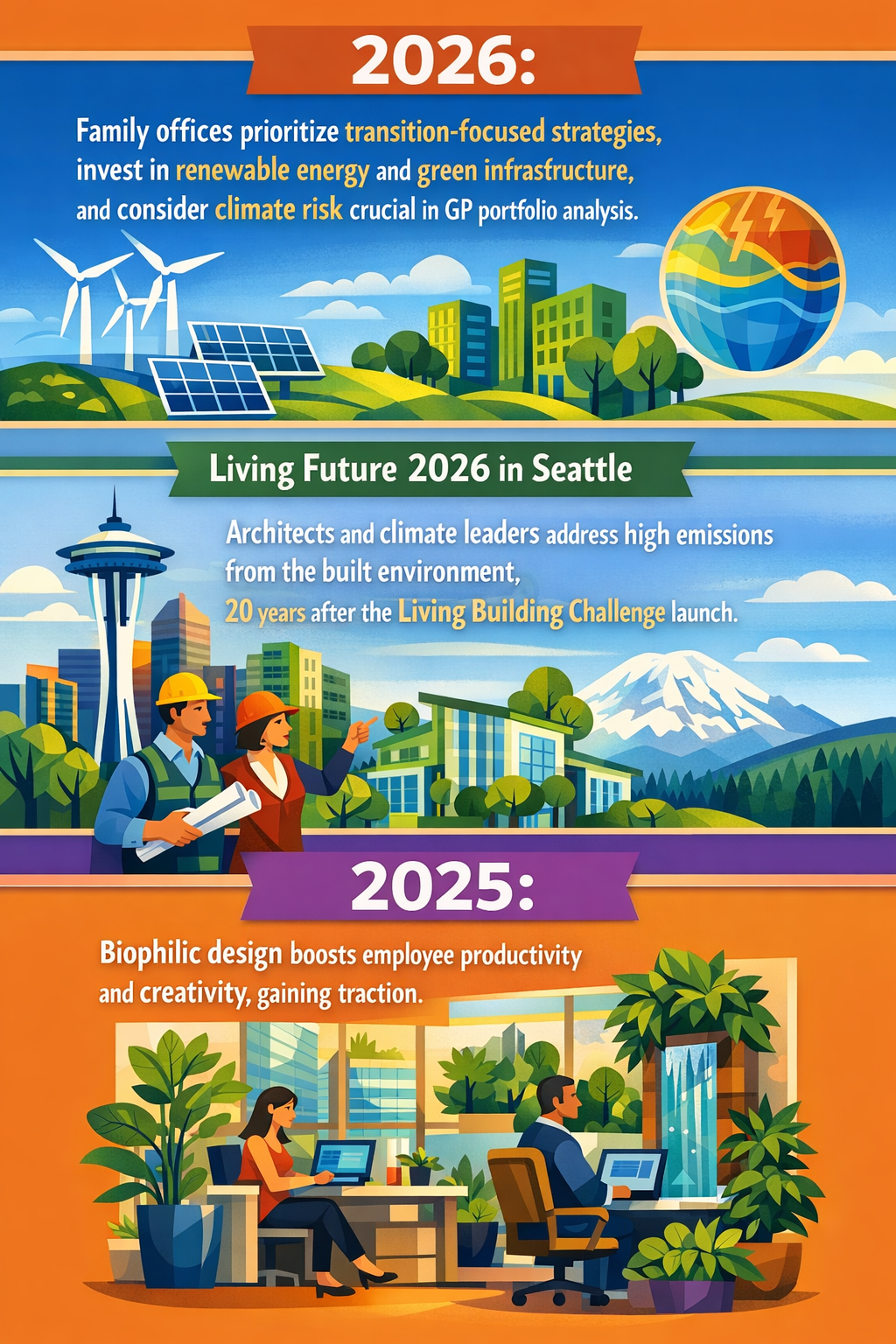
This shift aligns with the growing emphasis by family offices and long-term investors on green infrastructure and climate-risk-aware portfolio transition strategies (IQ-EQ 15/11/2025). Capital allocation is increasingly directed at R&D into biomimetic materials and smart composites that satisfy embodied carbon caps while delivering biophilic qualities, such as natural air purification, light modulation, or humidity regulation.
Meanwhile, the Living Building Challenge’s recent conferences highlight persistent challenges as overall emissions from the built environment remain unacceptably high despite progress in green construction (PR Newswire 20/11/2025). This underscores a systemic inflection point where incremental “green” efforts are insufficient without disruptive material innovation rooted in nature-inspired resilient systems.
Thus, the substantive structural theme emerging is the fusion of biophilic design with embodied carbon and circular economy imperatives to spawn new material innovation pathways. This nexus substitutes token natural elements with functionally biomimetic, low-impact building materials that may redefine industrial production and regulatory schemas.
Disruption Pathway
Material innovation driven by biophilic principles could escalate through increased integration in national embodied carbon regulations and circular economy policies. Accelerating research, development, and demonstration (RD&D) efforts incentivized by public frameworks may lower costs and improve performance of these materials compared to traditional concrete, steel, or plastics (Springer Sustainability 10/05/2025). Enhanced verification and certification processes aligned with biophilic-materials standards would create trust and market demand, prompting early adopters in commercial real estate and infrastructure sectors to shift procurement strategies.
As procurement volume increases, traditional materials supply chains may experience stresses and disruption caused by declining demand for high-carbon inputs. This could marginalize incumbent manufacturers without innovation capabilities or expose vulnerabilities in the cement and steel supply chains, catalysing consolidation or diversification toward biomimetic composites. Regulatory adaptations might follow, with expanded embodied carbon frameworks explicitly referencing biophilic and biomimetic material standards, requiring architects and developers to meet holistic environmental and wellness criteria.
Feedback loops could emerge whereby issuer ratings and green bond frameworks begin to reward projects employing certified biophilic materials, attracting more capital into innovation ecosystems and incentivizing supplier transformation. Conversely, unintended consequences such as ‘greenwashing’ through superficial biophilic features without genuine embodied carbon reductions could prompt regulatory backlash, necessitating stricter audit regimes.
Dominant models of architectural practice may evolve into interdisciplinary collaborations—blending biology, material science, and architecture—while new governance frameworks incorporate environmental psychology metrics alongside carbon metrics. This could reshape both industrial structures and public policy, moving beyond aesthetically driven biophilic design toward structural greening embedded in supply chains and regulatory mandates.
Why This Matters
Decision-makers in capital deployment face shifting risk-reward profiles: investments in traditional, carbon-intensive materials manufacturing may depreciate as markets pivot toward biomimetic low-carbon alternatives. Regulatory frameworks that incorporate embodied carbon and circular economy principles will likely tighten, affecting the legal compliance and permitting processes for new buildings.
Competitive positioning could shift strongly toward firms integrating advanced biophilic materials science, drawing on multi-disciplinary innovation pipelines. Supply chain resilience may depend on controlling or accessing novel biomimetic inputs, requiring forward-looking industrial strategy and potentially cross-sector collaboration. Liability could extend to failure in meeting new environmental or wellness performance standards, with governance models increasingly integrating biophilic credentials as part of project approval and rating mechanisms.
Implications
This development may represent structural change by redefining valuation and procurement routines around embodied carbon and biophilic integration. It is likely to move beyond current biophilic design’s incremental focus on occupant well-being to embed large-scale carbon impact reduction and material circularity as non-negotiable design criteria.
However, this signal is not simply an incremental design trend or an aesthetic fad. Its disruptive potential depends on scaling RD&D, embedding biomimetic materials in embodied carbon regimes, and capital reallocations within construction and materials sectors. Some may interpret this as an extension of existing green building innovation, but the synthesis of biophilia with regulatory carbon and circularity frameworks elevates it to a previously under-recognized inflection.
Early Indicators to Monitor
- Growth in patent filings related to biophilic biomimetic building materials and composites.
- Emergence of embodied carbon regulatory drafts explicitly referencing biophilic or biomimetic materials.
- Venture capital and family office investment clustering in biomimetic materials startups aligned with sustainable building.
- Formation of international or national standards for biophilic materials performance and embodied carbon metrics.
- Procurement commitments from major real estate developers or public agencies favoring certified biophilic materials.
Disconfirming Signals
- Failure to embed biophilic materials specifications within embodied carbon regulatory frameworks or their dilution into non-binding guidelines.
- High cost premiums or technical failures of biomimetic materials precluding market adoption at scale.
- Entrenchment of incumbent materials industries through lobbying or subsidization, blocking innovation diffusion.
- Market or investor backlash against green innovation perceived as ‘greenwashing’ leading to stricter, less nuanced regulations.
Strategic Questions
- How can capital allocation strategies align with emerging material innovation ecosystems integrating biophilic design and embodied carbon frameworks?
- What regulatory mechanisms might be designed or adapted to credibly certify and incentivize the use of biomimetic biophilic materials at scale?
Keywords
Biophilic Design; Embodied Carbon; Biomimetic Materials; Circular Economy; Sustainable Architecture; Green Infrastructure; Capital Allocation; Industrial Strategy
Bibliography
- Given that embodied carbon regulation involves material innovations, circular economy strategies, and green infrastructure policies, integrating RD & D-driven solutions into national frameworks could accelerate policy adoption and strengthen global climate commitments. Springer Sustainability. Published 10/05/2025.
- Twenty years after the launch of the Living Building Challenge, architects, designers, and climate leaders will gather in Seattle for Living Future 2026 to confront a difficult question: despite decades of green building progress, emissions from the built environment remain dangerously high. PR Newswire. Published 20/11/2025.
- In 2026, family offices are expected to move beyond compliance towards transition-focused strategies, backing renewable energy and green infrastructure while treating climate risk as an essential consideration when analysing a GP’s portfolio. IQ-EQ. Published 15/11/2025.
- Biophilic design, which connects people with nature by incorporating natural elements, will gain prominence in 2024. London Loves Business. Published 02/12/2023.
- Living Building Challenge official initiatives and reports on sustainability in architecture. Living Future Institute. Last updated 15/09/2025.