
The Unseen Structural Inflection: Micro-Regionalisation via Nearshoring’s Next Phase
Deglobalisation and regionalisation are often framed as macro-scale realignments in supply chains towards fewer but larger regions or massive onshoring efforts. Yet an overlooked emerging inflection suggests a far more granular evolution: the rise of micro-regional supply agglomerations driven by layered nearshoring strategies coupled with localized industrial ecosystems. This could reshape capital allocation, regulatory priorities, and industrial architectures over the coming 5–20 years beyond conventional narratives of mere geographic proximity adjustment.
The shift from globalisation to regionalisation has accelerated post-pandemic and amidst geopolitical tensions, with enterprises prioritizing supply chain resilience and shorter logistics routes. However, a genuinely non-obvious nuance gaining traction is the clustering of industrial activities not just at the country or macro-region scale but within sub-national micro-regions optimized for interconnected supplier networks, talent pools, infrastructure, and regulatory incentives. This micro-regionalisation can fracture traditional regulatory and economic zones and reconfigure industrial structure in ways rarely addressed in current scenario planning.
Signal Identification
This development qualifies as an emerging inflection indicator because it moves beyond nearshoring as a simplistic “relocation” of production towards a multi-layered clustering phenomenon occurring within nearshored geographies. The signal is evidenced by growing supplier diversification combined with regional industrial real estate expansion and government policies incentivizing concentrated supply ecosystems at municipal or state levels. The plausibility band is Medium-High, with a 5–10 year horizon for observable scaling in America’s Mexico and southern U.S. border corridors and up to 20 years globally as similar patterns appear in Southeast Asia and Europe.
Sectors most exposed include manufacturing (especially electronics and automotive), logistics, industrial robotics deployment, and policy domains in trade, tariffs, and regional planning.
What Is Changing
Existing analysis frequently highlights nearshoring moving manufacturing out of China towards Mexico or Southeast Asia (SUAID Global 03/02/2026), but deeper examination reveals that firms are increasingly optimizing specific local clusters within these nearshoring countries. This cluster formation is exemplified by intensified industrial leasing activity in U.S. domestic manufacturing hubs (The AI Consulting Network 25/03/2026), which is stimulated by reshoring incentives and efforts to mitigate tariffs (White House 15/02/2026). These regional clusters do not replicate the global supply chain’s sprawling footprints but instead rely on dense, interdependent ecosystems akin to Silicon Valley or German Mittelstand networks at a smaller scale.
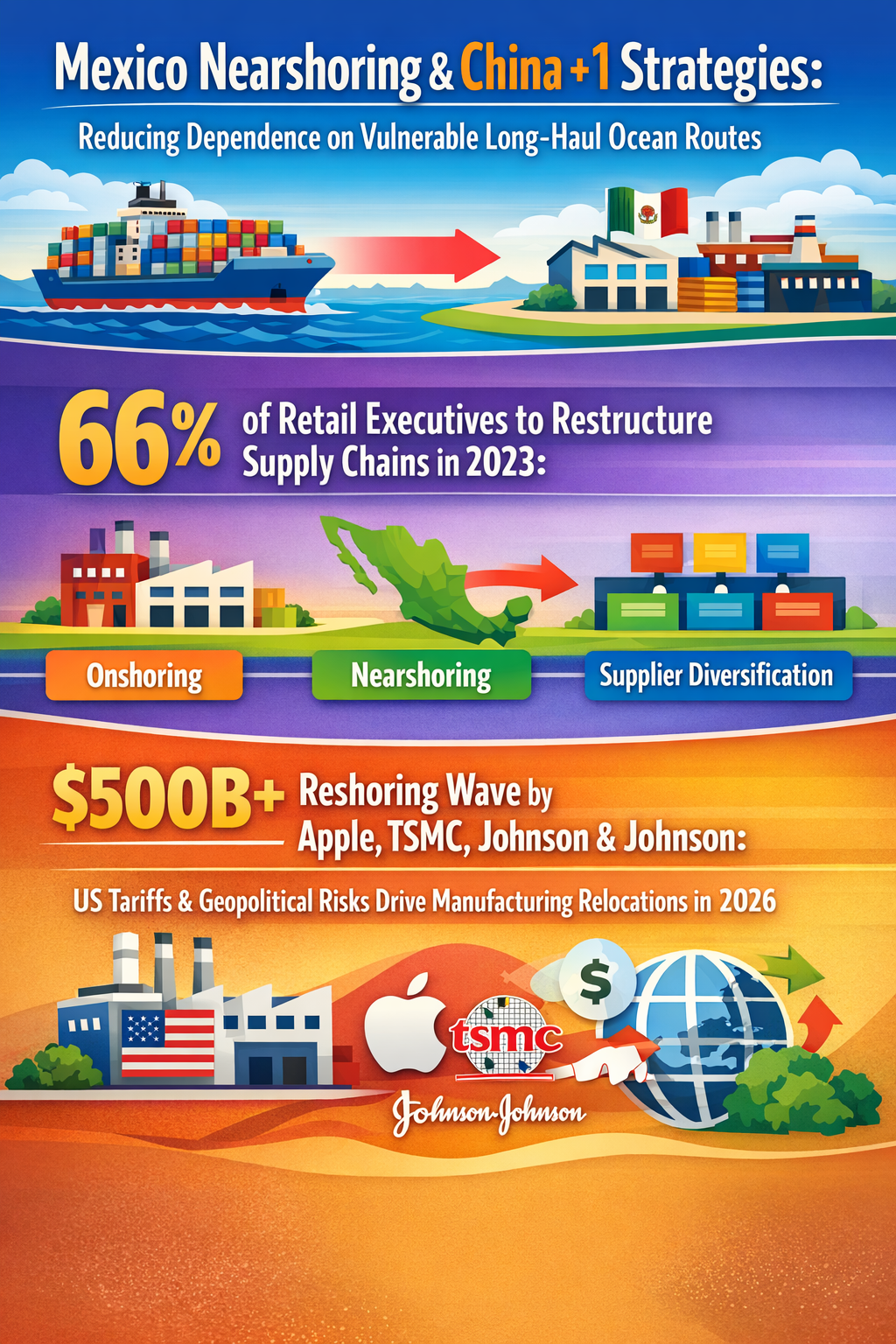
Retail executives’ intentions to diversify suppliers and restructure supply chains toward onshoring, nearshoring, or local supplier bases (SPS Commerce 11/01/2026) further reinforce this fragmenting dynamic. Thus, nearshoring is not simply a geographic adjustment but a fundamental shift to micro-regional economies characterized by integrated supply clusters, talent networks, and regulatory innovation zones.
This contrasts with the traditional model of nearshoring as moving a factory to a single foreign country and instead points to multi-node regional supplier ecosystems that optimize logistics cost, geopolitical risk, and digital integration. Moreover, geopolitical policy tools — including tariffs and regulatory incentives — increase the advantage for micro-regions that can adapt rapidly and coordinate vertically integrated production (Transport Topics 18/02/2026; ERSA Electronics 02/03/2026).
Disruption Pathway
Micro-regionalisation could evolve structurally via the cumulative effect of policies incentivizing domestic and nearshore investment combined with firms’ supply risk diversification. As costs rise globally and tariffs persist, companies increasingly find value in clustering suppliers and production within coordinated small regions that offer streamlined customs, shared infrastructure, and local talent. This dynamic accelerates as urban and regional planners recognize the benefits of integrated supply polycultures and prioritize investment in connected transport, digital infrastructure, and workforce development.
Such micro-regions introduce stress by fracturing national uniformity in regulatory and industrial policy frameworks, forcing governments to create finer geographical differentiation in incentives and standards. This fragmentation may increase cross-border friction inside former economic blocs or countries, as localized strengths compound uneven development and competition between localities intensifies.
Over time, dominant governance models that rely on national or macro-regional industrial policy could shift towards federated, multi-layered regulatory environments optimized for industrial clusters. This feedback loop encourages more micro-regions to arise, accelerating a patchwork ecosystem that challenges traditional global supply chain scalability but offers resilience and agility.
Unintended consequences may include increased complexity in compliance, higher costs for multinational coordination, and potential bottlenecks as micro-regions compete for prime supply ecosystem status, thereby creating a new dynamic of supply chain “land grabbing.” This evolution is distinct from simple deglobalisation or nearshoring as it implies new industrial architectures at a sub-national level.
Why This Matters
Decision-makers face implications across capital allocation, regulatory strategy, and industrial policy. Capital allocation towards industrial real estate, robotics, and logistics may increasingly prioritize micro-regions over national averages, demanding enhanced local intelligence and risk adjustments. Regulatory frameworks may need redesigning to facilitate multi-scalar governance — harmonizing local innovation zones with national objectives.
Competitive positioning could become entrenched at the micro-regional level, with companies’ global strategies hinging on their ability to master local supplier networks in multiple regions rather than mere offshore manufacturing hubs. Supply chains might fragment into nested clusters rather than linear global networks, changing risk profiles and liability regimes. This complexity heightens demand for enhanced scenario planning and strategic intelligence functions.
Implications
This micro-regionalisation trend could likely prompt a paradigm shift in industrial and regulatory strategy, particularly in manufacturing and logistics sectors. It might reconfigure global supply chain designs from broad regional shifts to a mosaic of specialized industrial nodes. Regulatory frameworks should anticipate increasing demands for localized policies rather than universal trade rules. Capital deployment may increasingly favor flexible, localized infrastructure and advanced automation solutions embedded within cluster ecosystems.
This is not merely a transient “nearshoring hype” cycle or a return to onshoring’s centralized factory model, nor is it purely geopolitical tariff retaliation. Instead, it reflects a deeper systemic restructuring of industrial geography fueled by economic, political, and operational logic converging on micro-regions.
Competing interpretations exist — some analysts may argue that cost pressures will ultimately force reconsolidation or automation that negates the need for physical proximity clusters. Others may view this as a transient ripple caused by recent shocks rather than an enduring structural change.
Early Indicators to Monitor
- Increasing industrial real estate transactions and leasing activity concentrated in sub-national clusters (e.g., U.S. border states, Mexican industrial corridors) (The AI Consulting Network 25/03/2026)
- Supplier diversification procurement data showing rising contracts within proximate sub-regions (SPS Commerce 11/01/2026)
- Government regulatory drafts or industrial policies targeting cluster-level incentives rather than national schemes (White House 15/02/2026)
- Capital flows toward industrial automation and logistics infrastructure in emerging micro-regions (ERSA Electronics 02/03/2026)
- Standards formation or collaboration agreements at regional cluster levels (Transport Topics 18/02/2026)
Disconfirming Signals
- Sustained global cost advantages and logistics efficiencies in mega-hub manufacturing (e.g., China, Southeast Asia) that negate micro-regional clustering benefits
- Regulatory moves towards centralized national or supra-national frameworks that erode local autonomy in industrial policy
- Failure of integrated supply clusters to deliver resilience or cost benefits due to coordination complexity
- Sharp contraction of tariffs or geopolitical tensions, which reduces nearshoring incentives (SUAID Global 03/02/2026)
Strategic Questions
- How can firms adapt capital allocation strategies to prioritize investment in emerging micro-regional ecosystems instead of broad national geographies?
- What regulatory reforms would optimize multi-layered governance systems that facilitate cluster-level industrial innovations while maintaining national policy coherence?
Keywords
Deglobalisation; Regionalisation; Nearshoring; Micro-Regionalisation; Supply Chain Restructuring; Industrial Clusters; Tariffs; Supply Chain Resilience; Capital Allocation; Industrial Policy
Bibliography
- 66% of retail executives plan to restructure their supply chains through onshoring, nearshoring, or supplier diversification if input costs rise this year. SPS Commerce. Published 11/01/2026.
- Mexico nearshoring and China + 1 strategies reduce dependence on long-haul ocean routes that are vulnerable to geopolitical disruption. SUAID Global. Published 03/02/2026.
- Geopolitical uncertainty has increased as the U.S. government seeks to promote capacity reshoring through tariffs and other policies, raising the risk of supply chain fragmentation and higher operating costs. / China. ERSA Electronics. Published 02/03/2026.
- CBRE expects 2026 industrial leasing to rise as reshoring and tariff mitigation drive domestic manufacturing, with vacancy stabilizing in the mid-6% range. The AI Consulting Network. Published 25/03/2026.
- Nearshoring is continuing to reshape U.S. supply chains in 2026 even though tariffs and geopolitical risks complicate cross-border moves. Transport Topics. Published 18/02/2026.
- CONTINUING TO UTILIZE TARIFFS TO PROTECT U.S. INTERESTS: Tariffs will continue to be a critical tool in President Trump's toolbox for protecting American businesses and workers, reshoring domestic production, lowering costs, and raising wages. White House. Published 15/02/2026.