
Satellite-Mediated AI Inference: The Under-Recognised Connectivity Inflection Reshaping Strategic Capital and Governance
This paper explores the emerging inflection in connectivity driven by the integration of orbital computing clusters and satellite laser mesh networks, enabling AI inference processing in low Earth orbit. Beyond incremental 5G/6G or satellite broadband expansion, this development poses a structural challenge to terrestrial cloud infrastructure, regulatory frameworks, and industrial positioning over the next decade.
The capacity of constellations like SpaceX’s Starlink to seamlessly route AI inference requests through orbital edge computing platforms is a weakly acknowledged yet plausibly transformative signal. It could radically alter where and how connectivity-enabled computation occurs, shifting capital from terrestrial hyperscalers to space-based operators, complicating data sovereignty regimes, and creating new supply chain architectures. This paper evaluates why this development merits urgent scenario planning and strategic response among decision-makers.
Signal Identification
This development qualifies as an emerging inflection indicator due to its potential to disrupt the foundational architecture of connectivity and computational infrastructure. It moves beyond broadband expansion or incremental enhancements to the network (e.g., 5G/6G proliferation) by embedding AI inference capacity directly into the orbital constellation layer, in contrast to conventional terrestrial data centers or edge nodes.
Its plausibility horizon is medium to high within 5–10 years, driven by rapid satellite deployment enabled by next-generation launch vehicles and increasing investment in space-based networks. Sectors exposed include telecommunications, cloud computing, AI services, regulatory authorities, aerospace, and cybersecurity.
What Is Changing
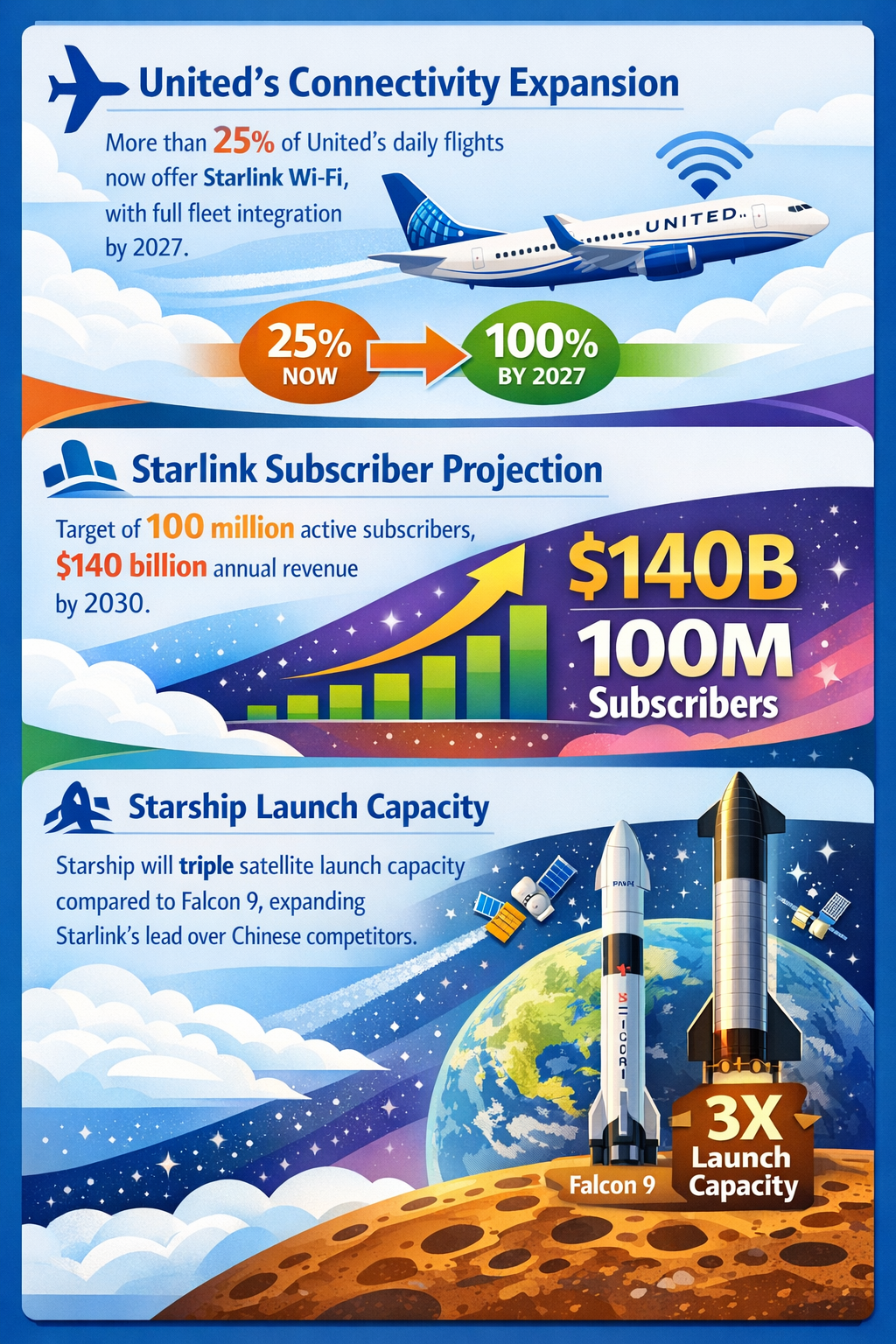
Multiple articles highlight the rapid expansion of mega-constellations and their connectivity capabilities. Starlink’s increasing fleet size, enhanced by SpaceX’s Starship heavy launch vehicle capable of deploying three times the satellites per launch, significantly outpaces competitors (The Straits Times 09/06/2026). This scale underpins critical infrastructure for direct-to-cell and aviation connectivity (WealthCG 12/06/2026; Sassofia 12/06/2026).
Crucially, SpaceX is pioneering seamless routing of AI inference requests from Earth-based clients to its orbital computing clusters via a laser-mesh network joining Starlink satellites (Klover.ai 01/06/2026). Unlike traditional cloud services dependent on terrestrial fiber optic and 5G/6G infrastructures, this orbital edge model could offer unique latency, cost, and sovereign data processing advantages—challenges for terrestrial hyperscalers (Amazon, Microsoft, Google) to replicate.
Complementary trends in low Earth orbit sensors and 5G integration with non-terrestrial networks expand this paradigm. Concepts like synchronized distributed massive multiple-input multiple-output (MIMO), extreme MIMO, and integrated sensing enable not just connectivity but a fused communications-sensing ecosystem in space (Ericsson 15/06/2026). Operating satellites at intermediate altitudes (200–300 km) may offer drone-quality LiDAR and imagery with 5G connectivity to ordinary devices, enabling novel industrial and defense applications (Cyclops Space Tech 14/06/2026).
The convergence of these developments elevates the orbit from a passive relay infrastructure to an active computational and sensing domain. This changes how data is captured, processed, and controlled, with significant implications for regulatory frameworks and market dynamics.
Disruption Pathway
Accelerating this trajectory depends on several conditions. The pace of satellite deployment must continue to scale, supported by reusable heavy lift launchers like Starship, driving down unit costs and enabling large orbital computing clusters. Simultaneously, advancements in satellite inter-satellite laser communication and edge AI silicon architectures are necessary to handle inference workloads efficiently in this environment.
As AI inference shifts from terrestrial cloud to orbit, traditional hyperscalers may face resource competition and cost pressures, eroding their dominant supply chain advantage in fiber, data center real estate, and terrestrial edge nodes. New dependencies on space-based hardware and ground station infrastructure introduce supply chain reconfiguration and geopolitical risk.
Regulatory frameworks overseeing data sovereignty, spectrum allocation, and space traffic management will come under strain. National jurisdictions may find existing paradigms inadequate to govern computation and data flows occurring at the orbital edge, triggering regulatory adaptation or fragmentation. Data privacy regimes could be re-interpreted as data processing physically moves beyond national borders.
Dominant industrial models of centralized terrestrial data centers could gradually decentralize into a hybrid terrestrial-orbital landscape. This shift may initiate feedback loops whereby increased space processing capabilities drive demand for further satellite constellations and launch services, compounding capital flow to space infrastructure providers.
Unintended consequences might include increased orbital debris risks from proliferating constellations, complicating governance and operational reliability. Additionally, geopolitical rivalries over space-based computational infrastructure could lead to bifurcated or regionalised techno-regulatory blocs, raising barriers to interoperability and capital mobility.
Why This Matters
For capital allocators, recognizing this shift earlier can position portfolios toward emerging orbital-edge infrastructure players, satellite launch providers, and AI hardware vendors innovating for space deployment. Conversely, late recognition could leave traditional cloud hyperscalers vulnerable to disintermediation.
Regulators need to revisit data governance, spectrum management, and outer space legal frameworks. This signal suggests a need to prepare for computational sovereignty debates extending into orbital domains and review accountability models for AI applications operating partly or wholly off-planet.
Strategists in telecommunications and aerospace sectors must reassess partnerships, R&D focus, and cross-sector innovation pathways integrating AI, satellite communications, and sensing. Long-term industrial structure realignments could emerge as capital moves toward integrated space-compute-communications providers.
Supply chains will likely diversify to include space-grade semiconductor manufacturing, orbital servicing and logistics, and ground-space data interface equipment. Liability regimes around orbital asset operation and cyber resilience may require overhaul as connectivity systems converge with AI and space infrastructure.
Implications
This development could likely drive structural change in the connectivity ecosystem beyond current 5G/6G and IoT device expansion narratives. It might reshape the locus of computational power from terrestrial data centers and cloud nodes to orbital edge clusters, upending traditional cost and latency assumptions.
Capital allocation patterns may shift systematically toward companies integrating launch capacity, satellite mesh networking, and AI processing in orbit, rather than purely terrestrial infrastructure operators. Regulatory regimes might migrate from classic telecommunications and data jurisdiction models toward cross-domain and space law frameworks.
This signal is not merely hype around Starlink’s broadband proliferation or incremental 6G improvements but a substantive reconfiguration of the connectivity-compute paradigm. It should not be confused with transient adoption of commercial satellite internet for last-mile access, which is now well understood.
Competing interpretations may argue the maturation of terrestrial AI cloud infrastructure or quantum networking may obviate the need for orbital AI inference. However, current scale and latency limitations alongside geopolitical supply chain complexities suggest space-based computation may realize advantages difficult to replicate terrestrially.
Early Indicators to Monitor
- Patenting trends in satellite-borne AI inference hardware and inter-satellite laser communication technology
- Contracts and capital raising rounds for space-edge AI service providers and integrated satellite compute networks
- Draft regulatory proposals on orbital data sovereignty, AI governance beyond Earth, and cross-jurisdictional data transfer laws
- Launch manifest growth of Starship-class vehicles or equivalent heavy reusable rockets
- Emergence of standards for integrated communication and sensing in non-terrestrial networks (NTN) under international bodies
Disconfirming Signals
- Significant technical failures or delays in deploying scalable orbital computing clusters or laser-mesh inter-satellite networking
- Breakthroughs in terrestrial AI cloud infrastructure that drastically reduce latency and cost per inference, negating orbital advantage
- International treaties severely restricting satellite constellations or space-based data processing for security or debris mitigation reasons
- Market rejection of integrated space-edge AI services due to cost, reliability, or cybersecurity concerns
Strategic Questions
- How should capital deployment adjust to emerging orbital edge AI infrastructure capabilities relative to terrestrial cloud investments?
- What regulatory and governance frameworks need proactive updating to address sovereignty, liability, and data protection for space-based computation?
Keywords
Orbital computing; Space-based AI inference; Laser-mesh networks; Starship launch vehicle; Satellite constellations; Non-terrestrial networks (NTN); Data sovereignty; Connectivity disruption; Space governance
Bibliography
- The EchoStar spectrum transaction and the broader Starlink Direct to Cell opportunity could help expand SpaceX's mobile connectivity business. WealthCG. Published 12/06/2026.
- Successful deployment of Starship, SpaceX's next-generation heavy rocket that can launch three times as many satellites in one launch as Falcon 9, could widen the gap between Starlink and its Chinese challengers exponentially. The Straits Times. Published 09/06/2026.
- If SpaceX can seamlessly route inference requests from Earth to orbital clusters via the existing Starlink laser-mesh constellation, xAI will possess a structural cost advantage that no terrestrial competitor (Amazon, Microsoft, Google) can replicate. Klover.ai. Published 01/06/2026.
- An entirely new wave of use cases and devices will be made possible by 6G technologies, including synchronized distributed massive MIMO, extreme MIMO, non-terrestrial networks, integrated communication and sensing. Ericsson. Published 15/06/2026.
- Operating at 200-300 km could enable drone-quality imagery, LiDAR from space, and 5G connectivity to ordinary phones, potentially expanding capabilities and strengthening Europe's sovereign space infrastructure. Cyclops Space Tech. Published 14/06/2026.