Our Scans
·
Smart Technologies
·
Four Scenarios
Introduction
Forecasts for 2026 across sectors such as power and utilities, intelligent devices, IT services, textiles, and Internet of Things (IoT) reveal a shared optimism for technological advancement, sustainability, and digitization. Key trends emphasize AI integration, edge computing, smart infrastructure, circular economy models, and customer-centric digital transformation. Yet, these optimistic narratives inherently carry biases favoring innovation's promise while often underestimating barriers like workforce shortages, regulatory complexity, cybersecurity risks, and socioeconomic disparities.
For instance, the power and utilities sector expects digital grid modernization to drive resilience and operational efficiency (EY, 2026-05-10). Simultaneously, the IT services and intelligent device markets project rapid growth fueled by cloud adoption, AI, and emerging cybersecurity challenges (Market Data Forecast, 2026-05; AISpeaker, 2026-05-01). Textile innovation projects a blending of high tech with sustainability and customization (Rongxu Textile, 2026-03-09; Global Textile Times, 2026-05-07). The IoT landscape undergoes transformation via edge AI, 5G, and security imperative challenges (Jincan, 2026-01-12).
A balanced future outlook requires unpacking these forecasts into four inductive scenario archetypes reflecting continuity, constraint, degradation, and disruption — each revealing distinct strategic imperatives shaped by the interplay of technology, environment, economy, politics, and societal values.
Scenario Archetypes
1. Continuation: Sustained Growth and Incremental Innovation
The “business as usual” trajectory suggests steady advancements in digital infrastructure, AI integration, and sustainable practices, expanding across industries.
- Technological Maturation:
- Cloud services, AI, and IoT devices experience incremental efficiency gains, underpinning sectors like utilities, manufacturing, and healthcare with better data-driven decision-making and operational automation (EY, 2026).
- 5G and edge computing continue to reduce latency and enhance real-time analytics in industrial and consumer applications, making intelligent devices more prevalent and responsive (Jincan, 2026-01-12).
- Environmental and Regulatory Compliance:
- Sustainability becomes embedded through incremental circular textile manufacturing, renewable energy integration, and carbon reporting systems like CBAM preparing entities for carbon pricing (iPoint Systems, 2026-01-01; Rongxu Textile, 2026-03-09).
- Enterprises navigate complex privacy and cybersecurity landscapes cautiously, adopting zero-trust architectures and managed services as compliance becomes non-negotiable (Market Data Forecast, 2026-05).
- Economic Stability and Incremental Workforce Adaptation:
- IT and manufacturing sectors experience controlled workforce transitions, with upskilling programs addressing talent gaps while maintaining operational continuity (MatrixBCG, 2026-04-18; EY, 2026).
This scenario may favor incremental innovation, risk management, and investment continuity, enabling organizations to gradually realize value from digital transformations. Yet, it risks complacency regarding emerging disruptions or systemic vulnerabilities.
2. Limits and Discipline: Navigating Constraints and Adaptive Resilience
Under mounting environmental, regulatory, and resource constraints, industries modify behaviors and innovate within tightened boundaries.
- Environmental Boundaries Driving Circularity and Efficiency:
- Textile manufacturers and utilities aggressively adopt circular economy practices, material traceability, and low-carbon production to meet stricter regulations and consumer demand for sustainability (Global Textile Times, 2026-05-07; iPoint Systems, 2026-01-01).
- Utilities prioritize grid resilience and optimize capital allocation to balance rising demand with affordability and regulatory compliance (EY, 2026).
- Technology Adoption under Workforce and Regulatory Constraints:
- AI and automation accelerate but must be carefully introduced due to workforce skill shortages and ethical compliance concerns; regulation tightens on data security and privacy (MatrixBCG, 2026-04-18; Jincan, 2026-01-12).
- Enterprises implement disciplined investment strategies, often favoring managed service models to control costs in volatile economic environments (Market Data Forecast, 2026-05).
- Social Shifts and Value Realignment:
- Consumer expectations favor transparency, ethical sourcing, and personalization, while organizations embed these values operationally, despite cost and complexity challenges (AISpeaker, 2026-05-01; Rongxu Textile, 2026-03-09).
- Regulators and enterprises co-evolve frameworks to enforce sustainable practices, carbon pricing, and cybersecurity governance.
This scenario calls for strategic discipline, transparency, and innovation within limits, emphasizing resilience, governance, and ethical leadership as core success factors.
3. Decline and Collapse: Fragile Systems Under Crisis Stress
Systemic shocks, crises, or inability to adapt escalate failures in key infrastructures and markets.
- Infrastructure Breakdown and Service Disruptions:
- Power grids strain under increasing electrification demand and extreme weather, with delayed modernization leading to cascading outages and regulatory penalties (EY, 2026).
- Supply chains for critical tech components and sustainable materials break down due to geopolitical tensions or economic shocks, impacting IT and textile production.
- Accelerated Talent Shortages and Cybersecurity Failures:
- Workforce skill gaps widen, especially in AI, cybersecurity, and cloud management, resulting in project delays and suboptimal operations (MatrixBCG, 2026-04-18; Market Data Forecast, 2026-05).
- IoT and cloud ecosystems suffer large-scale breaches causing loss of trust, financial damage, and regulatory crackdowns (Jincan, 2026-01-12).
- Economic Volatility and Consumer Backlash:
- Rising costs and economic strain limit consumer spending on advanced products, especially smart and personalized textiles and electronics (AISpeaker, 2026-05-01; Rongxu Textile, 2026-03-09).
- Political instability and regulatory fragmentation hinder coordinated responses to climate challenges, intensifying crisis conditions.
This scenario suggests elevated risk exposure and urgent need for contingency planning, diversified supply chains, enhanced security postures, and proactive crisis management.
4. Transformation: Paradigm-Shifting Innovations and Societal Renewal
Disruptive forces catalyze a rewiring of industries, social systems, and environmental stewardship.
- Convergence of AI, IoT, and Circularity:
- Advanced AI embedded widely at edge devices enables autonomous, optimized resource management in smart grids, manufacturing, and urban systems, moving beyond incremental digitization (Jincan, 2026-01-12; EY, 2026).
- Textile innovation delivers regenerative, multifunctional bio-fabrics meeting exacting consumer and environmental demands, fueled by AI-driven design and circular manufacturing (Global Textile Times, 2026-05-07).
- Economic and Social Reimagination:
- New business models emphasizing platform ecosystems, shared value creation, and sustainability foster inclusive growth and resilient supply chains (EY, 2026).
- Consumer empowerment with transparency tools (digital product passports, AI-driven personalization) redefines market dynamics and brand loyalty (iPoint Systems, 2026-01-01).
- Political and Regulatory Innovation:
- Collaborative governance of technologies such as AI, quantum-safe encryption, and DLT underpin trust frameworks and agility in response to systemic risks, exemplified by strategic pivots of companies like Unisys (MatrixBCG, 2026-04-18).
- Global coordination enables carbon pricing mechanisms like CBAM to function as effective drivers of low-carbon innovation and supply chain transformation (iPoint Systems, 2026-01-01).
This scenario emphasizes visionary leadership, ecosystem collaboration, and systemic innovation as engines of a more sustainable, equitable, and dynamic future.
Implications for Present Decision-Making
- Investment Strategy: Firms should balance incremental digital investments to sustain current operations with exploratory funding for transformational technologies, such as AIoT, digital twins, circular manufacturing, and quantum-safe security.
- Resilience Building: Preparing for growing environmental, regulatory, and geopolitical constraints necessitates adopting adaptive frameworks around capital allocation, supply chain agility, and workforce skill development.
- Data Governance and Security: As cyber threats escalate, embedding zero-trust, AI-driven security, and compliance capabilities from design phases forward will protect value and reputation.
- Customer-Centric Innovation: Organizations must integrate transparency, personalization, and sustainability authentically into offerings to meet evolving consumer values and regulatory demands.
- Collaborative Ecosystems: Strategic partnerships, cross-sector alliances, and engagement with regulatory bodies foster agility and access to emerging opportunities while mitigating systemic risks.
Further Reading
- Solutions: To enhance reliability while minimizing capital expenditures, utilities should: Upgrade grid and IT infrastructure with smart technologies, including AMI and DERMS, to optimize grid management, integrate DERs and reduce outage risks while enabling customer independence and flexibility. EY. 10/05/2026. https://www.ey.com/en_us/industries/power-utilities
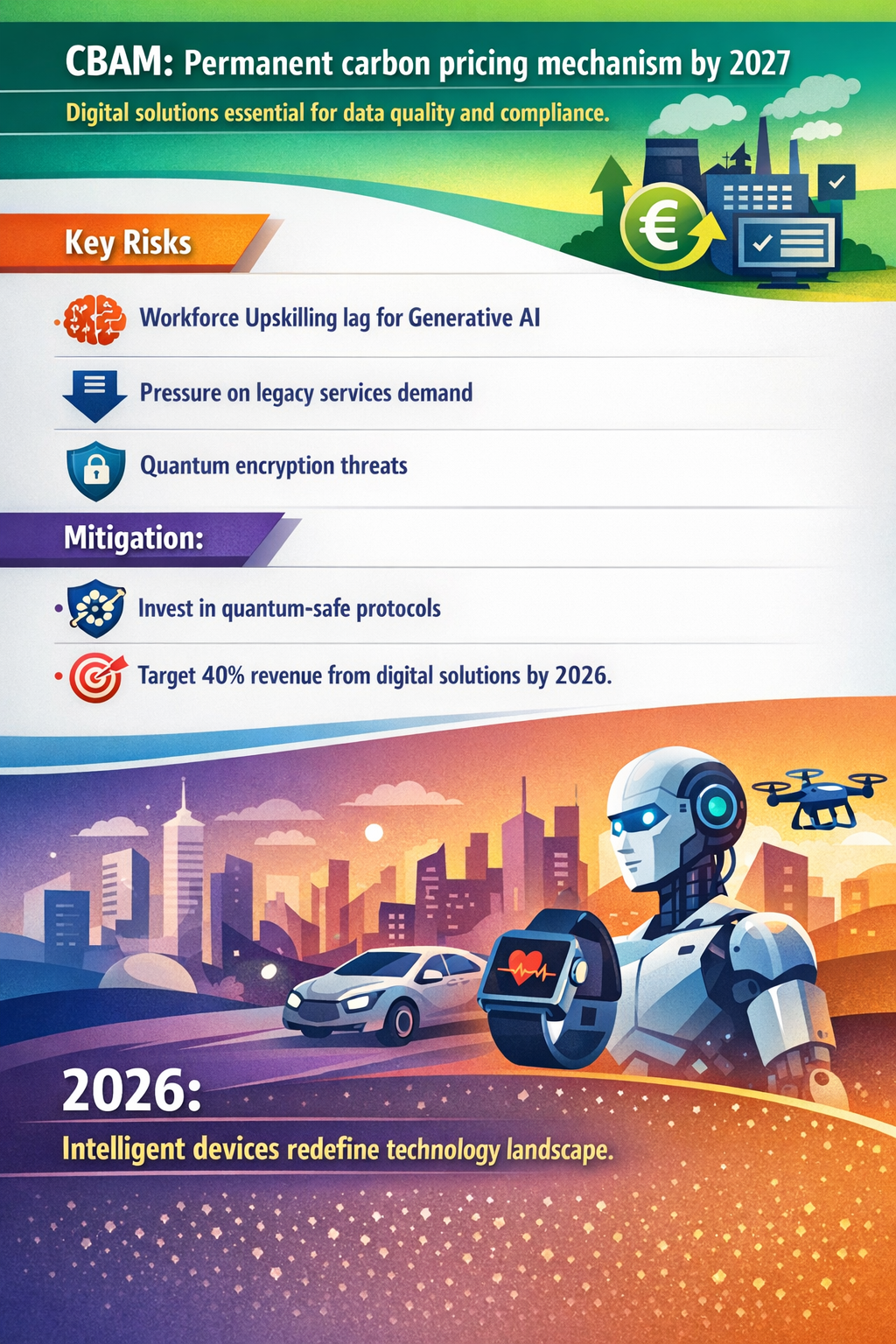
- In 2026, intelligent devices will redefine the landscape of technology. AISpeaker. 01/05/2026. https://www.aispeaker.com/blog/2026-best-intelligent-device-innovations-for-buyers/
- Key risks include workforce upskilling lag for Generative AI, pressure on legacy services demand, and encryption threats from quantum advances; mitigating actions include investments in quantum-safe protocols and a target to shift to 40% revenue from digital solutions by 2026. MatrixBCG. 18/04/2026. https://matrixbcg.com/blogs/competitors/unisys
- With CBAM evolving into a permanent carbon pricing mechanism, digital solutions are essential to ensure data quality, reduce compliance risks and prepare for the financial obligations starting in 2027. iPoint Systems. 01/01/2026. https://www.ipoint-systems.com/news/details/cbam-start-2026/
- Spending on IoT solutions is expected to grow by 14% annually. Market Data Forecast. 05/2026. https://www.marketdataforecast.com/market-reports/united-states-it-services-market
- 60% of textile manufacturers plan to invest in smart technologies by 2026. Rongxu Textile. 09/03/2026. https://www.rongxutextile.com/blog/2026-high-quality-custom-textile-manufacturer-trends-insights/
- The boundary between garments and intelligent devices will continue to blur throughout the decade. Global Textile Times. 07/05/2026. https://www.globaltextiletimes.com/trends/how-fashion-is-redefining-fabric-innovation-in-2026/
- By 2026, cybersecurity will transition from an afterthought to a fundamental design principle for all IoT solutions. Jincan. 12/01/2026. https://www.jincan.net/solution/iot-trends-2026.html
Briefing Created: 27/05/2026