
Rural Aging Amidst Urbanization: The Underappreciated Social Inflection Reshaping Demography and Infrastructure
Examining the demographic paradox of urban dominance alongside accelerating rural aging uncovers a subtle yet profound social change that could reshape capital flows, regulatory frameworks, and service structures over the next two decades.
While global urbanization is widely recognized as a transformative megatrend, the concurrent demographic aging concentrated in rural areas, especially in developing economies like India, remains underappreciated. This weak signal portends an inflection where rural social structures, healthcare demands, and mobility patterns diverge sharply from urban trajectories. Recognizing and integrating this dual demographic pattern is crucial for regulators, investors, and planners to avoid strategic blind spots as it may fundamentally alter assumptions about resource allocation, infrastructure development, and social policy design.
Signal Identification
This signal qualifies as an emerging inflection, identified by the growing contrast between rapid urbanization and simultaneously concentrated aging populations in rural regions. It is distinct from broad demographic shifts that assume urban areas absorb or homogenize aging trends. Its horizon is medium to long-term (10–20 years), with a high plausibility band given current UN projections and country-specific demographic studies (Economic Times 04/06/2024). Sectors exposed include healthcare, urban and rural infrastructure, transportation, social services, and regulatory policy frameworks governing inter-regional capital deployment and public welfare.
What Is Changing
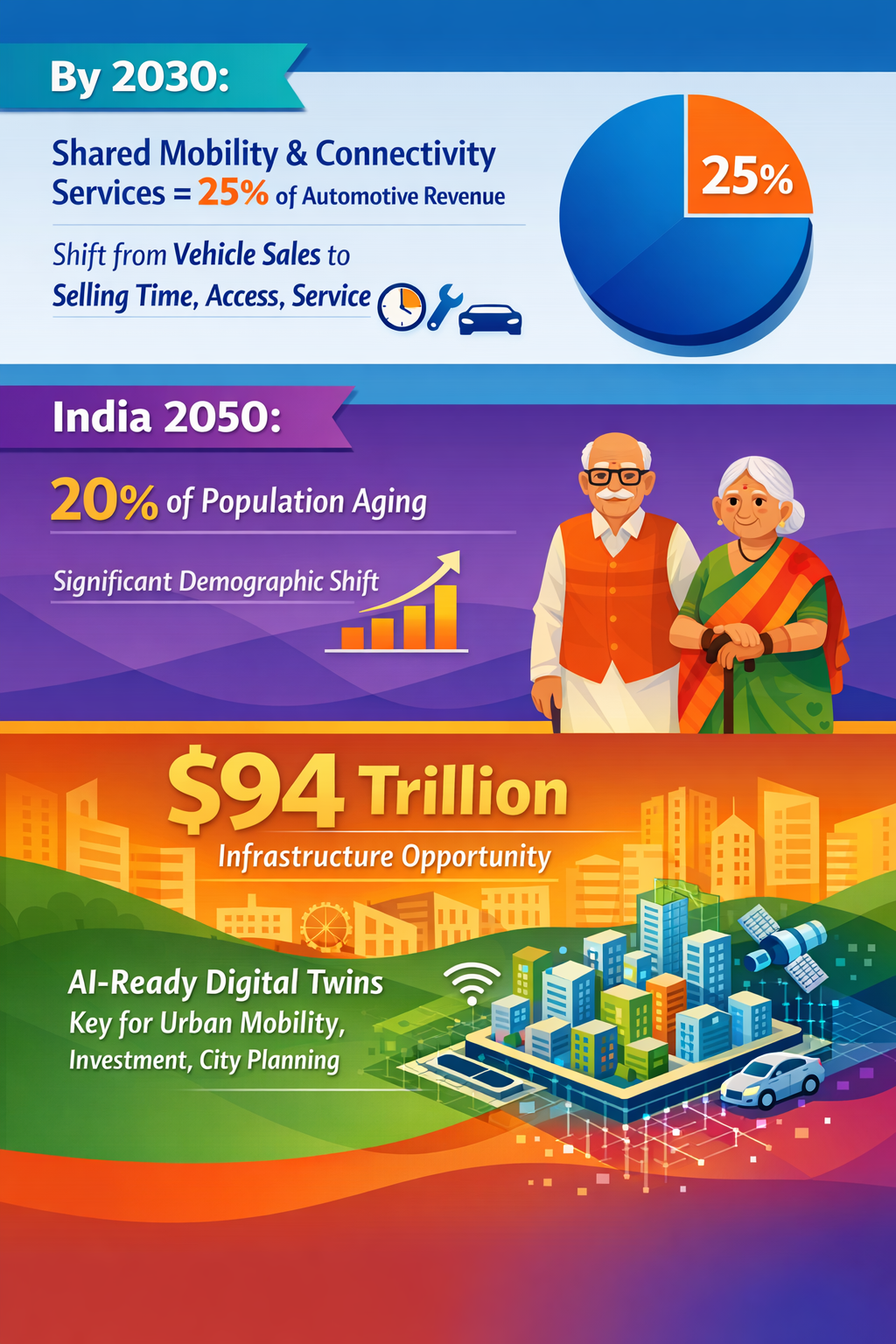
Global urban population growth is poised to push 68% of humanity into cities by 2050, driven by UN-Habitat and UN Department of Economic and Social Affairs projections forecasting roughly 6.6 billion urban dwellers (WSWS 11/08/2026). This expansion fuels rising demand for personal mobility solutions in urban hubs (Persistence Market Research 03/05/2024), and accelerates investment in shared mobility and connectivity services, which may capture up to 25% of automotive sector revenues by 2030 (Drivee.ai 14/04/2024).
However, this urban-centric view obscures a demographic inversion in rural areas of countries like India, where approximately 70% of the elderly population will reside by 2050, despite the country’s rapid economic transformation (Economic Times 04/06/2024). Aging in rural zones is occurring without parallel wealth accumulation or infrastructure modernization. This is creating a "grey divide" running counter to the narrative of demographic concentration in urban environments.
Such aging patterns challenge existing healthcare models that often direct resources to urban centers, despite a rising elder dependency ratio in more isolated locales (Straits Times 15/05/2024). Efforts by healthcare providers, such as Thomson Medical Group broadening focus beyond obstetrics amid falling birth rates, underscore the growing need to diversify service models as demographic profiles shift (Straits Times 15/05/2024).
Capital allocation patterns, traditionally prioritizing urban infrastructure and technology ecosystems, may not yet fully account for the mounting social care demands in rural areas with aging populations. The battery manufacturing boost in France’s industrial strategy (Persistence Market Research 22/04/2024) exemplifies how urban-industrial hubs attract disproportionate investment, leaving rural aging needs less addressed.
Disruption Pathway
The rural aging demographic could accelerate structural change through several interacting mechanisms. First, escalating elder care needs in resource-poor rural zones will exert mounting pressures on health, mobility, and social services systems traditionally optimized for younger urban populations. Government and institutional responses may initially prioritize patchwork initiatives to extend urban services rurally, which would prove inefficient and insufficient.
This mismatch can drive new service delivery paradigms focused on decentralized, community-integrated care supported by emerging mobility and connectivity technologies. For example, shared mobility platforms tailored to elder accessibility could evolve, linking rural residents to remote healthcare and social services, partially offsetting infrastructure deficits (Drivee.ai 14/04/2024). Over time, these decentralized models may question the urban centrality of capital-intensive healthcare infrastructure.
The mismatch between rural aging and urban investment patterns introduces stresses in regulatory and industrial frameworks, particularly where subsidies, healthcare reimbursements, and mobility infrastructures are designed around dense urban populations. Private investors may initially eschew rural aging markets, deeming them high-risk and low-yield, until demographic realities force redirection of capital allocation towards these underserved segments.
This evolution may engender feedback loops where underinvestment perpetuates rural socio-economic stagnation, increasing mobility and health inequities, which in turn spur activism, policy reform, and technology innovation targeted at balancing urban-rural disparities. Regulatory regimes could gradually shift from uniform, urban-biased frameworks towards differentiated policies incentivizing rural electrification, telehealth, and elder-friendly transport solutions.
Eventually, industries such as automotive, healthcare, and urban infrastructure could see their dominant business models reconfigure from scale-focused, centralized delivery towards more modular, distributed, and socially embedded approaches oriented on aging rural populations’ needs.
Why This Matters
For capital allocators and regulators, overlooking the rural aging inflection risks systemic underperformance of investments, ineffective social policies, and amplified regional inequalities. Infrastructure investments assuming that population aging parallels urban concentration may misallocate resources and miss growing demand pockets.
The automotive and mobility sectors, in particular, face strategic exposure as they transition from selling vehicles to selling mobility as a service. Tailoring solutions for elderly rural residents—a population with fundamentally different demands than urban commuters—could require rethinking vehicle design, service delivery, and business models (Drivee.ai 14/04/2024).
Public health financing and social safety nets may need recalibration to address the socio-economic precarity of rural elders, whose spatial isolation and lack of healthcare infrastructure differ significantly from the urban elderly population addressed by policies in countries like Singapore and France (Straits Times 15/05/2024; Persistence Market Research 22/04/2024).
Regulatory frameworks will encounter pressure to evolve beyond binary urban-rural policy models, integrating demographic complexity into capital deployment decisions, social welfare regulations, and industrial strategy formulations.
Implications
This development may drive structural change by reallocating capital investment towards rural healthcare infrastructure, specialized mobility services, and digital connectivity solutions within a two-decade horizon. The industrial structure of healthcare, transportation, and social service sectors could shift from centralized, urban-focused systems to hybrid models that combine urban scale with rural adaptability and social embeddedness.
This signal is not a transient ripple or an isolated rural demographic challenge; it likely reflects a systemic social inflection emerging from persistent demographic, economic, and technological trends. However, it should not be conflated with generalized urbanization narratives or assumed synonymous with rural depopulation—aging elders remain a significant, stationary demographic with distinct needs.
Competing interpretations might argue that rural aging will diminish as urban lifestyles attract younger populations or that technological advances will homogenize urban-rural service delivery. Such positions may underweight socio-economic disparities and infrastructural limitations uniquely shaping rural aging dynamics.
Early Indicators to Monitor
- Government and private sector capital allocation shifts explicitly targeting rural elder care infrastructure and mobility services.
- Growth in patent filings and venture funding related to decentralized healthcare delivery and rural-oriented mobility platforms.
- Emergence of regulatory drafts incentivizing differentiated social welfare and transport policies acknowledging rural aging.
- Institutional adoption of geographic and demographic segmentation in public health and infrastructure investment planning.
- Rise in healthcare providers broadening service scope beyond traditional urban models, as exemplified by Thomson Medical Group’s strategic realignment.
Disconfirming Signals
- Reversal or stagnation in rural aging demographics due to migration or policy interventions equalizing age distributions.
- Breakthroughs in remote diagnostics or care negating the need for infrastructure adaptation specific to rural aging.
- Persistent capital concentration in urban-centric models without rural adaptation, coupled with observable stagnation in rural elder quality of life (>15 years horizon).
- Uniform regulatory frameworks ignoring demographic granularity and failing to incentivize rural-specific investments.
Strategic Questions
- How should regulatory frameworks evolve to incentivize capital flow towards aging rural populations without fragmenting national infrastructure strategies?
- What role can emerging mobility and digital connectivity technologies play in bridging the rural aging care gap, and how can industry position itself to capitalize on this evolving demand?
Keywords
Rural Aging; Urbanization; Shared Mobility; Social Infrastructure; Demographic Inflection; Healthcare Innovation; Capital Allocation; Regulatory Adaptation
Bibliography
- UN-Habitat and the UN Department of Economic and Social Affairs, which generates and compiles major global demographic, economic, and social data, project a global population of about 9.7 billion by 2050, with about 68% living in urban areas-around 6.6 billion people. WSWS. Published 11/08/2026.
- The global urban population reached 57% in 2023 and is expected to hit 68% by 2050, driving greater demand for personal mobility as more people live in urban centers. Persistence Market Research. Published 03/05/2024.
- Continued government support for electric mobility and strategic manufacturing investments is expected to strengthen France's position within Europe's battery supply chain. Persistence Market Research. Published 22/04/2024.
- India faces a significant demographic shift with one in five citizens aging by 2050, with nearly 70% of elderly expected to live in rural areas. Economic Times. Published 04/06/2024.
- Any demographic response will still take time, and therefore TMG's strategy in Singapore will continue to remain broader than maternity alone. Straits Times. Published 15/05/2024.
- Shared mobility and connectivity services could account for up to 25% of total automotive industry revenue by 2030, as value shifts away from simply selling a vehicle and toward selling time, access, and ongoing service. Drivee.ai. Published 14/04/2024.