
Virtual Power Plants via Electric Vehicles: An Under-Recognized Inflection in Transport and Energy Integration
Exploring the emergent role of electric vehicles as aggregated distributed energy resources within virtual power plants reveals a potential paradigm shift impacting capital allocation, regulatory frameworks, and the industrial landscape over the next two decades.
Beyond the headline growth of electric vehicle (EV) sales, a subtle yet structurally significant development is gaining traction: the integration of EVs into Virtual Power Plants (VPPs). Enabled by regulatory advancements such as the US Federal Energy Regulatory Commission’s (FERC) Order 2222, this inflection could transform how transport assets participate in energy markets, influence grid stability, and reshape infrastructure investment. Unlike conventional narratives focused on EV adoption rates or battery technologies, this signal points to a systemic convergence of transport and power sectors with wide-ranging implications.
Signal Identification
This development qualifies as an emerging inflection indicator because it represents a nascent but accelerating linkage between transport electrification and grid-edge energy management, moving beyond mere EV sales penetration. It demonstrates a shift from passive energy consumption by vehicles to active market participation as flexible, aggregated energy assets—an evolution still under-recognized within transport and energy strategic communities. The timeframe for widespread structural impact is estimated at 10–20 years, reflecting the pace needed for infrastructure scaling, regulatory harmonization, and market adaptation. The plausibility band is medium to high given current regulatory momentum (e.g., FERC Order 2222), ongoing growth in EV fleets, and technological capabilities in communications and control systems. Sectors exposed include automotive manufacturing, utilities, grid operators, energy markets, and urban infrastructure planning.
What Is Changing
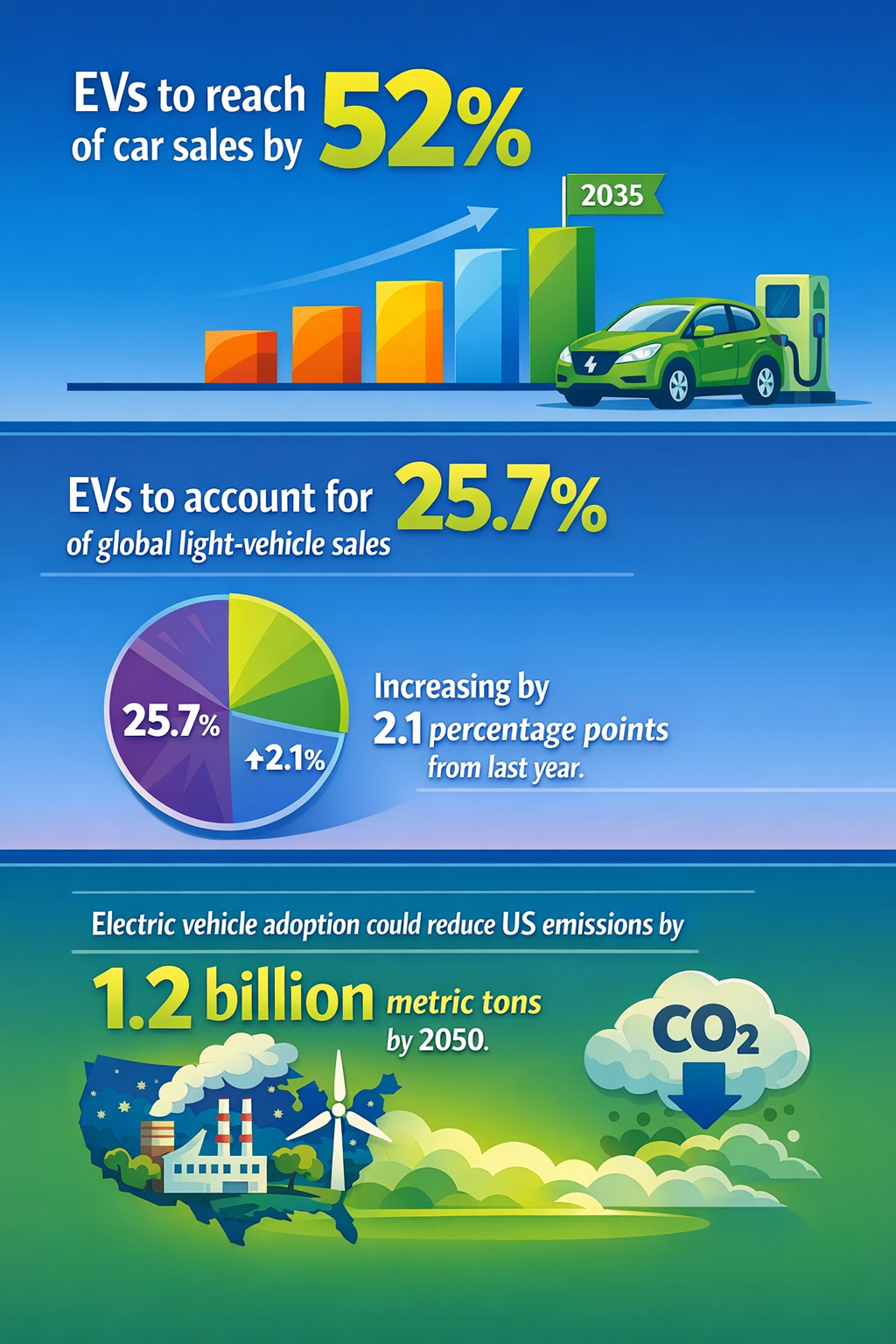
The acceleration of EV sales to 25.7% of global light-vehicle sales in 2026, projected to reach over 50% by 2035 (Electric Cars Report 12/08/2026; Global Fleet 15/08/2026), establishes the baseline scale from which grid integration dynamics will evolve.
However, moving beyond sales penetration, the aggregation of distributed energy resources (DERs)—including solar photovoltaics, stationary batteries, EV batteries, and smart devices—into Virtual Power Plants is emerging as a key structural enabler of energy flexibility (Straits Research 02/08/2026). VPPs pool multiple small-scale, geographically dispersed assets to trade electricity or provide ancillary grid services as a single entity, increasingly allowed under policies like FERC Order 2222. This regulatory shift lowers barriers for EV fleets to enter energy markets as aggregated resources, linking transport demand-side management with power grid stability.
The conventional view treats EVs primarily as mobility assets with environmental benefits such as emissions reduction—expected to drop US emissions by up to 1.2 billion metric tons by 2050 (Riley Eyewear 20/06/2026). Yet, what is under-recognized is that EV batteries, when idle and connected, function as decentralized energy storage units, making the transport fleet a significant, flexible, and dispatchable energy resource.
BMW’s introduction of its Neue Klasse EVs with advanced battery technology and software platforms further highlights this transformation, as vehicles become software-defined assets capable of complex energy interactions (Bizfortune 18/08/2026). This convergence of automotive innovation and energy integration enables bi-directional power flows, dynamic charging, and market-responsive energy behavior at scale.
Thus, the substantive structural theme is the emergent symbiosis of transport electrification and energy market decentralization, driven by regulatory enablers, advanced vehicle technologies, and distributed asset aggregation. It represents a systemically distinct phenomenon beyond incremental EV diffusion or cleaner transport narratives.
Disruption Pathway
This inflection could escalate through several causally linked phases. Initially, technology maturity (vehicle-to-grid communication, smart charging infrastructure) and regulatory acceptance (orderly market participation of DERs and EV fleets) will be crucial enablers. As EV stock grows and poolable battery capacity reaches critical mass, VPP operators will deploy more sophisticated aggregation algorithms, increasing asset responsiveness and value capture.
This dynamic will introduce stresses on existing grid operations and regulatory frameworks. For example, distribution system operators (DSOs) may confront fluctuating local loads and bidirectional flows challenging traditional grid management paradigms. Monopoly utilities might face revenue erosion from prosumer-enabled energy trading. Current regulatory constructs, often based on centralized generation and unidirectional flows, may need substantive overhaul to accommodate distributed transport-energy assets and market models.
Structural adaptations may follow that redefine industry boundaries and regulatory authorities. Automotive companies could evolve to become energy service providers or grid participants. Energy regulators may integrate transport sector oversight more explicitly within electricity market governance. Infrastructure investment priorities may shift markedly toward smart chargers, bidirectional inverters, and communication networks rather than solely road or vehicle-centric capital. These shifts feed back into accelerating EV fleet integration and grid-edge market sophistication, creating reinforcing cycles.
Under conducive conditions—such as aligned regulatory incentives, robust data-sharing frameworks, and market design innovation—the dominant model of separate transport and energy sectors could shift toward highly integrated, decentralized, and digitally orchestrated mobility-energy ecosystems. This would disrupt incumbent utilities, reconfigure supply chains, and force new strategic positioning across sectors.
Why This Matters
Decision-makers face exposure across multiple vectors. Capital allocation may pivot toward integrated infrastructure supporting simultaneous mobility and energy roles for EVs, requiring coordination between automotive, energy, and telecom investments. Regulatory frameworks will need redesign to facilitate fair access and efficient markets for EV-backed DERs, balancing consumer protection with innovation incentives.
Industrial structure implications include potential convergence of traditional automotive OEMs with energy utilities or technology firms, blurring sector boundaries and creating new competitive dynamics. Supply chains might evolve to emphasize digital control hardware, battery management systems, and interoperability standards over conventional mechanical vehicle components.
Governance challenges also emerge in liability (e.g., vehicle battery degradation from power grid service), cybersecurity of aggregated vehicle fleets, and consumer data rights. Strategic positioning must recognize that ignoring or underestimating the transport-energy nexus risks losing both market share and regulatory influence.
Implications
This development could plausibly catalyze a structural transformation in capital deployment, regulatory oversight, and strategic industry alignment. EV fleets may become integral grid balancing assets, compelling capital markets to value companies with cross-sector capabilities and digital integration strategies. Regulators may adopt new mandates incorporating transport-energy interaction metrics into market rules.
However, this is not guaranteed; it is unlikely a marginal increase in EV sales or isolated VPP pilots alone will yield systemic change. Instead, it requires layered alignment—technical, regulatory, and economic—to scale. Competing interpretations might view this as an incremental feature of “smart grid” evolution rather than a profound transport inflection. Skeptics may argue that VPP models are niche or that consumer participation will remain limited.
Nonetheless, failure to monitor and adapt could entrench legacy industrial strategies and delay energy system decarbonization. This signal likely signals significant potential disruption that warrants proactive strategic attention rather than reactive adaptation.
Early Indicators to Monitor
- Regulatory approvals and implementations of market rules enabling DER aggregation beyond pilot states or countries, especially extensions of FERC Order 2222-like policies
- Growth in EV fleet operators offering vehicle-to-grid (V2G) or bidirectional charging services at scale through commercial platforms
- Patent filings and R&D investments in integrated vehicle energy management systems, smart inverters, and grid-edge control algorithms
- Capital allocation shifts by OEMs and utilities toward joint energy-mobility ventures or infrastructure co-development projects
- Formation of interoperability and data-sharing standards between automotive and energy sectors
Disconfirming Signals
- Persistent regulatory resistance or rollback regarding DER market participation rights and aggregation rules
- Technological bottlenecks preventing reliable, scalable bidirectional vehicle-grid interactions, such as battery degradation concerns or cyber-security failures
- Consumer resistance to V2G participation due to complexity, cost, or perceived risks
- Declines or stagnation in EV adoption rates due to economic or supply chain factors undermining fleet scale
Strategic Questions
- How should regulatory frameworks evolve to integrate transport electrification assets into energy markets while safeguarding grid reliability and consumer interests?
- What strategic partnerships or capabilities must industrial players develop to leverage the convergence of electric mobility and grid-edge energy services?
Keywords
Electric Vehicles; Virtual Power Plants; Vehicle-to-Grid; Distributed Energy Resources; Energy Regulation; FERC Order 2222; Transport-Energy Convergence; Grid Services; Bidirectional Charging
Bibliography
- EVs are expected to account for 25.7% of global light-vehicle sales, up 2.1 percentage points from the previous year. Electric Cars Report. Published 12/08/2026.
- BMW Neue Klasse EVs: BMW's upcoming Neue Klasse electric vehicles are expected to introduce next-generation battery technology, improved efficiency, and advanced software systems. Bizfortune. Published 18/08/2026.
- The aggregation of distributed energy resources including solar, batteries, EVs, and smart devices into Virtual Power Plants is a key trend, enabled by regulatory advancements such as FERC Order 2222. Straits Research. Published 02/08/2026.
- The share of EVs will rise to 52% of all cars sold by 2035. Global Fleet. Published 15/08/2026.
- Widespread adoption of electric vehicles could reduce US emissions by up to 1.2 billion metric tons by 2050. Riley Eyewear. Published 20/06/2026.