
Climate-Driven Inflation Shifts: An Under-Recognised Inflection Altering UK Economic Foundations
This paper evaluates the underappreciated structural inflection whereby climate-induced commodity price shocks, specifically food inflation exacerbated by weather anomalies, may recalibrate capital allocation, regulatory priorities, and industrial architecture in the UK economy over the next 5 to 20 years.
Beyond headline concerns about energy cost shocks and geopolitical instability inflating prices, this analysis highlights how persistent climate volatility—manifesting through 'climateflation' of food prices and related supply chain disruptions—constitutes a weak signal with potential for systemic economic transformation. The interplay of slowed growth with inflation pressures driven by weather risks introduces a dynamic policy challenge with requisite shifts in investment and regulatory frameworks, potentially redefining industrial competitiveness and fiscal governance.
Signal Identification
This development is classified as an emerging inflection indicator due to the increasing frequency and severity of climate-related disruptions to primary commodity supplies—especially food—and their measured impact on inflationary dynamics (Oxford Economics forecasting weather’s outsized role in 2027 food inflation). Unlike transient geopolitical shocks or cyclical inflation swings, climateflation demonstrates persistence linked to global warming trends, imparting medium to high plausibility over a 5–10 year horizon with extension into the 10–20 year scale as climatic instabilities compound.
Sectors exposed include agriculture, food processing, energy, industrial manufacturing, public finance, and financial services (inflation expectations and risk premia). This signal escapes mass recognition because energy price shocks and geopolitical tensions dominate immediate policy discourse (The Guardian 16/08/2026; CPA UK News 17/08/2026), obscuring nuanced climate-linked inflation pathways.
What Is Changing
Multiple reports converge on a theme of complex inflationary pressures where energy, food, and commodity costs interact with sluggish economic growth, further complicated by climate change effects.
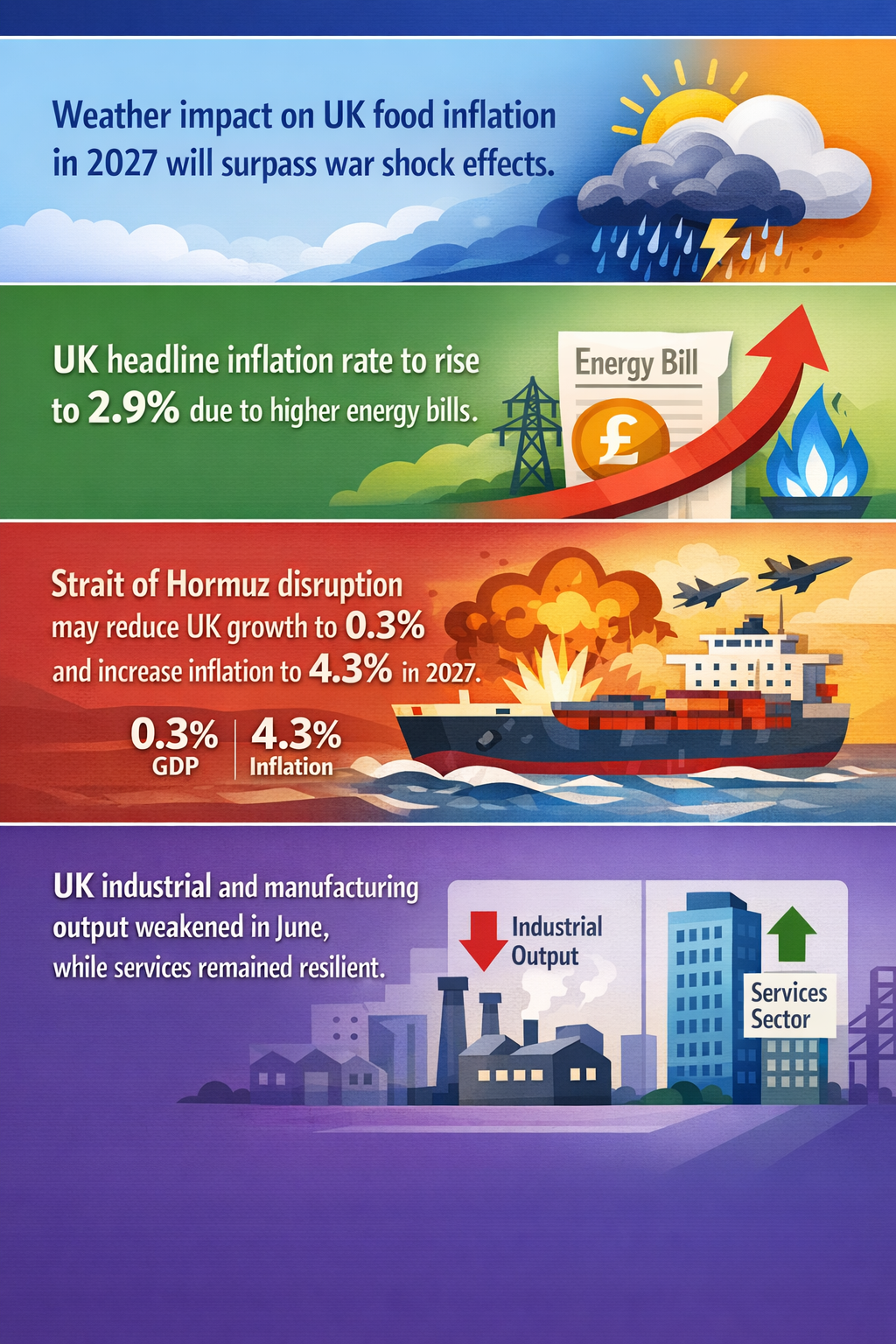
Energy cost surges, indicated by rising UK gas and electricity bills, exacerbate headline inflation near 3% in the short term (The Guardian 16/08/2026). However, Oxford Economics explicitly forecasts that adverse weather will contribute more significantly to food inflation in 2027 than fading war-related disruption (Forbes 01/08/2026).
This inflection extends beyond transitory shocks toward a structural integration of climate volatility into core inflation measures, complicating Bank of England monetary policy which now grapples with a high-wire balancing act: restrictive rates risk dampening already slow growth, while easing prematurely risks persistent inflationary pressures (Investment Consensus 18/08/2026).
Meanwhile, UK manufacturing and industrial production weakened in June even as service sectors remained resilient, signaling sectoral divergence under input cost stress and shifting demand profiles (CPA UK News 13/08/2026). These trends highlight how intense commodity price pressures permeate manufacturing supply chains reliant on energy and raw materials, while services’ relative insulation reflects structural economy shifts.
Government reforms aiming at investment stimulus and productivity enhancements offer a strategic counterbalance but face headwinds from external inflationary drivers, which may blunt efficacy absent integrated climate-risk mitigation approaches (Kalkine News 14/07/2026).
Disruption Pathway
The materialisation of climateflation as a structural economic force may follow a staged pathway. Initially, incremental weather-related agricultural disruptions will trigger localized food price spikes with mild inflationary blips. As climate variability intensifies and becomes more systemic, repeated episodes will strain supply chains, escalate production costs, and unsettle long-term price stability.
This escalation could hasten capital reallocation toward climate-resilient sectors (e.g., alternative proteins, controlled environment agriculture) and away from high-vulnerability commodity-dependent industries. Concomitantly, inflation persistence connected to weather risks will stress monetary policy frameworks reliant on historic inflation-growth correlations, necessitating novel regime adjustments.
Regulatory frameworks may adapt to integrate climate risk in fiscal policy and inflation targeting, potentially imposing innovative taxes, subsidies, or mandates to incentivize climate-resilient supply chains. Industrial structure could bifurcate, privileging actors that internalize climate risk management versus those vulnerable to escalating input volatility.
Feedback loops may emerge if climateflation-induced monetary tightening constrains investment in climate adaptation, amplifying vulnerabilities and thus inflation risks. Additionally, geopolitical tensions over food and energy resources could intensify, reinforcing inflation volatility.
Dominant models for economic regulation and strategic positioning may shift as climate risk transcends an environmental externality to become a macroeconomic pivot. Traditional cost-of-living metrics and monetary policy alone may prove insufficient, prompting governance innovation adaptable to ecological-economic complexity.
Why This Matters
For capital allocation, this indicates a growing imperative to factor climate-linked inflation volatility and supply chain fragility into investment risk assessments, favoring resilient infrastructure and diversified sourcing strategies.
Regulators may need to broaden the inflation targeting remit to explicitly incorporate environmental and climate risk parameters, revisiting the efficacy of interest rate policy amid structural inflation dynamics not driven by demand but supply shocks.
Industrial strategy may increasingly prioritize climate-adaptive production paradigms and localised supply chains to mitigate inflation spillovers, reshaping sectoral competitive positioning in food, manufacturing, and energy.
Supply chains may confront new liability paradigms as climate-induced disruptions become a foreseeable risk, potentially increasing claims, insurance costs, and regulatory compliance requirements.
Governance models will be tested to integrate cross-sectoral climate economics within monetary and fiscal tools, demanding sophisticated interdisciplinary approaches unprecedented in post-war economic policy frameworks.
Implications
This development may precipitate enduring structural inflation pressure linked to climate volatility rather than transient supply shocks.
Monetary policy could struggle to maintain balance, potentially pivoting toward multi-objective strategies that accommodate climate risk alongside traditional growth and inflation targets.
Capital may increasingly flow to climate-resilient and inflation-hedged assets, while sectors exposed to weather-related input volatility might contract or seek structural transformation.
Governments could implement novel regulatory regimes incorporating climateflation risk disclosure, adaptive fiscal measures, and cross-sector collaboration frameworks.
This is not a conventional inflation cycle driven purely by monetary or geopolitical factors but a complex exogenous shift requiring re-calibration of economic orthodoxy.
Competing interpretations might argue that energy and geopolitical risks alone will continue to dominate inflation trajectories, or that technological innovation in agriculture will blunt climate volatility; however, current data suggest the systemic nature of climateflation is underestimated.
Early Indicators to Monitor
- Rising frequency and geographic clustering of extreme weather event disruptions linked to key commodity outputs.
- Policy drafts or regulatory proposals integrating climate risk factors into inflation measures or monetary policy frameworks.
- Concentration of venture and infrastructure capital flows into climate-resilient food technology, supply chain diversification, and alternative protein sectors.
- Insurance market data reflecting increased premiums or claims linked to climate-disrupted agricultural production.
- Shift patterns in UK industrial production versus service sector outputs correlated with input commodity price volatility.
Disconfirming Signals
- Rapid technological breakthroughs enabling stable global food production despite climatic variability.
- Significant de-escalation in geopolitical tensions reducing commodity price instability.
- Monetary policy innovations successfully decoupling inflation persistence from supply-side climate shocks.
- Stable or falling energy prices eliminating secondary inflation impacts on production costs.
- Government reforms that markedly increase productivity and investment, neutralizing inflationary pressures despite climate constraints.
Strategic Questions
- How should monetary policy frameworks evolve to integrate persistent climate-driven inflation risks without jeopardizing economic growth?
- What capital allocation strategies can best mitigate portfolio exposure to climateflation-induced volatility across UK industries?
Keywords
climate inflation; food security; supply chain resilience; monetary policy; capital allocation; industrial strategy; inflation targeting; climate risk
Bibliography
- The surge in UK gas and electricity bills last month will push Britain's headline inflation rate to 2.9%. The Guardian. Published 16/08/2026.
- Oxford Economics now expects the weather to add more to 2027 food inflation than the fading war shock. / UK. Forbes. Published 01/08/2026.
- The Bank of England is weighing softer growth against renewed inflation risks, while tax rumours, defence spending pressures and packaging costs are adding to concerns about future margins. / UK. CPA UK News. Published 01/07/2026.
- The combination of slower economic activity and easing inflation creates a difficult policy balance for the MPC: keeping rates restrictive for too long could weaken growth further, while easing policy prematurely could allow persistent domestic inflation pressures to return. / UK. Investment Consensus. Published 18/08/2026.
- UK industrial and manufacturing output weakened in June even as services remained resilient. CPA UK News. Published 13/08/2026.
- If government reforms successfully encourage greater investment and productivity, Britain could strengthen its long-term economic growth prospects. Kalkine News. Published 14/07/2026.