Our Scans
·
Education
·
Intelligence Briefing
Intelligence Briefing about Education
Critical Trends Impacting the Organization
- Government-backed initiatives are accelerating AI deployment in education and healthcare sectors by 2027, enabling new digital solutions and infrastructure upgrades (Tashios).
- Innovations including digital building permits and the OpenDesk platform are set to transform educational administration and learning environments by the end of 2026 (BusinessMole).
- Policy shifts such as the UAE’s removal of homework for early grades and tighter electronic device controls aim to reshape learning experiences towards project-based assessments in 2026–27 (Emirates247).
- Reading underachievement in EU fifteen-year-olds remains critically high at 26.2%, far above the 2030 target of 15%, signaling urgent educational quality challenges (NewsMediaEurope).
- Countries like Kazakhstan are heavily investing in educational and digital capacity to prepare for uncertain future AI-driven economies (AstanaTimes).
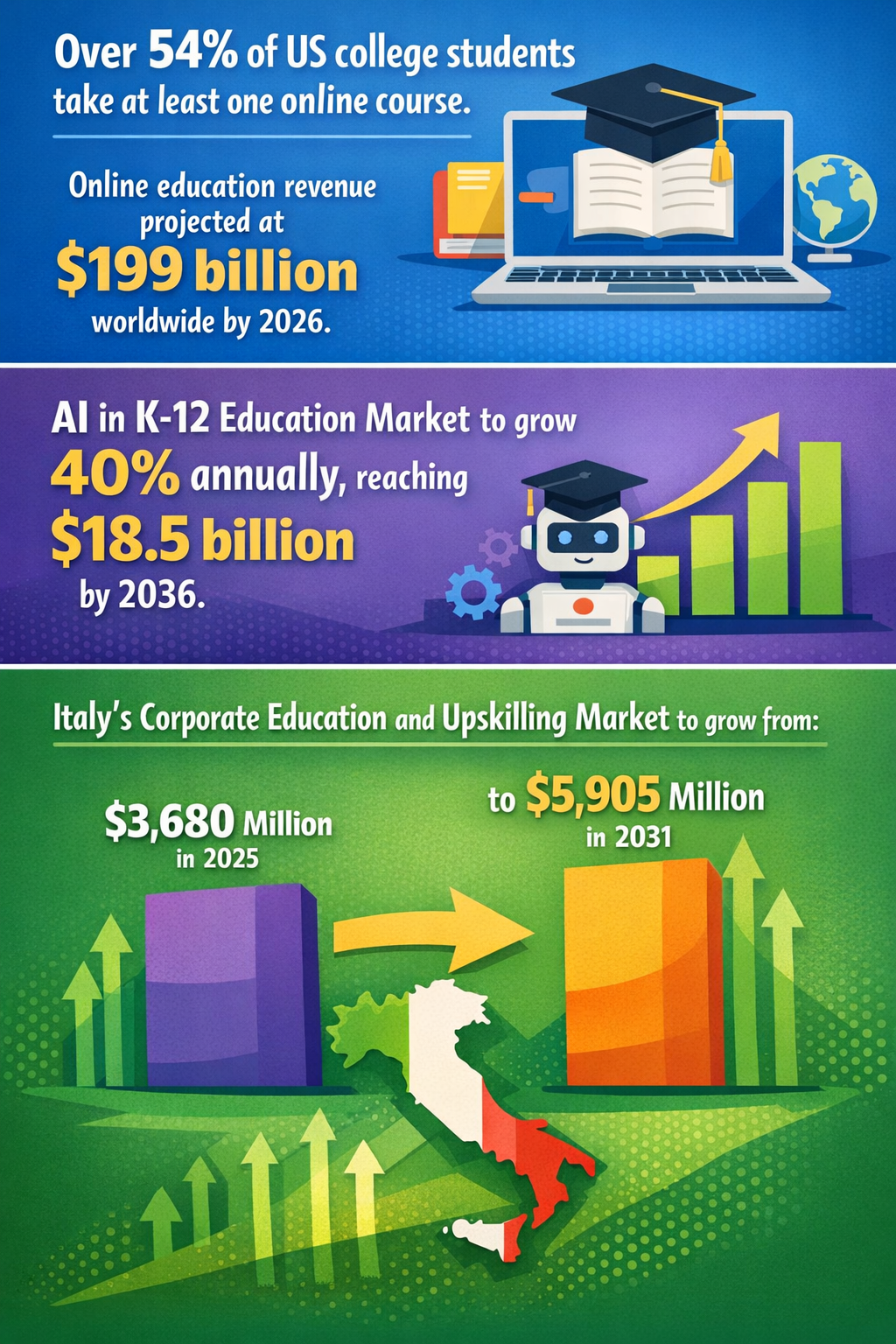
- Online education continues its rapid growth, with over half of US college students taking online courses and expected global revenues of $199 billion in 2026, marking a substantial market expansion (Devlin Peck).
Key Challenges, Opportunities, and Potential Risks
- Challenge: Persistent underachievement in literacy threatens future workforce readiness and equitable education outcomes.
- Opportunity: Integration of AI and digital tools in education can personalize learning, increase engagement, and improve administrative efficiency.
- Risk: Over-reliance on technology may exacerbate the digital divide and limit access in underserved populations.
- Opportunity: Policy reforms (e.g., project-based learning, decreased homework) could foster critical thinking and creativity among students.
- Challenge: Rapid growth of online education demands robust quality assurance and accreditation standards to maintain educational integrity.
- Risk: Uncertainty around the future AI economy requires adaptable educational frameworks capable of responding to evolving skill demands.
Scenario Development
- Best Case: Governments effectively integrate AI and digital tools with inclusive policies, reducing literacy gaps while expanding access to quality online and in-person education globally.
- Moderate Progress: Digital infrastructure improves but unevenly, resulting in increased online education uptake but persistent inequalities and mixed student outcomes.
- Stagnation: Educational reforms stall; traditional systems prevail with limited AI adoption, exacerbating skill mismatches and underachievement rates.
- Worst Case: Rapid technology deployment without equitable frameworks widens the digital divide, literacy declines further, and workforce preparation fails to meet AI-driven economy demands.
Strategic Questions
- How can policymaking balance rapid AI and digital integration with equity and quality assurance in education?
- What frameworks could be developed to continuously monitor and address literacy and learning outcome disparities?
- In what ways can online education scalability be aligned with maintaining rigorous academic standards and learner engagement?
- How might education systems remain flexible to evolving skill demands stemming from uncertain AI economic landscapes?
Actionable Insights for Strategic Decision-Making
- Investing in adaptive AI-driven educational platforms could enable personalized learning paths that address diverse learner needs.
- Developing cross-sector partnerships may expand infrastructure capacity and sharing of best digital education practices.
- Stress-testing policies through scenario planning could highlight vulnerabilities and guide resilient education reforms.
- Encouraging pilot programs of project-based and technology-restricted learning could provide data to optimize policy shifts.
- Implementing continuous monitoring systems for literacy metrics may help in early detection of underachievement trends and targeted interventions.
Briefing Created: 06/09/2026