
Asynchronous Telehealth Expansion: The Under-Recognized Inflection in Health Futures
This insight paper reveals the burgeoning structural transformation in healthcare delivery anchored by asynchronous telehealth services—a development poised to recalibrate regulatory frameworks, capital allocation, and industry configuration over the next decade. Moving beyond real-time teleconsultations, asynchronous modalities are quietly shifting clinical workflows and patient access, unlocking latent efficiencies and risk distribution challenges not yet fully embraced in strategic forecasting.
Recent regulatory relaxations permitting store-and-forward telehealth in dermatology and ophthalmology, alongside emergent cross-jurisdictional telehealth provider models, signal a nascent but impactful departure from synchronous paradigms. This paper evaluates how asynchronous telehealth may constitute an inflection point that redefines healthcare industrial boundaries, payment models, and provider credentialing within a 5–10 year horizon.
Signal Identification
The expansion of asynchronous telehealth—characterized by the transmission and evaluation of clinical data (images, videos, or patient-generated information) outside of a live interaction—represents a critical emerging inflection in digital health delivery. Unlike widely discussed synchronous telehealth services, this asynchronous modality is less visible yet poised to scale significantly, altering patient-provider interaction models and regulatory approaches. The time horizon for broad sectoral impacts is medium-term (5–10 years) with a high plausibility band, as regulatory experiments, pilot programs, and capability maturation are already underway. Key sectors exposed include healthcare providers, payers (especially public insurers such as Medicare), regulatory bodies, health technology vendors, and pharmaceutical companies.
What Is Changing
Recent regulatory shifts exemplify a move toward enabling asynchronous telehealth consumption. The Centers for Medicare & Medicaid Services (CMS), for instance, announced waivers allowing dermatology and ophthalmology providers to evaluate digital images without requiring synchronous communication with patients (Arnold Porter 02/04/2026). This deviance from the traditional “interactive telecommunications system” requirement signals recognition of asynchronous assessment’s clinical legitimacy and operational efficiency.
Another dimension is the evolving use of telehealth to circumvent geographic and legal constraints, as seen in abortion access where patients in restrictive states seek care through providers shielded by other states’ laws, enabled via telehealth technologies (Guttmacher Institute 15/06/2026). This indicates increasing complexity in jurisdictional health policy and the blending of asynchronous communication and legal frameworks.
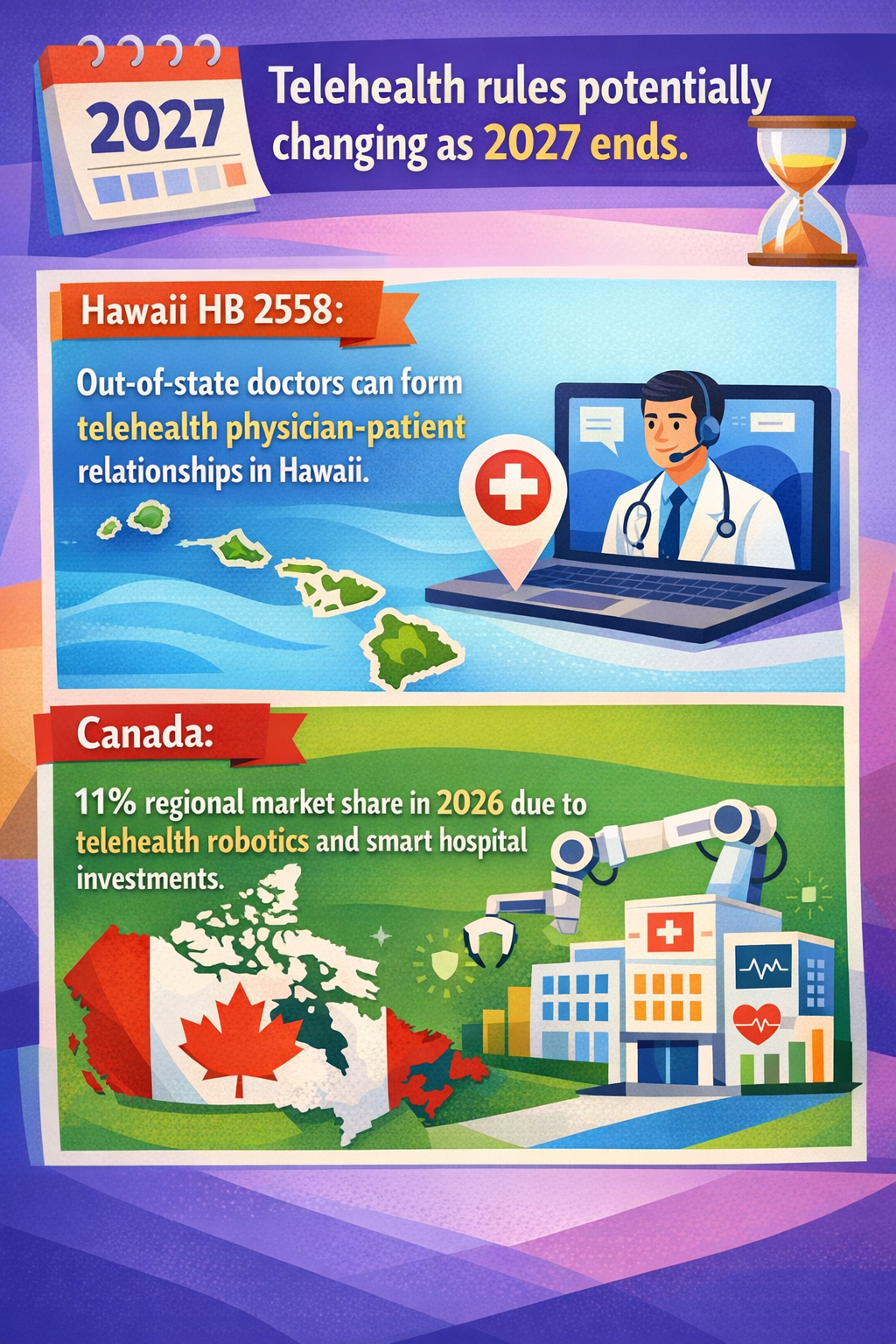
Alongside these regulatory developments, states like Hawaii have innovated by allowing out-of-state physicians to establish initial patient relationships through telehealth, sidestepping local physician shortages (JD Supra 24/03/2026). Combining asynchronous modalities with remote provider integration stands to disrupt traditional state-based licensure and workforce models.
Furthermore, Medicare’s extension of telehealth coverage including provisions beyond COVID-19 emergency declarations affords temporary regulatory relief, with uncertainty on long-term permanence (UnderstoodCare 10/03/2026). This regulatory liminality enables incremental experimentation, especially for asynchronous care models increasingly embedded in care pathways like chronic disease management.
This evolution contrasts with the spotlight on breakthrough therapeutics (e.g., lorlatinib transforming lung cancer outcomes) (Cancer Therapy Advisor 20/06/2026) by underscoring health system redesign as a parallel, less heralded lever of transformation.
Disruption Pathway
The asynchronous telehealth inflection could escalate structurally through iterative regulatory approvals for broader digital diagnostic modalities beyond dermatology and ophthalmology. Incremental validation of clinical outcomes, bolstered by AI-assisted image interpretation or triage, may accelerate provider adoption, increasing asynchronous case volumes. Providers, payers, and technology suppliers might invest heavily in digital infrastructure and workflow redesign to optimize asynchronous throughput.
Concurrently, the loosening of geographic licensure barriers for remote providers—exemplified by Hawaii’s legislative action—could proliferate, driven by persistent provider shortages and digital platform economies. This destabilizes existing state-based credentialing regimes and incentivizes multi-jurisdictional telehealth conglomerates, introducing new competitive dynamics and governance challenges.
As issuer-provider-patient interactions become decoupled in time and space, billing models and liability frameworks must adapt. Fee-for-service paradigms may strain under asynchronous workflows that commoditize ‘digital information exchange’ rather than ‘live interaction.’ Payers could adopt novel reimbursement schemas calibrated to asynchronous service units, potentially including risk-adjusted global payments for remote monitoring driven by digital data streams.
Feedback loops may reinforce technology adoption as care quality standards codify asynchronous metrics, enabling broader payer acceptance and provider confidence. However, unintended consequences such as diagnostic errors from image quality variability, digital divide inequities, or fragmented continuity of care could spur regulatory recalibrations. Incumbent hospital systems might contest decentralization by investing in proprietary platforms to maintain patient capture and data governance.
Ultimately, a structural ecosystem may emerge where asynchronous telehealth is normalized as a core medical service modality, enabling new entrants and business models. Regulatory frameworks will likely shift from rigid synchronous telehealth definitions to inclusive, modality-agnostic standards based on outcome equivalence and data governance.
Why This Matters
Decision-makers face significant ramifications. Capital allocation might shift from bricks-and-mortar expansion toward digital platforms and asynchronous care capabilities, altering investment profiles for health systems, technology firms, and insurance carriers. Regulatory agencies must preemptively refine licensure, privacy, and quality assurance frameworks to accommodate asynchronous workflows integrated with cross-jurisdictional care delivery models.
Industrial structures could fragment as telehealth platforms scale beyond synchronous service intermediaries into comprehensive asynchronous commerce and clinical hubs. Established providers risk losing patient volumes to agile remote digital players. Supply chains for diagnostics, data management, and digital device provisioning will evolve, rewarding firms apt at integrating asynchronous data streams securely and scalably.
Governance models face novel liability uncertainties as care timing and provider-patient relationships become asynchronous and geographically dispersed. Public payers' reimbursement policies could redefine standards of care measurement, emphasizing adaptable digital outcome metrics over traditional visit-centered models. Effective risk governance and oversight mechanisms will be paramount to maintaining quality and equity.
Implications
This development could structurally recalibrate health system architectures by moving clinical decision-making outside temporal constraints and physical proximity. It may unlock capital efficiencies by enabling ‘visitless’ care management and distributed clinical expertise sourcing. Regulatory regimes might evolve toward outcome-focused, modality-agnostic validation protocols that integrate asynchronous workflows as standard-of-care.
The phenomenon is unlikely to be transient or limited to pandemic response contingencies, as it builds on inherent advantages in scalability, patient access, and clinician capacity utilization. Conversely, it should not be conflated with telehealth hype oriented primarily toward consumer convenience or entirely synchronous teleconsultations.
Competing interpretations could view asynchronous telehealth as fragmenting care continuity or exacerbating health disparities if digital barriers are overlooked. However, ignoring the structural potential may expose incumbents to rapid disintermediation as value migrates to digital ecosystem orchestrators.
Early Indicators to Monitor
- Regulatory approvals extending asynchronous telehealth modalities beyond dermatology and ophthalmology
- State legislative movements expanding multi-jurisdictional telehealth provider licensure
- Trends in payer reimbursement models embracing asynchronous diagnostic and monitoring codes
- Venture capital and corporate investment clustering in asynchronous telehealth platforms and AI diagnostic tools
- Formation of cross-industry standards governing asynchronous telehealth quality, data security, and clinical workflow integration
Disconfirming Signals
- Reinstatement or persistence of restrictive regulatory requirements mandating synchronous interaction for telehealth reimbursement
- Adverse clinical outcome data undermining the reliability of asynchronous diagnostic interpretations
- Entrenchment of state licensure frameworks blocking interstate telehealth practice despite workforce shortages
- Economic disincentives or payer withdrawal from asynchronous reimbursement schemes
- Widespread digital infrastructure failures or patient adoption resistance limiting scalability
Strategic Questions
- How can healthcare organizations strategically invest in asynchronous telehealth capabilities to preempt competitive disruption and optimize care delivery?
- What regulatory adaptations are necessary to balance patient safety, provider accountability, and market innovation in asynchronous, cross-jurisdictional telehealth?
Keywords
Asynchronous telehealth; Digital health regulation; Telemedicine reimbursement; Interstate medical licensing; Healthcare workforce shortages; Health technology investment; Care continuity models
Bibliography
- CMS will waive the interactive telecommunications system requirement for certain asynchronous dermatology and ophthalmology telehealth services. Arnold Porter. Published 02/04/2026.
- An abortion seeker in Texas could access care via telehealth from a provider based in New York, under the protection of New York's shield law. Guttmacher Institute. Published 15/06/2026.
- The first chamber of the Hawaii legislature passed HB 2558 aimed at addressing Hawaii's physician shortage by allowing out-of-state doctors to establish initial physician-patient relationship with Hawaii residents through telehealth services. JD Supra. Published 24/03/2026.
- Congress extends Medicare telehealth coverage for two years. UnderstoodCare. Published 10/03/2026.
- Lorlatinib has the potential to transform advanced ALK-positive NSCLC into a chronic disease for some patients. Cancer Therapy Advisor. Published 20/06/2026.